


It costs nothing to click, respond and retweet. But what price do we pay in our relationships and our peace of mind?
Almost anything you give sustained attention to will begin to loop on itself and bloom
When people talk about the value of paying attention and slowing down, they often make it sound prudish and monk-like. But we shouldn’t forget how interesting and overpoweringly pleasurable sustained attention can be.

How to reclaim your attention from the distraction economy | Psyche Videos
Could you watch this video on full screen, 1x speed, with no distractions? Here are five steps to rebuild your attention span

The Attention Economy and the Collapse of Cognitive Autonomy
Check out the first in a series on social media from Denny Center Student Fellow Rai Hasen Masoud (F'27) to learn more about the attention economy and it's impacts on our democracy.
An attention economic perspective on the future of the information age
In this paper, we apply an attention economic perspective to explain current and predict future trends in our society. We first describe the rise of the attention economy, and we highlight one important mechanism of this economy: a spiral of attention scarcity. Second, we show that an attention economic perspective provides glimpses of a potential future. In particular, we predict an information environment that increasingly targets citizens with attention-grabbing content, form, and technology; a continuing trend toward excessive media consumption levels; and a continuing trend toward inattentive uses of information. We also predict increasing problems of public misinformation and misconceptions; an increased prevalence of certain mental and physical health issues; and an increased reliance on technology to perform mental tasks. At the end of this paper, we show why and how despite these predictions, alternative futures are conceivable. These alternatives largely depend on the behavior of various social actors. We discuss resistance to the attention economy by consumers and producers, a laissez-faire policy toward the attention economy, a policy of taxing attention-seeking efforts, and the promotion of public values in regulatory policies toward the internet.
The attention market—and what is wrong with it
Attention is described as a “scarce commodity” that is traded in “a marketplace.” This, it is further claimed, contributes to a “widespread sense of attentional crisis.” But is there really an attention market, and if so, what, if anything, is wrong with it? We defend the claim that there are markets in attention. We provide an account of such attention markets and use that account to address what is morally wrong with them. Our account draws on knowledge of how attention works and what roles it plays in the mind. The attention market trades in an ability to influence our attention – somewhat (though not exactly) like the labor market trades in an ability to influence how we use our capacity for work. Specifically, the commodity it trades in is attentional landscaping potential, viz. the ability to systematically influence patterns of attention by changes to the sensory environment individuals are exposed to. Attention markets thus, we argue, commodify influence over a human capacity that plays a central role in shaping individual experience, agency, and belief formation. This feature of attention markets makes them ethically problematic. As markets in access to external influence, attention markets pose a special threat to individual autonomy and escape the classical liberal defense of free markets. Those who value autonomy should worry about the attention markets that exist today.

Buy wisely
Whenever I buy things I try to prioritize cost per use. Sometimes I consider other priorities such as cost per smile, cost per thrill, cost per externality, ...
Rethinking the cognitive foundations of the attention economy
The attention economy is the economic system in which human attention is the scarce resource. This literature takes a particular passage in Herbert Simon’s seminal Chapter Designing Organization fo...

Revisiting evidence for an attentional tunneling effect caused by scarcity
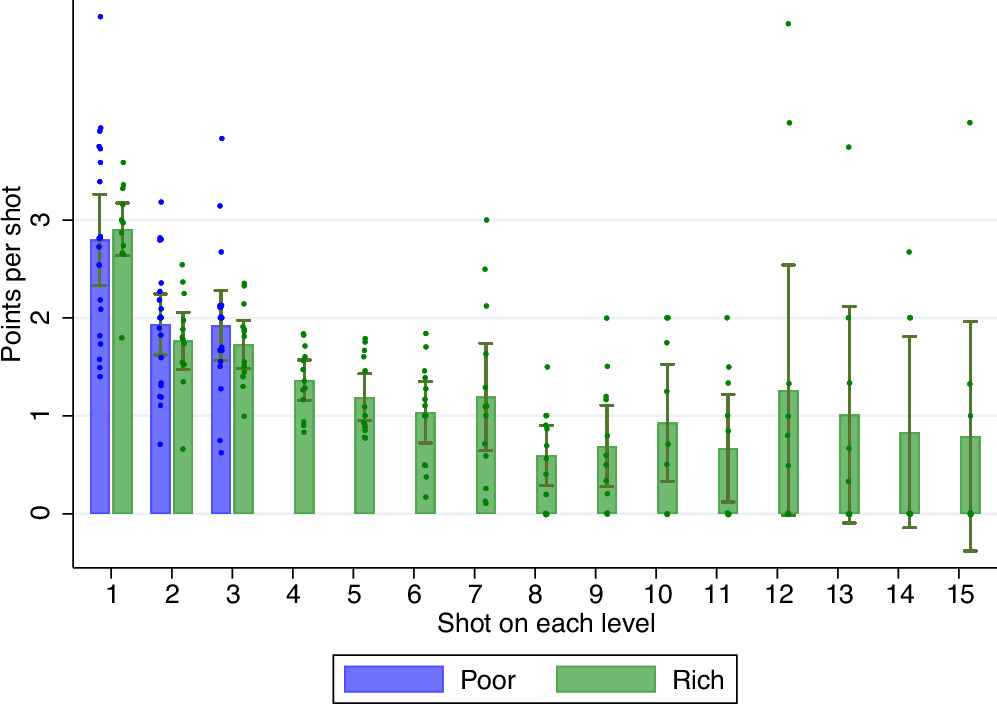
People in poverty sometimes behave in ways that perpetuate their socioeconomic condition. By one influential account, these behaviors arise from psychological effects of scarcity on attention that create greater focus toward managing scarce resources, at the cost of attention to potentially-beneficial information outside of this ‘tunnel’. Although the tunneling hypothesis has been widely discussed in academia and beyond, its direct empirical support derives primarily from a landmark study by Shah et al. (2012) in which participants played games while their access to resources was experimentally manipulated, rendering participants either ‘rich’ or ‘poor’. Here, we present new analyses that contest the original interpretation of the data, showing that the behavioral differences between ‘rich’ and ‘poor’ participants are more parsimoniously explained by the game’s structure than by an attentional shift caused by the scarcity manipulation—a conclusion we substantiate through an additional experiment. We contextualize our findings within the literature on scarcity and attention, and highlight the need for greater clarity regarding the tunneling hypothesis itself.
Tightwads and spendthrifts: An interdisciplinary review
Consumers rely on a “pain of paying” to help deter their spending. While this is beneficial for some consumers, others experience levels of pain that create problems. “Tightwads” experience too much pain when considering spending and therefore spend less than they would ideally like to spend. By contrast, “spendthrifts” experience too little pain and therefore spend more than they would ideally like to spend. Neither are happy with how they handle money. In the decade since the tightwad‐spendthrift construct was introduced, much has been learned about what it is and is not (e.g., frugality, greed), what contextual factors are likely to reduce its importance, how it plays a role within romantic relationships, and when it might first emerge in childhood. This paper reviews the wide range of interdisciplinary research relevant to the tightwad‐spendthrift construct and proposes several directions for new research.

Dec 2020 -- Jelle Bruineberg -- Embodied cognition and the attention crisis
Cognitive Load and Social Media Advertising
Social media engagement requires cognitive resources, which subsequently impact the advertisements consumers see while browsing. For the most part, however, advertising practitioners and scholars s...

Introducing a network for thoughtful conversations
The quality of conversations on the Internet is terrible. Most platforms like Twitter, Facebook, Instagram, Reddit, etc. optimize for engagement as their key metric. This spawns and rewards behavior that leads to bragging of gameable metrics such as likes and followers, self-feeding thought bubbles, knee-jerk reactions, “if you’re not on our side, you’re on their side” mentality, and thought policing even by people who think they’re fighting for a good cause. Today’s Internet doesn’t incentiviz

How We Pay Attention Changes the Very Shape of Our Brains
Imagine arriving at the airport just in time to catch a plane. Everything in your behavior betrays the heightened concentration of your attention. Your mind on alert, you look for the departures si…

The High Cost of Not Doing Experiments - Behavioral Scientist
We can pay dearly, in blood, treasure, and well-being, for experiments that aren’t done. -Richard Nisbett, Mindware

The internet has evolved to foster a fatal expectation: that the things we depend on every day are free. They aren't, but we're allowed to pretend they are with the help of ad-driven business models. The real cost is substantial, and can be measured in time, money, relationships, health, and more.

Fund Your Internet
fundyourinternet.orgCapturing our Attention by @neillevy.bsky.social "we possess sophisticated capacities of epistemic vigilance, which work reasonably well to distinguish reliable from unreliable information, but ... we do not have parallel defences against attentional capture" > tandfonline.com/doi/full/10.1080/00048402.202…

