

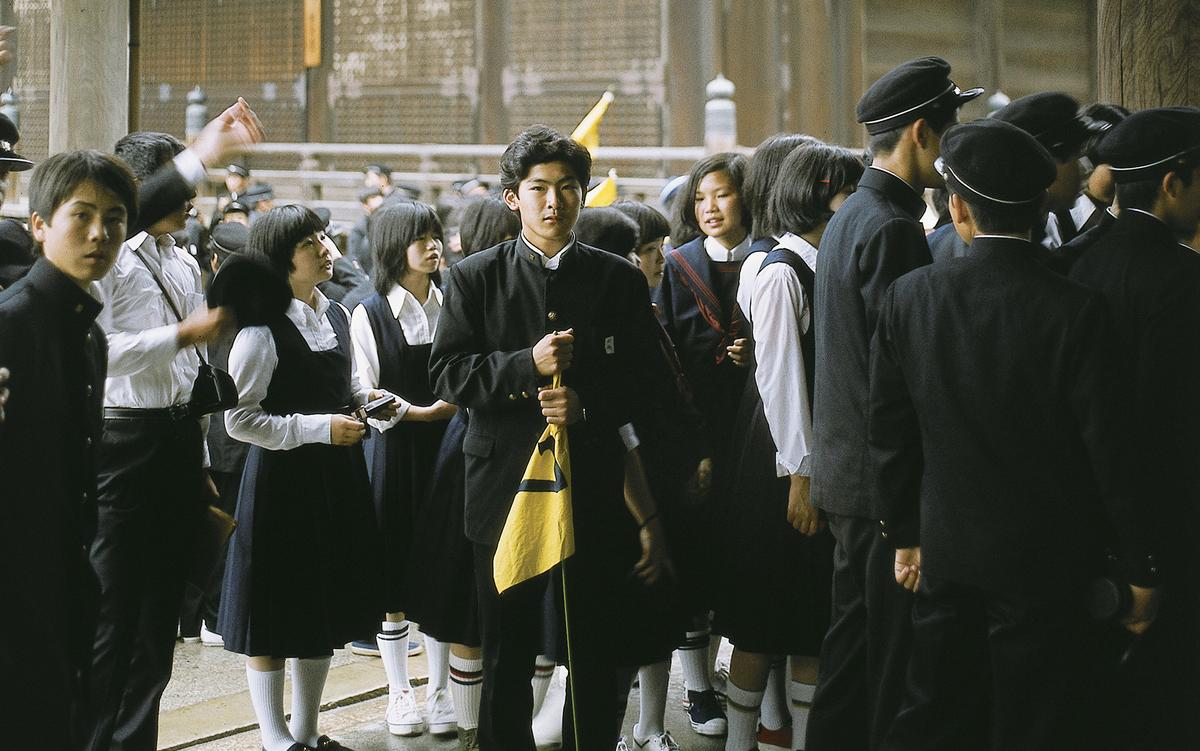
Japan’s Cold War education policy used religion to ‘make’ the ideal humans needed by its nascent economy. Did it work?
Religion matters for economic growth through various channels
Standard models of economic growth depict physical capital, human capital, population/labour, and total factor productivity as proximate determinants of economic growth. But their deeper determinants are poorly understood. This column argues that religion – as one of the most ubiquitous social phenomena – can spur or impair economic growth by affecting each of these four elements of the macroeconomic production function.


Little Boy: The Arts of Japan’s Exploding Subculture
Society cannot recover from such an epic scale of devastation - the atomic bombs dropped on Hiroshima and three days later on Nagasaki on August 9, 1945 - but may, instead, manifest trauma as a perpetual genetic scar—ontological chasm which moves as a consumptive demon ripping up through the generations as a peripatetic wound, egregious disfigurement banished from conscious thought, inflating to cartoon benignity in a pantomime of humanity, sutured gash badly sewn and always reopening, futile replacement of scarred mortality for the immaculate technology of machines, and finally as the wholesale abandonment of frail humanity for alternative existential states.
Against Economics
Mainstream economists nowadays might not be particularly good at predicting financial crashes, facilitating general prosperity, or coming up with models for preventing climate change, but when it comes to establishing themselves in positions of intellectual authority, unaffected by such failings, their success is unparalleled. One would have to look at the history of religions to find anything like it. To this day, economics continues to be taught not as a story of arguments—not, like any other social science, as a welter of often warring theoretical perspectives—but rather as something more like physics, the gradual realization of universal, unimpeachable mathematical truths.

When "yang" goes wrong — LessWrong
On the connection between deep atheism and seeking control.

(Working Paper) Good Faith Design: Religion as a Resource for Technologists
Previous work has found a lack of research in HCI on religion, partly driven by misunderstandings of values and practices between religious and technical communities. To bridge this divide in an empirically rigorous way, we conducted an interview study with 48 religious people and/or experts from 11 faiths, and we document how religious people experience, understand, and imagine technologies. We show that religious stakeholders find non-neutral secular embeddings in technologies and the firms and people that design them, and how these manifest in unintended harms for religious and nonreligious users. Our findings reveal how users navigate technoreligious practices with religiously informed mental models and what they desire from technologies. Informed by this, we distill six design values -- wonder, humility, space, embodiedness, community, and eternity -- to guide technologists in considering and leveraging religion as an additional, valid sociocultural resource when designing for a holistic user. We further spell out directions for future research.

Samurai city - Works in Progress Magazine
For three hundred years, Japan enjoyed enviable stability and peace. All it took was locking up its warlike samurai elite in the world’s least efficient city.

CFP: Religion, Politics, and Cognitive Warfare | The Journal for Cultural and Religious Theory | JCRT
This call for papers invites work on religion, politics, and cognitive warfare, exploring how belief, media, conspiracy, identity, and power shape struggles over reality, interpretation, and life in an age of disinformat

Fight, Magic, Items: The History of Final Fantasy, Drag…
Take a journey through the history of Japanese role-pla…

How to Make Friends and Build a Social Circle in Japan
Living abroad can be isolating, but it doesn’t have to stay that way. Here's everything I learned about making friends in Japan over the course of ten years.

Japanese web design: weird, but it works. Here's why
First They Built a Secular Apocalypse Belief System. Now They Want Religious Authority.
Over the weekend, a clip about “Anthropic thinks it’s building God” started making the rounds.

Why Religion, Not Income, Predicts the American Vote
Inside the data that shows socioeconomic status barely matters once you know someone’s religious tradition.

Can Religions Be Reborn? | Over The Mountains to Civilizational Renewal #9
Secularization Comes for the Religion of Technology: Or, how to make sense of techno-optimist manifestos, the Open Ai/Altman affair, EA/e-acc movements, and the general sense of cultural stagnation
The Convivial Society: Vol. 5, No. 3

Sam Harris and the Myth of Perfectly Rational Thought
The famous proponent of New Atheism is on a crusade against tribalism but seems oblivious to his own version of it.
