Biology’s next great horizon is to understand cells, tissues and organisms as agents with agendas (even if unthinking ones)
The sentient cell: the cellular foundations of consciousness
"All species, extant and extinct, from the simplest unicellular prokaryotes to humans, have an existential consciousness. Without sentience, the first cells that emerged some 4 billion years ago would have been evolutionary dead-ends, unable to survive in the chaotic, dangerous environment in which life first appeared and evolved. In this book, Arthur Reber's theory, the Cellular Basis of Consciousness (CBC), is outlined and distinguished from those models that argue that minds could be instantiated on artificial entities and those that maintain consciousness requires a nervous system. The CBC framework takes a novel approach to classic topics such as the origin-of-life, philosophy of mind, the role of genes, the impact of cognition, and how biological information is processed by all species. It also calls for a rethinking of a variety of issues including the moral implications of the sentient capacities of all species, how welfare concerns need to be expanded beyond where they currently are, and critically, how all life is intertwined in a coordinated cognitive ecology. The Sentient Cell explores this revolutionary model, which updates the standard neo-Darwinian framework within which current approaches operate and examines the underlying biomolecular features that are the likely candidates for the "invention" of consciousness and outline their role in cellular life." --

Agentic systems are adept at solving well-scoped, verifiable problems in computational biology
We introduce CompBioBench, a benchmark of 100 diverse tasks for evaluating agentic systems in computational biology. Unlike mathematics and programming, which more readily admit systematic verification, biological data are inherently noisy and open to interpretation.
Anatomy of a Nature AI article
Edgy first paragraph in bold text saying something gently provocative but essentially brainless.
Learning Outside the Brain: Integrating Cognitive Science and Systems Biology
Learning is commonplace in organisms such as ourselves and even in organisms as far distant as the bee and the octopus. Such learning is implemented by brains, or neuronal networks, and has been extensively studied within ethology, psychology, cognitive science, and neuroscience. Whether learning also takes place in nonneuronal settings has remained a matter of sustained controversy, too often dominated by ideological views. In this survey, I will explain how learning can be rigorously interpreted as a form of information processing and then explore the evidence for whether learning also takes place in organismal contexts outside the brain, such as physiology, development, and individual cells. I will try to explain why it is important to build bridges in this way between cognitive science and systems biology, why concepts and methods from various branches of engineering may be helpful in this task, and what the eventual impact may be on how we think about the organism.
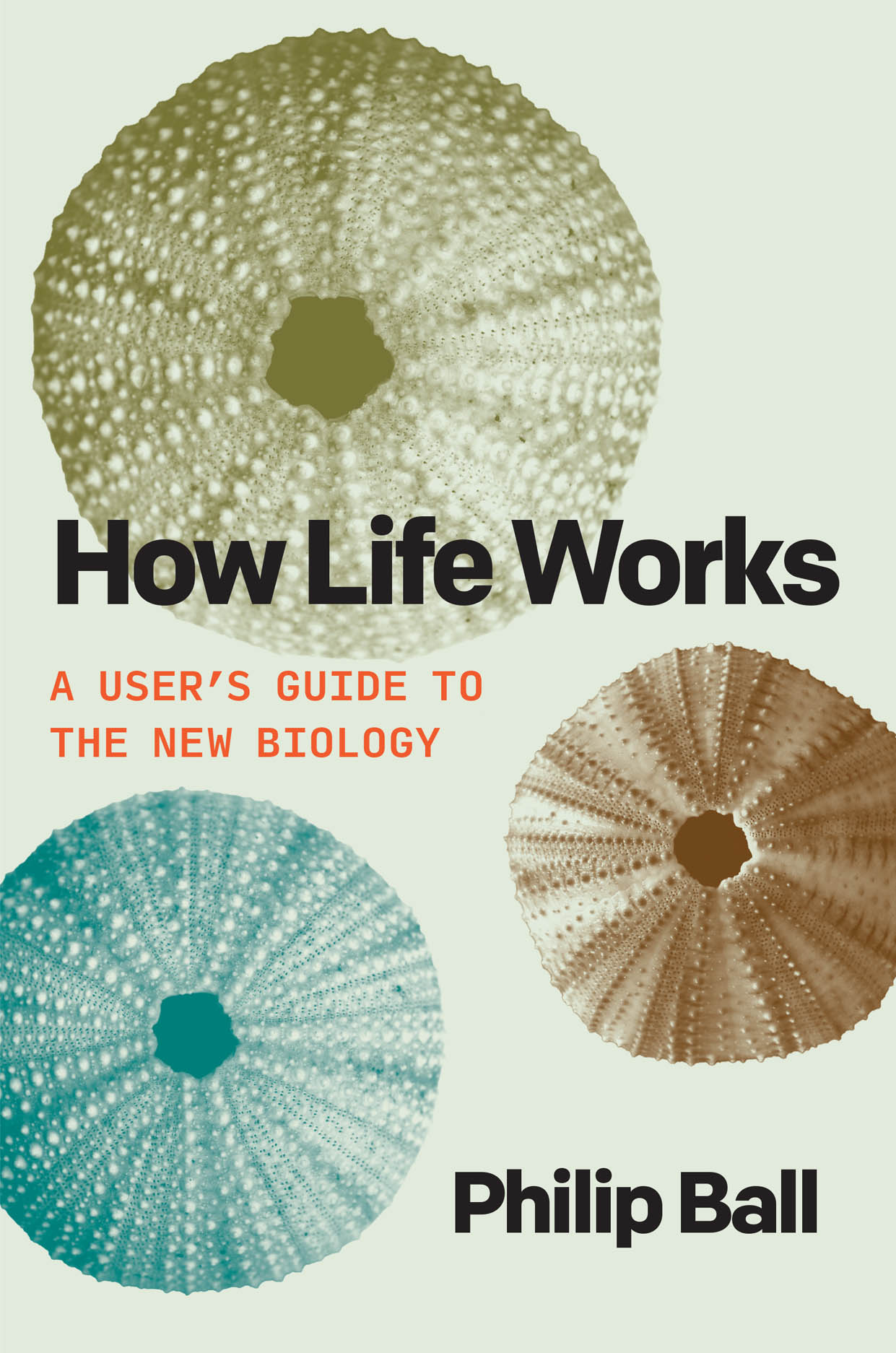
How Life Works: A User’s Guide to the New Biology
“Bold and intriguing.”—Wall Street Journal • “Penetrating. . . . Provocative and profound.”—Publishers Weekly (starred review) • “Offers plenty of food for thought.”—Kirkus Reviews (starred review) “Ball’s marvelous book is both wide-ranging and deep. . . . I could not put it down.”—Siddhartha Mukherjee, author of The Song of the Cell and the Pulitzer Prize–winning The Emperor of All Maladies A new, cutting-edge vision of biology that revises our understanding of what life itself is, how to enhance it, and what possibilities it offers. Biology is undergoing a quiet but profound transformation. Several aspects of the standard picture of how life works—the idea of the genome as a blueprint, of genes as instructions for building an organism, of proteins as precisely tailored molecular machines, of cells as entities with fixed identities, and more—have been exposed as incomplete, misleading, or wrong. In How Life Works, Philip Ball explores the new biology, revealing life to be a far richer, more ingenious affair than we had guessed. Ball explains that there is no unique place to look for an answer to this question: life is a system of many levels—genes, proteins, cells, tissues, and body modules such as the immune system and the nervous system—each with its own rules and principles. How Life Works explains how these levels operate, interface, and work together (most of the time). With this knowledge come new possibilities. Today we can redesign and reconfigure living systems, tissues, and organisms. We can reprogram cells, for instance, to carry out new tasks and grow into structures not seen in the natural world. As we discover the conditions that dictate the forms into which cells organize themselves, our ability to guide and select the outcomes becomes ever more extraordinary. Some researchers believe that ultimately we will be able to regenerate limbs and organs, and perhaps even create new life forms that evolution has never imagined. Incorporating the latest research and insights, How Life Works is a sweeping journey into this new frontier of the life sciences, a realm that will reshape our understanding of life as we know it.
Deleuze and Biosemiotics: Biological Emergence, Agency, and Subjectivity in Logic of Sense and A Thousand Plateaus
Functional Information: Towards Synthesis of Biosemiotics and Cybernetics
Biosemiotics and cybernetics are closely related, yet they are separated by the boundary between life and non-life: biosemiotics is focused on living organisms, whereas cybernetics is applied mostly to non-living artificial devices. However, both classes of systems are agents that perform functions necessary for reaching their goals. I propose to shift the focus of biosemiotics from living organisms to agents in general, which all belong to a pragmasphere or functional universe. Agents should be considered in the context of their hierarchy and origin because their semiosis can be inherited or induced by higher-level agents. To preserve and disseminate their functions, agents use functional information - a set of signs that encode and control their functions. It includes stable memory signs, transient messengers, and natural signs. The origin and evolution of functional information is discussed in terms of transitions between vegetative, animal, and social levels of semiosis, defined by Kull. Vegetative semiosis differs substantially from higher levels of semiosis, because signs are recognized and interpreted via direct code-based matching and are not associated with ideal representations of objects. Thus, I consider a separate classification of signs at the vegetative level that includes proto-icons, proto-indexes, and proto-symbols. Animal and social semiosis are based on classification, and modeling of objects, which represent the knowledge of agents about their body (Innenwelt) and environment (Umwelt).
Is Life Just Different? | Quanta Magazine
The idea of ‘biological agency’ — that life devises its own goals and behaves accordingly — complicates our understanding of what it means to be alive. But does it serve a scientific purpose?
562 – Ecological Cognition III: Radical Embodied Cognitive Science (part 1)
562 Continuing the journey in understanding the Ecological approach to cognition by looking at Tony Chemero’s book: Radical Embodied Cognitive Science. Conceptualizing cognition in terms of agent-environment dynamics instead of computation and representation. What is RECS, and where did these ideas come from?Download link
Georgie Newson - Thinking Collectives: Biological Naturalism and the Problem of Group Minds
The biogenic approach to cognition
After half a century of cognitive revolution we remain far from agreement about what cognition is and what cognition does. It was once thought that these questions could wait until the data were in. Today there is a mountain of data, but no way of making sense of it. The time for tackling the fundamental issues has arrived. The biogenic approach to cognition is introduced not as a solution but as a means of approaching the issues. The traditional, and still predominant, methodological stance in cognitive inquiry is what I call the anthropogenic approach: assume human cognition as the paradigm and work ‘down’ to a more general explanatory concept. The biogenic approach, on the other hand, starts with the facts of biology as the basis for theorizing and works ‘up’ to the human case by asking psychological questions as if they were biological questions. Biogenic explanations of cognition are currently clustered around two main frameworks for understanding biology: self-organizing complex systems and autopoiesis. The paper describes the frameworks and infers from them ten empirical principles—the biogenic ‘family traits’—that constitute constraints on biogenic theorizing. Because the anthropogenic approach to cognition is not constrained empirically to the same degree, I argue that the biogenic approach is superior for approaching a general theory of cognition as a natural phenomenon.
jsomers.net | I should have loved biology
In biology class, biology wasn't presented as a quest for the secrets of life. The textbooks wrung out the questing.

Lectures on Perception: An Ecological Perspective
Lectures on Perception: An Ecological Perspective addresses the generic principles by which each and every kind of life form—from single celled organisms (e.g., difflugia) to multi-celled organisms (e.g., primates)—perceives the circumstances of their living so that they can behave adaptively. It focuses on the fundamental ability that relates each and every organism to its surroundings, namely, the ability to perceive things in the sense of how to get about among them and what to do, or not

Panel: Biodesign x AI: Interactions in the Algorithmic Wet Lab
Complexity Explorables
A collection of interactive explorable explanations of complex systems in biology, physics, mathematics, social sciences, epidemiology, ecology and other fields....