When AI agents start making decisions, calling tools, and coordinating with other agents without waiting for human approval, the governance playbook most...
From chatbots to assistants: governance is key for AI agents
AI's shift into agentic technology ushers in a new set of governance and security challenges that will mean defining to what extent they should be autonomous

Agentic AI Governance: A Strategic Framework for Autonomous Systems
Agentic AI is moving from chat to action. Learn how to govern autonomous systems using the "Digital Contractor" framework and the 3-Tiered Guardrail system.

Introducing the Agent Governance Toolkit: Open-source runtime security for AI agents | Microsoft Open Source Blog
Discover how the Microsoft Agent Governance Toolkit brings policy, identity, and reliability to autonomous AI agent systems.

Can AI Be Governed? Only If We Build Normatively Competent AI
Hadfield's discussion brings the idea of AI governance back to the core idea of steering the behavior of an AI system. As she notes, this not only involves technical questions about how AI systems ar...
AI Agents Are Taking Over: And That’s Good For Business
Autonomous AI societies are transforming commerce with self-governing, agent-driven systems, redefining the future of business through collaborative intelligence.

AI agent runs amok in Fedora and elsewhere
Agentic AI systems can be used to do a variety of things autonomously on behalf of a human user [...]
MI9: An Integrated Runtime Governance Framework for Agentic AI
Agentic AI systems capable of reasoning, planning, and executing actions present fundamentally distinct governance challenges compared to traditional AI models. Unlike conventional AI, these systems exhibit emergent and unexpected behaviors during runtime, introducing novel agent-related risks that cannot be fully anticipated through pre-deployment governance alone. To address this critical gap, we introduce MI9, the first fully integrated runtime governance framework designed specifically for safety and alignment of agentic AI systems. MI9 introduces real-time controls through six integrated components: agency-risk index, agent-semantic telemetry capture, continuous authorization monitoring, Finite-State-Machine (FSM)-based conformance engines, goal-conditioned drift detection, and graduated containment strategies. Operating transparently across heterogeneous agent architectures, MI9 enables the systematic, safe, and responsible deployment of agentic systems in production environments where conventional governance approaches fall short, providing the foundational infrastructure for safe agentic AI deployment at scale. Detailed analysis through a diverse set of scenarios demonstrates MI9's systematic coverage of governance challenges that existing approaches fail to address, establishing the technical foundation for comprehensive agentic AI oversight.

Characterizing Agentic Flooding of Government Services
AI agents are making it easier for the public to interact with government, such as by helping them apply for benefits, understand complex policies, and make their opinions heard. Although...
Agentic Engineering Management
To what extent AI is OK to use in software development might be debated, but in general, the idea is not a controversial one anymore. The debate rather moved on from code completion and simple PR summarizations to Agentic Engineering, where an execution loop allows an AI Agent to function

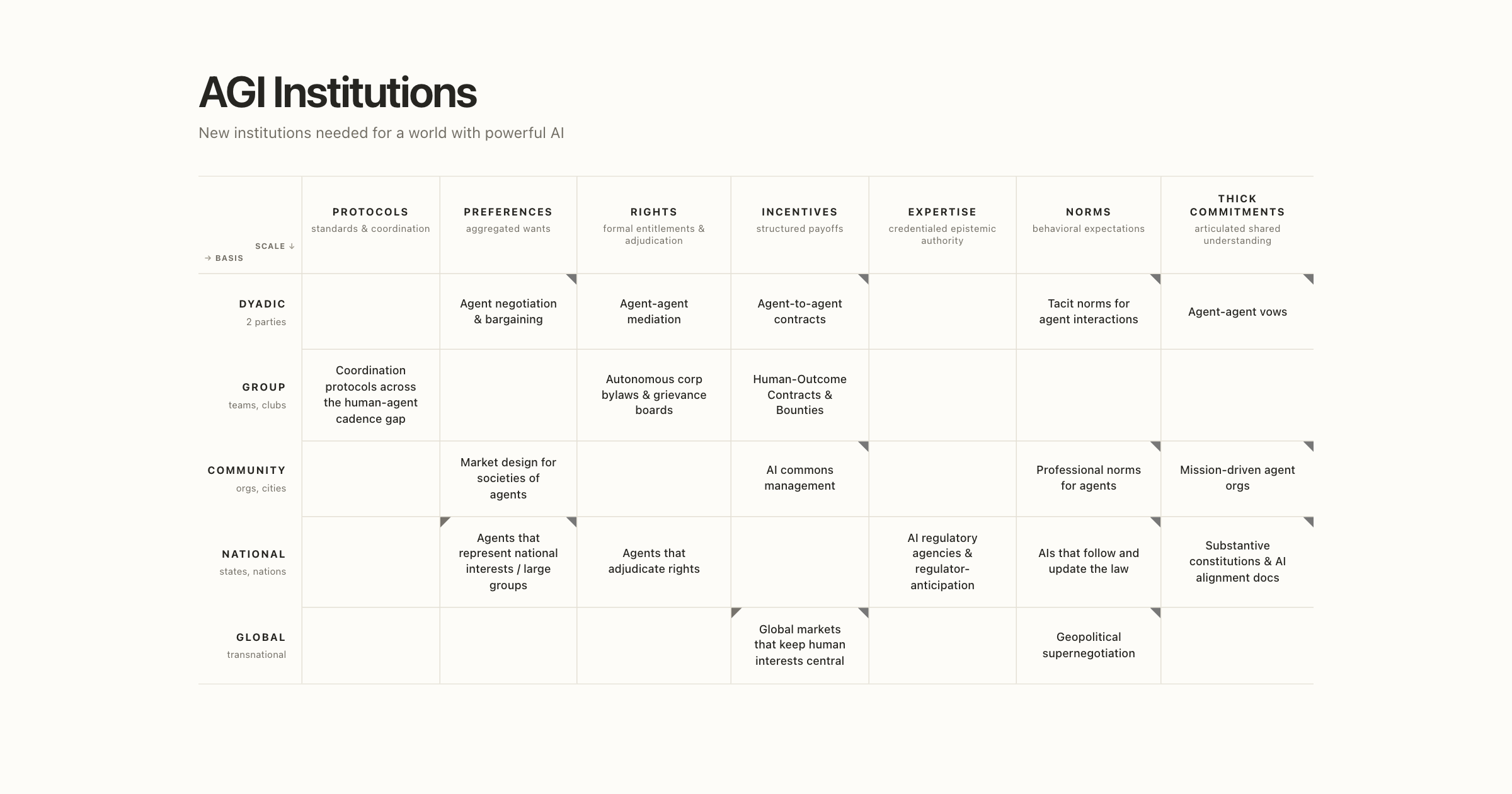
Existing Human Institutions — AGI Institutions Wiki
How existing human institutions handle coordination across scales — and how autonomous AI agents break them. Maps protocols, preferences, rights, incentives, expertise, norms, and thick commitments from dyadic to global.
Infrastructure in the Age of AI Gatekeepers
What happens when AI agents choose your stack
The Agentic Systems Series - The Agentic Systems Series
Welcome to the complete guide for building AI coding assistants that actually work in production. This comprehensive three-book series takes you from fundamental concepts to implementing enterprise-ready collaborative systems.
The argument against AI agents and unnecessary automation
Opinion: OpenAI's Operator a solution in search of a problem

AI agents: the Autorité de la concurrence issues its opinion on the competitive functioning of the AI agents sector | Autorité de la concurrence
AI Agent Standards: Navigating New NIST Governance | Nemko Digital
NIST's new AI agent standards are here. Learn what they mean for AI governance, compliance, and liability. Get ahead of the new regulations.

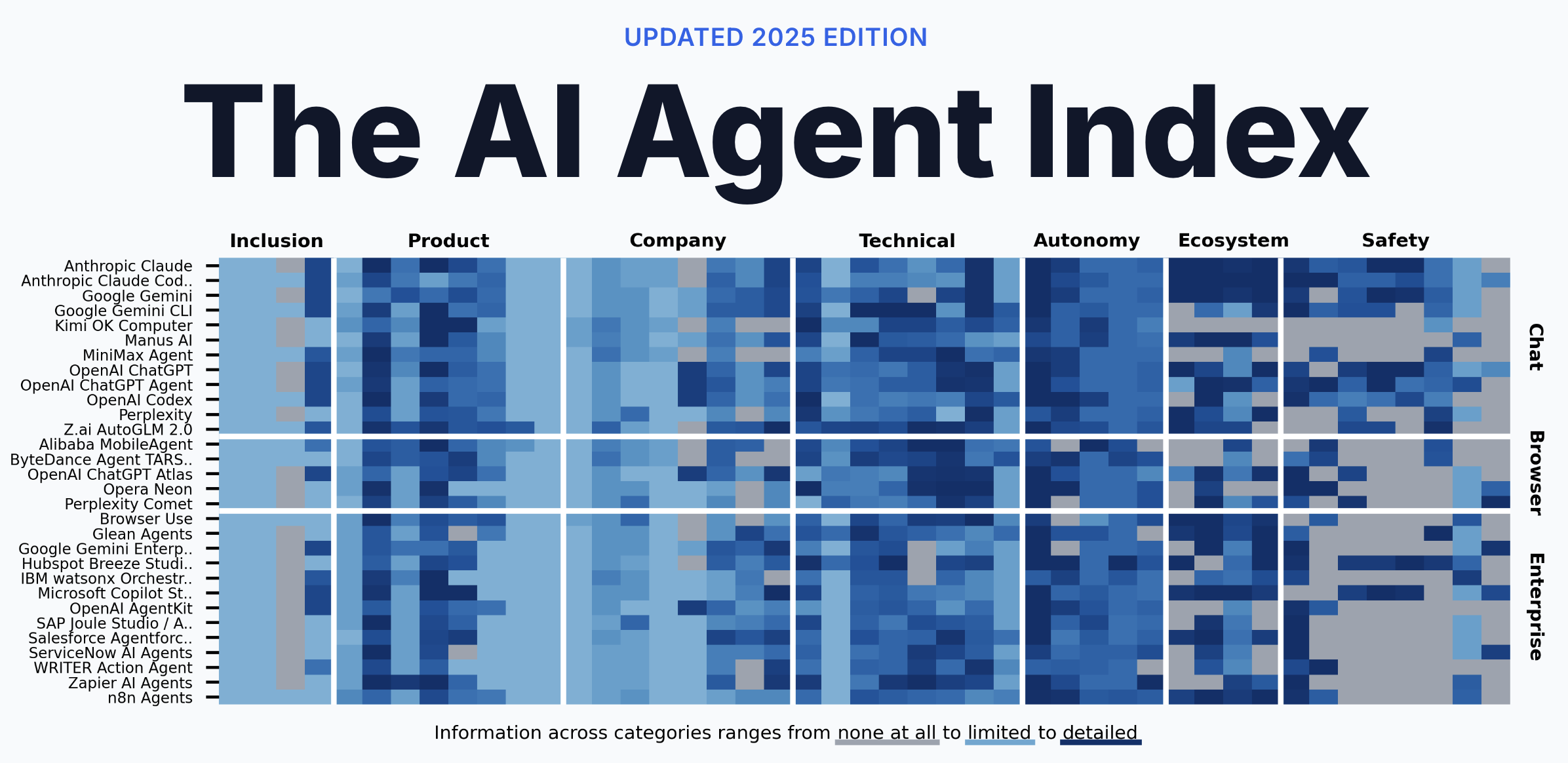
The 2025 AI Agent Index
Agentic AI systems are increasingly capable of performing complex tasks with limited human involvement. The 2025 AI Agent Index documents the origins, design, capabilities, ecosystem, and safety features of 30 prominent AI agents based on publicly available information and correspondence with developers.