

Your tools are your business, but everything you submit must be yours.
Responsible AI
Discover how AWS is committing to developing AI responsibly – to built trust, promote the safe development of AI, and act as a force for good.
AI Principles
A guiding framework for our responsible development and use of AI, alongside transparency and accountability in our AI development process.

Responsible use of AI in the military? US publishes declaration outlining principles
12 "best practices" for using AI and autonomous systems emphasize human accountability.

Responsible AI Principles and Approach | Microsoft AI
Discover Microsoft AI tools, industry-specific governance solutions, and responsible AI practices to make smarter, more informed decisions about AI implementation.

A Human-Centric Framework for Data Attribution in Large Language Models
In the current Large Language Model (LLM) ecosystem, creators have little agency over how their data is used, and LLM users may find themselves unknowingly plagiarizing existing sources. Attribution of LLM-generated text to LLM input data could help with these challenges, but so far we have more questions than answers: what elements of LLM outputs require attribution, what goals should it serve, how should it be implemented? We contribute a human-centric data attribution framework, which situates the attribution problem within the broader data economy. Specific use cases for attribution, such as creative writing assistance or fact-checking, can be specified via a set of parameters (including stakeholder objectives and implementation criteria). These criteria are up for negotiation by the relevant stakeholder groups: creators, LLM users, and their intermediaries (publishers, platforms, AI companies). The outcome of domain-specific negotiations can be implemented and tested for whether the stakeholder goals are achieved. The proposed approach provides a bridge between methodological NLP work on data attribution, governance work on policy interventions, and economic analysis of creator incentives for a sustainable equilibrium in the data economy.

How Shifting Responsibility for AI Harms Undermines Democratic Accountability | TechPolicy.Press
The moralization of individual AI use deflects responsibility away from powerful actors like corporations and governments, Suvradip Maitra and others write.

Human-Centered Artificial Intelligence: Three Fresh Ideas
Human-Centered AI (HCAI) is a promising direction for designing AI systems that support human self-efficacy, promote creativity, clarify responsibility, and facilitate social participation. These human aspirations also encourage consideration of privacy, security, environmental protection, social justice, and human rights. This commentary reverses the current emphasis on algorithms and AI methods, by putting humans at the center of systems design thinking, in effect, a second Copernican Revolution. It offers three ideas: (1) a two-dimensional HCAI framework, which shows how it is possible to have both high levels of human control AND high levels of automation, (2) a shift from emulating humans to empowering people with a plea to shift language, imagery, and metaphors away from portrayals of intelligent autonomous teammates towards descriptions of powerful tool-like appliances and tele-operated devices, and (3) a three-level governance structure that describes how software engineering teams can develop more reliable systems, how managers can emphasize a safety culture across an organization, and how industry-wide certification can promote trustworthy HCAI systems. These ideas will be challenged by some, refined by others, extended to accommodate new technologies, and validated with quantitative and qualitative research. They offer a reframe -- a chance to restart design discussions for products and services -- which could bring greater benefits to individuals, families, communities, businesses, and society.
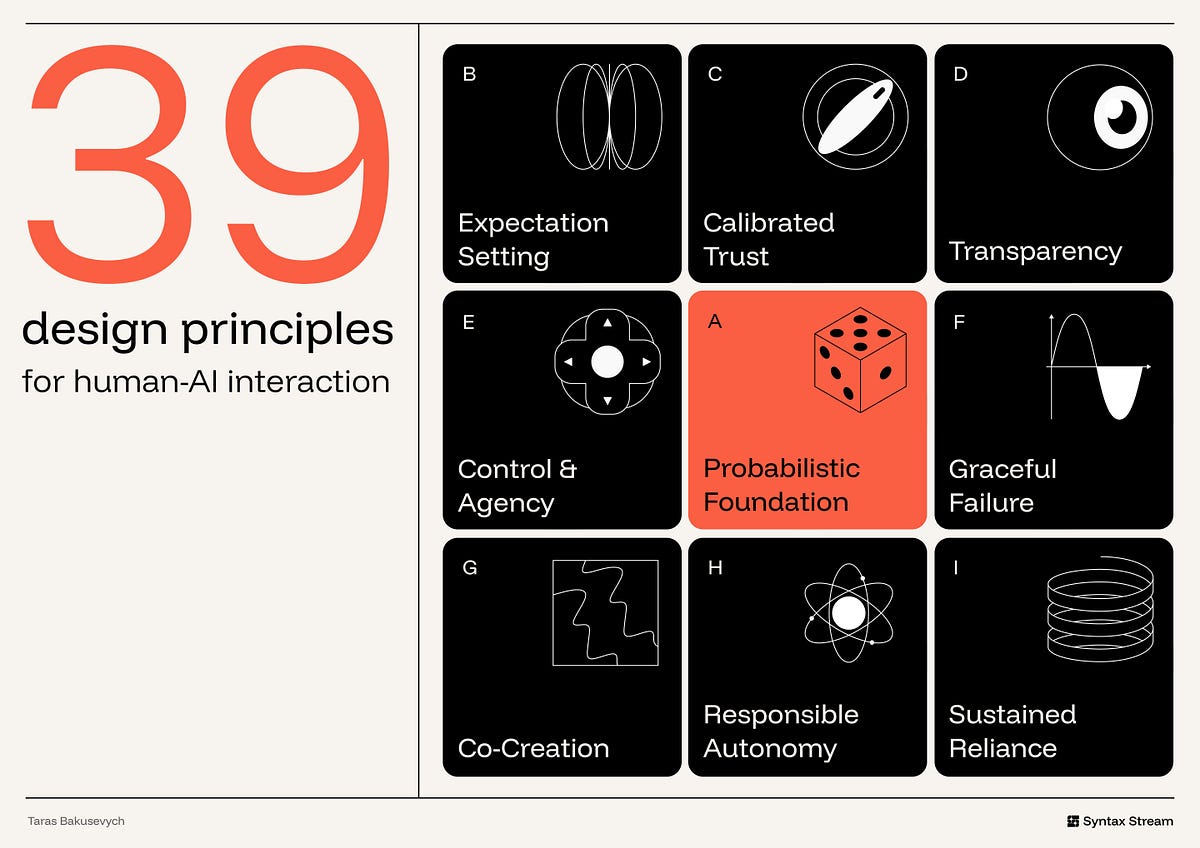
39 principles for designing human-AI interaction
An applied framework for designing AI interfaces that support appropriate reliance, user control, transparency, and responsible autonomy.
AI Contribution Policies
Ready-to-use AI contribution policies for open source projects.
We must not grant AI agents legal personhood
What kind of sanctions could keep a non-human corporation in check?

AI Grants
AI for Individual Rights Grant Application Form Use this form to apply for HRF AI for Individual Rights. Please direct questions to ai@hrf.org. *Required Fields *The Human Rights Foundation (“HRF”) is a U.S.-based 501(c)(3) nonprofit organization committed to promoting and protecting human rights and advancing democracy worldwide, with a particular focus on authoritarian regimes. In […]

AI and the Dangerous Fiction of ‘All Lawful Use’
Dunstan Allison-Hope and Iain Levine argue that human rights commitments are essential for all companies selling their products to governments worldwide.

Business Insider
Business Insider sees AI as a valuable tool. Newsroom staff may employ approved AI tools to assist with drafting, transcription, research, data analysis, fact-checking, and more. There is always human oversight when our journalists use AI, and they are responsible for the accuracy, fairness, originality, and overall quality of everything we publish. We also use AI for some automated products without human oversight, such as our search tool and audio briefing. We transparently label any products or content fully generated by AI. The technology, industry standards, and the law around AI are all evolving, and our thinking on this may evolve over time.
Americans for Responsible Innovation on Twitter / X
NEW: Today ARI released a blueprint for federal AI governance, including three pillars that promote safe frontier AI development: ✅ Standards set by the government ✅ Independent assurance they are met ✅ Transparency into frontier AI development https://t.co/s2mlUP27Wm pic.twitter.com/X6IhBS9jKF— Americans for Responsible Innovation (@americans4ri) August 10, 2026

in my imagination of the future, of AIs doing raw research, it was the AIs that had full control over the proofs they wrote--attribution was clear, and so was the choice to disclose it. but as it stands we are in some hybrid situationship where the human prompter still assumes responsibility.
