Your tools are your business, but everything you submit must be yours.
Our commitment to advancing bold and responsible AI, together
Details on Google's work with other leading AI companies to advance responsible practices in the development of artificial intelligence.

Data Cards: Purposeful and Transparent Dataset Documentation for Responsible AI
DOI: https://doi.org/10.1145/3531146.3533231 FAccT '22: 2022 ACM Conference on Fairness, Accountability, and Transparency, Seoul, Republic of Korea, June 2022
Responsible AI
Discover how AWS is committing to developing AI responsibly – to built trust, promote the safe development of AI, and act as a force for good.
AI Principles
A guiding framework for our responsible development and use of AI, alongside transparency and accountability in our AI development process.

Responsible use of AI in the military? US publishes declaration outlining principles
12 "best practices" for using AI and autonomous systems emphasize human accountability.

Responsible AI Principles and Approach | Microsoft AI
Discover Microsoft AI tools, industry-specific governance solutions, and responsible AI practices to make smarter, more informed decisions about AI implementation.

Responsible AI Principles and Approach | Microsoft AI
Discover Microsoft AI tools, industry-specific governance solutions, and responsible AI practices to make smarter, more informed decisions about AI implementation.
A Human-Centric Framework for Data Attribution in Large Language Models
In the current Large Language Model (LLM) ecosystem, creators have little agency over how their data is used, and LLM users may find themselves unknowingly plagiarizing existing sources. Attribution of LLM-generated text to LLM input data could help with these challenges, but so far we have more questions than answers: what elements of LLM outputs require attribution, what goals should it serve, how should it be implemented? We contribute a human-centric data attribution framework, which situates the attribution problem within the broader data economy. Specific use cases for attribution, such as creative writing assistance or fact-checking, can be specified via a set of parameters (including stakeholder objectives and implementation criteria). These criteria are up for negotiation by the relevant stakeholder groups: creators, LLM users, and their intermediaries (publishers, platforms, AI companies). The outcome of domain-specific negotiations can be implemented and tested for whether the stakeholder goals are achieved. The proposed approach provides a bridge between methodological NLP work on data attribution, governance work on policy interventions, and economic analysis of creator incentives for a sustainable equilibrium in the data economy.

How Shifting Responsibility for AI Harms Undermines Democratic Accountability | TechPolicy.Press
The moralization of individual AI use deflects responsibility away from powerful actors like corporations and governments, Suvradip Maitra and others write.

AI-Assisted Tools in the CHI 2027 Papers Review Process: What They Do, What They Do Not Do, and How Humans Remain Responsible - ACM CHI 2027
AI-Assisted Tools in the CHI 2027 Papers Review Process: What They Do, What They Do Not Do, and How Humans Remain Responsible Authors: Anna Cox, Tony Tang, Thomas Kosch, Erin Solovey, Petra Isenberg, Regan MandrykDate: 2026-08-29 Introduction In our recent post explaining the CHI 2027 Papers review process, we said we would pilot several AI-assisted […]

#NoAccountability | Allen Holub
The notion of accountability—and its lesser cousin, responsibility—often pop up in the context of business, as if both of those ideas are good things. A culture of accountability, we’re told, is essential to running a business. The word “accountable” appears all over the 2020 Scrum Guide. I don’t buy any of it. A culture of…
Human-Centered Artificial Intelligence: Three Fresh Ideas
Human-Centered AI (HCAI) is a promising direction for designing AI systems that support human self-efficacy, promote creativity, clarify responsibility, and facilitate social participation. These human aspirations also encourage consideration of privacy, security, environmental protection, social justice, and human rights. This commentary reverses the current emphasis on algorithms and AI methods, by putting humans at the center of systems design thinking, in effect, a second Copernican Revolution. It offers three ideas: (1) a two-dimensional HCAI framework, which shows how it is possible to have both high levels of human control AND high levels of automation, (2) a shift from emulating humans to empowering people with a plea to shift language, imagery, and metaphors away from portrayals of intelligent autonomous teammates towards descriptions of powerful tool-like appliances and tele-operated devices, and (3) a three-level governance structure that describes how software engineering teams can develop more reliable systems, how managers can emphasize a safety culture across an organization, and how industry-wide certification can promote trustworthy HCAI systems. These ideas will be challenged by some, refined by others, extended to accommodate new technologies, and validated with quantitative and qualitative research. They offer a reframe -- a chance to restart design discussions for products and services -- which could bring greater benefits to individuals, families, communities, businesses, and society.
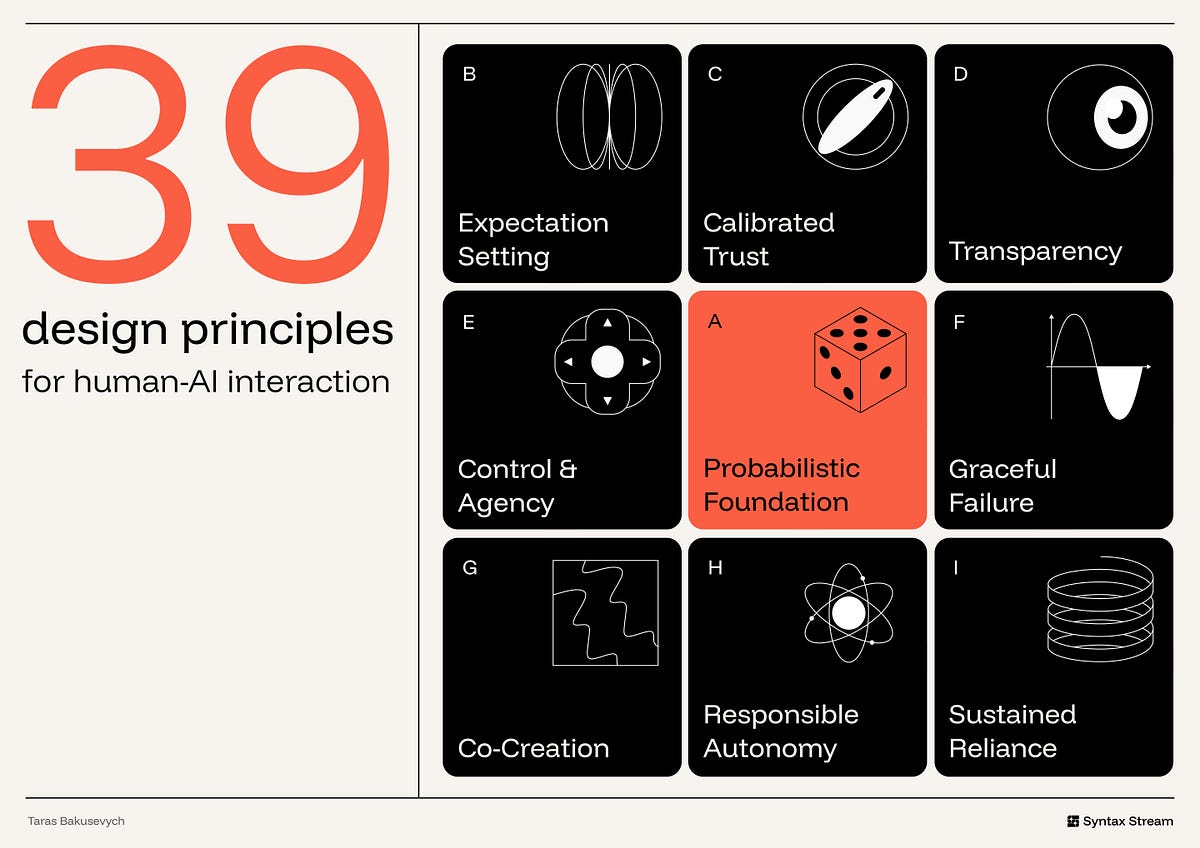
39 principles for designing human-AI interaction
An applied framework for designing AI interfaces that support appropriate reliance, user control, transparency, and responsible autonomy.

Introducing ‘Designing responsibly with AI’
Part 1 of a series to help design teams understand the ethical challenges when working with AI and have better control over the possible…

AI Contribution Policies
Ready-to-use AI contribution policies for open source projects.