


How and why did a custom-built online home for rational thinking attract a tiny but thriving coterie of far-right authoritarian racists who want to overthrow democracy in favor of monarchy?
Geeks for Monarchy: The Rise of the Neoreactionaries | TechCrunch
Many of us yearn for a return to one golden age or another. But there's a community of bloggers taking the idea to an extreme: they want to turn the dial way back to the days before the French Revolution. Neoreactionaries believe that all the good stuff from the past few centuries come from technology and capitalism, and that democracy and social progress have actually done more harm than good. They propose a return to old-fashioned gender roles, social order and monarchy.

Jeremy Gilbert on Twitter / X
Really useful analysis of NR / neo-monarchism/ long-termism as authoritarian responses to the perception that democracy just can't get anything done (cos it's locked in to the short-termism of the popularity / electoral cycle). Free to read here: https://t.co/U4z0qmBReM https://t.co/NG4XIUM6O8— Jeremy Gilbert (@jemgilbert) September 21, 2026
Time and the Neo-Monarchist Turn
One of the classical arguments against democracy concerns its supposed short-termism. Early-modern political thought contrasted the pitfalls of elected authority, whose timebound character was seen to invite inconstancy, instability and plunder, with the merits of indefinite rule on the model of kingship. Such reasoning has seen two revivals in recent years, first in a neo-liberal form as an argument for technocracy (see independent central banking), second in a neo-reactionary form as an argument for an all-powerful executive or ‘monarch’ (see the contemporary international far Right). This article looks at the structure of these political arguments and the work they do. Having reconstructed their historical background, it charts how the neo-monarchist turn marks a radicalisation in democracy-scepticism, guided by a patrimonial logic of authority as property ownership. The article goes on to examine the political-economic factors to which this responds, as well as the contradictions to which neo-monarchism is prone. As the article concludes, temporal arguments for authoritarian politics may be dubious in substance but merit careful observation in a context of widespread disaffection with existing institutions.

LiberationValues
LibertationValues is a political quiz aimed at anti-authoritarian leftists

LiberationValues
LibertationValues is a political quiz aimed at anti-authoritarian leftists
Constitutional agents for online governance – Writings and rehearsals by Nathan Schneider
In this reflection, I want to share an about-face I’ve been having in the strategy for defeating “implicit feudalism” with “governable stacks.” Both of these concepts are described in depth in my book Governable Spaces. Implicit feudalism is the widespread tolerance of highly centralized, low-accountability forms of governance in online communities, from big platforms to little group chats. Governable stacks are efforts to build socio-technical systems that can be co-governed by their participants in diverse and accountable ways.

Governable Stacks against Digital Colonialism
Critics have been converging around the logic of colonialism to describe the Internet economy. If we are serious about the laden language of the colonial, we should be ready to learn from struggles against pre-digital empires and colonial regimes. Although acts of insurrection may attract more attention, one thing leaders and theorists of anticolonial resistance have stressed persistently is the centrality of self-governance in everyday life as both a means and end of their movements. But the dominant platforms for online communities are not well-suited for durable self-governing. Resistance often relies on the same colonial firms it opposes. What would community-governed technologies look like? This paper introduces the concept of “governable stacks”, a framework for self-governing as resistance to digital colonialism.

What Happens When You Have a Choice? : A Breakdown of The People's Assembly and Blacksky's Vision for Democratic Tooling
Blacksky’s foundation is built on self-governance and self-determination. We took learnings from Black and Brown revolutionaries with our belief that everyone has the ability and the self-efficacy to do the things that are best for their community, but we also realize that that ability is something that is not seen as a right that everyone should be able to experience. Due to this, we sought out to create a solution, at least in the digital space, specifically for Blacksky.
We Need To Rethink Democracy
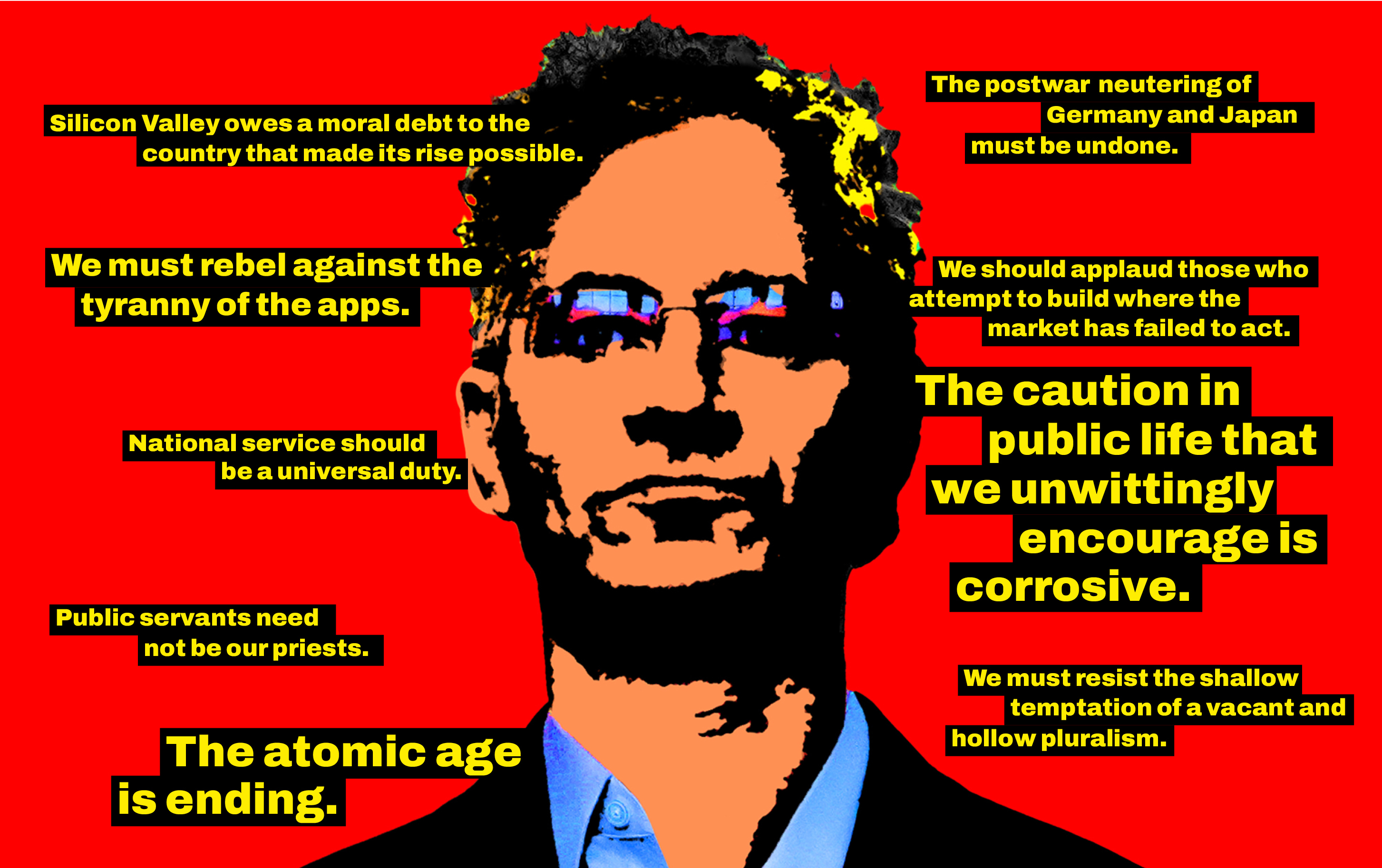
Palantir's social media manifesto is a blueprint for technofascism
The surveillance firm’s viral X post calls for hard power, conscription and the end of pluralism. AI expert and academic Mark Coeckelbergh on what happens when technology becomes the gateway to authoritarianism
Implicit Feudalism — Rushkoff Archive
Too many of us think it doesn’t matter when a platform like X/Twitter has a single, all-powerful owner. Most of our online worlds are simply run by what we hope are benevolent dictators. After all, we figure, if we don’t like what they’re doing or allowing, we can just leave, right? But in most cases we’re just jumping from one rich dude’s idea for how the world should be to another rich dude’s idea for how the world should be.
(PDF) Authoritarian Neoliberalism from Below: Subjectivity and Platform Capitalism in Argentina and Brazil
PDF | We are witnessing a worldwide resurgence of reactionary ideologies and movements, combined with an escalating assault on democratic institutions... | Find, read and cite all the research you need on ResearchGate

Social Media Vs Democracy
It can also be argued that authoritarianism is just politically superior at administering a political economy of broken promises and stagnating or falling standards of living. hup.harvard.edu/books/9780674976788

The Triumph of Broken Promises — Harvard University Press
www.hup.harvard.eduthe viability of many right-wing intellectuals and intellectual spaces is enormously dependent on the largesse of reactionary billionaires and foreign governments, who help them circumvent a marketplace of ideas where they would otherwise post extraordinarily poor sales

Don Moynihan
Its fair to ask if Orban's successful cultivation of the Western right wing intellectuals reflected that their networks were already dependent on patronage. Rod Dreher was funded by a weird billionaire, and when he stopped paying his salary, Orban did. Dreher already looking for a new gig.

