


This is a very quick post. I had an idea as I was walking the dog this evening, and I wanted to build a functioning demo and write about it within a couple of hours. While the post and idea started this evening, the genesis of the idea has been brewing for a while and goes back over a year to August 2024, when I wrote about being sucked into a virtual internet. WebSim has been on my mind for a while, because I loved the idea of being able to simulate my own version of the web using the browser directly and not via another web page. And a couple of weeks ago, I managed to work out how to get Puppeteer to intercept requests and respond with content generated via an LLM.
CrabTrap: Secure Agents in Production
CrabTrap is an LLM-as-a-judge HTTP proxy to secure agents in production. It intercepts and audits AI agent requests in real time. Try it on GitHub now.
Philipp Schmid on Twitter / X
Should we build the web for agents, not agents for the web? 🤔 A new paper argues that current research is misguidedly focuses on improving LLMs leading to significant problems with efficiency, reliability, and safety, proposing a new "Agentic Web Interface" (AWI) that sits on… pic.twitter.com/I90k6kdYdk— Philipp Schmid (@_philschmid) June 14, 2025

If you don't run your own LLM proxy, how the fuck do you even know whats going on?
I think the title captures the idea fully but I'll dig into it because this ain't Twitter. You're working an idea, a piece of code, or a multibillion a year SaaS app which is probably saving the world. Maybe you're automating the cloning process of grabbing
truefoundry/trueforge
The open-source agent harness - the runtime layer that turns an LLM into a working agent.
Permission Manifests for Web Agents
The rise of Large Language Model (LLM)-based web agents represents a significant shift in automated interactions with the web. Unlike traditional crawlers that follow simple conventions, such as robots$.$txt, modern agents engage with websites in sophisticated ways: navigating complex interfaces, extracting structured information, and completing end-to-end tasks. Existing governance mechanisms were not designed for these capabilities. Without a way to specify what interactions are and are not allowed, website owners increasingly rely on blanket blocking and CAPTCHAs, which undermine beneficial applications such as efficient automation, convenient use of e-commerce services, and accessibility tools. We introduce agent-permissions$.$json, a robots$.$txt-style lightweight manifest where websites specify allowed interactions, complemented by API references where available. This framework provides a low-friction coordination mechanism: website owners only need to write a simple JSON file, while agents can easily parse and automatically implement the manifest's provisions. Website owners can then focus on blocking non-compliant agents, rather than agents as a whole. By extending the spirit of robots$.$txt to the era of LLM-mediated interaction, and complementing data use initiatives such as AIPref, the manifest establishes a compliance framework that enables beneficial agent interactions while respecting site owners' preferences.

tholian-network/stealth
:rocket: Stealth - Secure, Peer-to-Peer, Private and Automateable Web Browser/Scraper/Proxy
3W for In-Browser AI: WebLLM + WASM + WebWorkers
What if AI agents could run entirely in your browser? Not just the UI part—the actual model inference, agent logic, and response generation, all happening locally without a single API call.

elements
As much as I struggle with on-device processing and the quality of its output compared to server models, I am excited by some of the APIs that are being built into browsers that are backed by LLMs and other AI inference models. For example, the prompt API, along with a multi-modal version that can take any arbitrary combination of text, image, and audio and run prompts against them. These APIs are neat but not yet web-exposed and many developers struggle to know what to do with a generic prompt. It’s not a solution that is natural to many people yet.
Sawyer Hood on Twitter / X
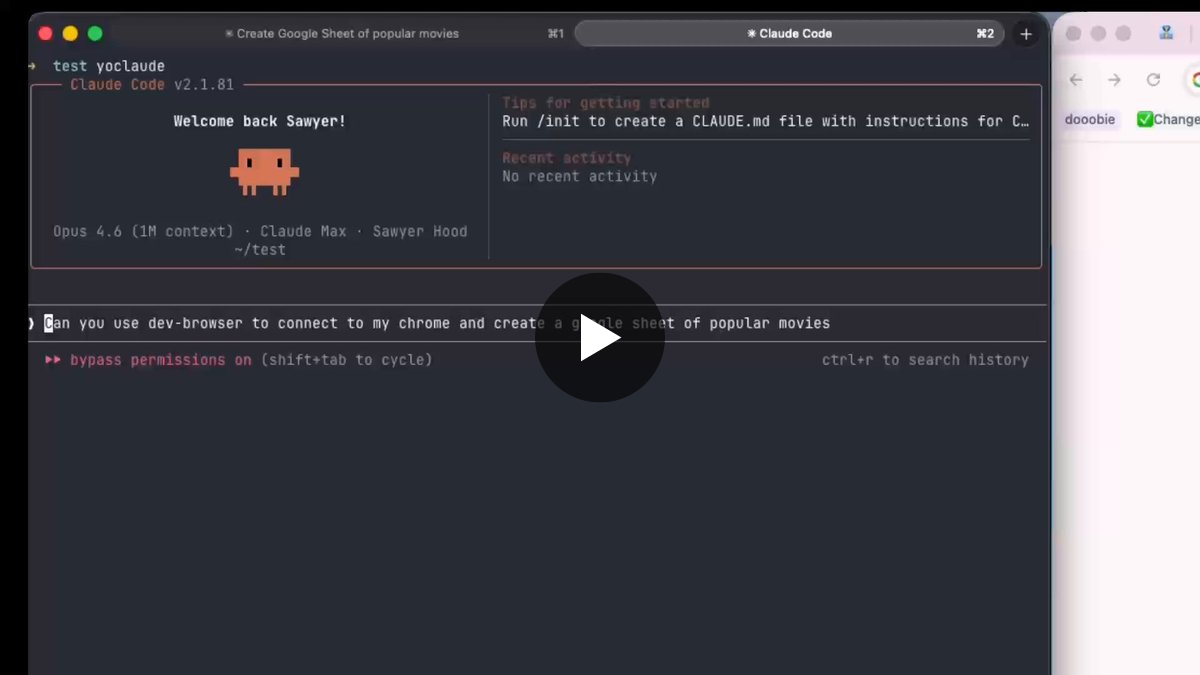
Introducing the new dev-browser cli. The fastest way for an agent to use a browser is to let it write code. Just `npm i -g dev-browser` and tell your agent to "use dev-browser" pic.twitter.com/U8VmsT5XVc— Sawyer Hood (@sawyerhood) March 25, 2026
Prism | Open-Source HTTP Mock and Proxy Server | Stoplight
Accelerate API development with realistic mock servers powered by API descriptions.

firecrawl/firecrawl
The context API to search, scrape, and interact with the web at scale. 🔥
shmuppetry
this is a page about shm's digital puppet rig. it is also an archive for shmuppet shows (lectures, performances, talks, etc., that I've given using the system.)
Tonight I integrated an LLM into every part of the request/response life-cycle of the the browser to see what I could do. aifoc.us/interception/ It was a lot of fun, in the demo linked I can rewrite a web page as before it's rendered by the browser to give me just a summary of the contents.

interception
aifoc.us
