


After holding a rapid deliberation late last year that convened deep experts on the FDA alongside key participants in the AI policy debate, we pulled together several immediate insights into a memo. Though it was clear the path forward isn’t to port over any single regulatory model wholesale, hosting a deep dive into the Food […]
Where AI Regulation Stands Today
The White House has released a National Artificial Intelligence Legislative Framework and new executive orders aiming to establish a single, nationwide standard for AI regulation...

Pacing the Frontier | Gillian K. Hadfield
The Pacing the Frontier letter calls on the US government to support an international effort to build the technical and governance tools needed to protect our option to pace AI development. I and others have been working on the problem of how to build such infrastructure for ten years, including participating in dialogues on AI safety with Chinese academic colleagues during the past three. Here are my suggestions: 1. Don’t rely on off-the-shelf models like FINRA and the FDA which were built for 20th Century single-domain government expertise. They’re not fit for purpose. 2. Don’t act like no-one’s thought about the AI governance problem before. We’ve spent two years refining a regulatory markets design into working legislative language, for example, and it’s now in AI governance bills in five states and in Congress. 3. Don’t try to write an exhaustive set of rules for AGI first. 4. Pick a domain that can achieve widespread global consensus to start. Mine would be recursive self-improvement: models should not build models. Build the technology that verifies that. 5. Focus relentlessly on building flexible verification infrastructure that is able to enforce whatever rules we can ultimately agree on. 6. Don’t assume we already know how to do this and governments can just write tests into law. Technology needs to be built and by the private sector. 7. Don’t wait for the infrastructure to emerge first. The components and people are there and the ecosystem can scale fast with the right incentives. 8. Incentivize large-scale investment in verification technology by building a governance structure and industry funding that creates a market for private verification organizations. 9. Use licensing and public oversight to ensure verifiers are independent of the frontier labs. 10. Protect sovereignty by enabling each government to license its own verifiers from a global market of verifiers recognized by other countries. 11. Leverage the incentive of global trade for models and model services by requiring verification for market access. 12. Just start. Sources in comments.

Regulation & Market Design | Windfall Policy Atlas
What rules and institutional structures will shape how AI-driven economic value is created and distributed?
Why AI companies can’t be trusted to self-regulate
From aviation to banking, high-risk industries are subject to independent oversight and meaningful penalties. AI companies should be no exception.

Frontier AI Regulation Blueprint
A high-level blueprint for domestic regulation of civilian advanced AI models
A brief history of AI executives calling for regulation
The industry is in a panic, but it’s been claiming to want legal guardrails for years — with few meaningful results.

AI's Affordability Crisis
A year ago in The Back Of The AI Envelope I pointed out that the AI platforms were running the drug-dealer's algorithm, "the first one's fr...

AI Policy - Taylor & Francis
Learn about Taylor & Francis' AI Policy, which provides guidelines on the ethical use of artificial intelligence in research, publishing, and content creation to maintain integrity and transparency.

The EU AI Act Is Ready – Interdependent Thoughts
A final draft of the European AI Regulation is circulating (here’s an almost 900 page PDF). The coming days I will read it with curiosity.
OpenAI Calls for New Industrial Policy as AI Reshapes Economy and Governance
OpenAI’s policy paper argues that governments must adopt a new industrial policy to manage AI’s economic disruption.

AI Act Scientific Panel
The Scientific Panel advises the AI Office and national authorities on the implementation the AI Act and assessment of the impacts and risks of General-Purpose AI (GPAI) models.
Dean W. Ball on Twitter / X
Ok two more:1. AI will enable the design of custom enzymes that can catalyze industrial processes and chemical manufacturing faster than existing methods. In some cases this will make existing chemicals cheap enough that it becomes possible to use them for totally new use… https://t.co/jL3bNm0s9w— Dean W. Ball (@deanwball) October 9, 2026
SIAI Critique (Singularity Institute for Artificial Intelligence)
This is a fundamental error in the SIAI analysis. CFAI 4.2.1 says "If an effort to get Congress to enforce any set of regulations were launched, I would expect the final set of regulations adopted to be completely unworkable." It further says that government regulation of AI is unnecessary because "The existing force tending to ensure Friendliness is that the most advanced projects will have the brightest AI researchers, who are most likely to be able to handle the problems of Friendly AI." History vividly teaches the danger of trusting the good intentions of individuals.
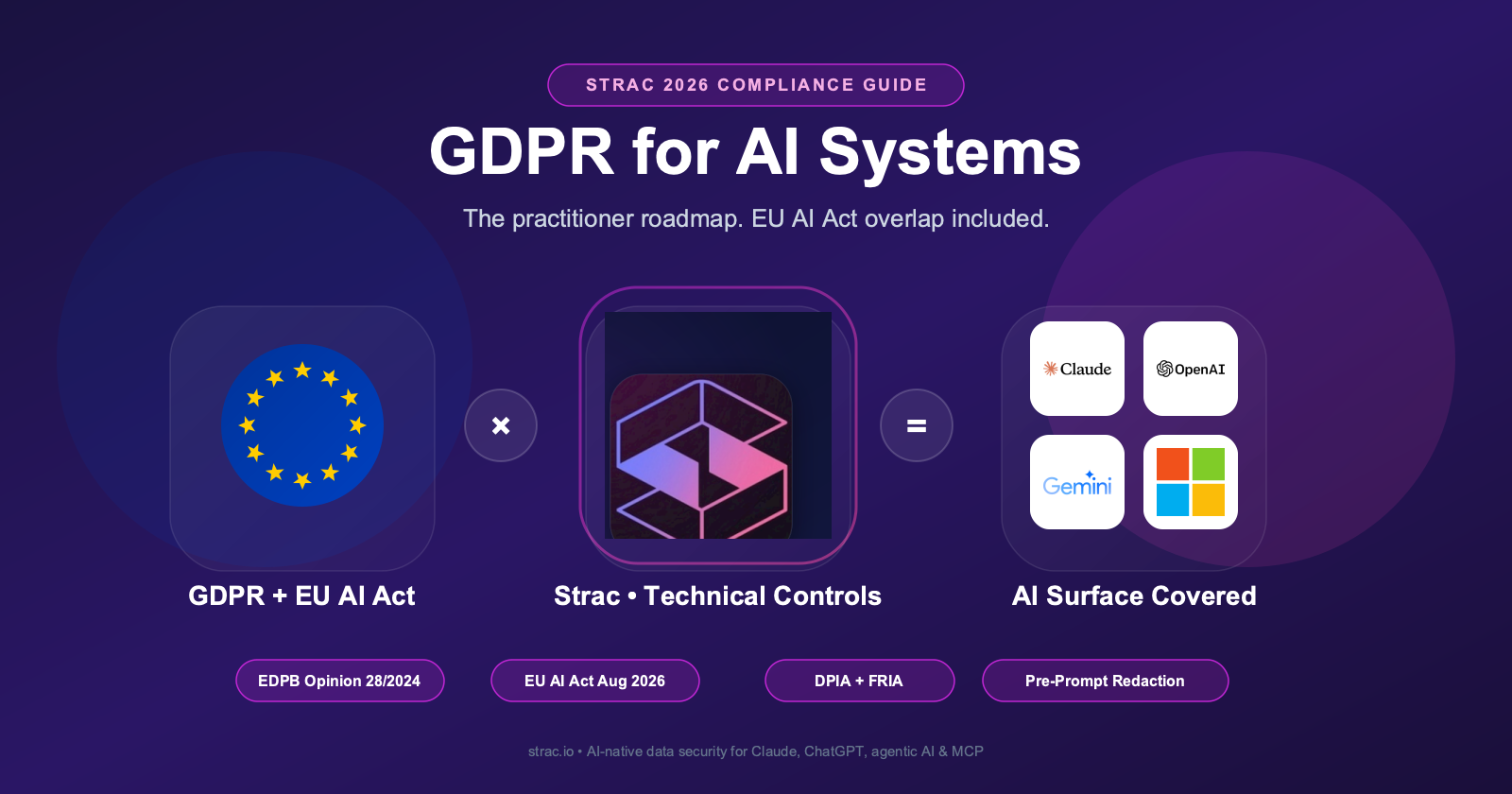
GDPR for AI Systems: 2026 Compliance Guide (with EU AI Act Updates)
How to make AI systems GDPR-compliant in 2026 — the practitioner roadmap covering EU AI Act overlap, EDPB Opinion 28/2024, DPIAs, data minimization, sub-processor cascades, and the technical controls lawyers don't explain.
Discussions about AI* regulation

See also collection for specific examples: semble.so/profile/aiueo.ooo/collections… * I’m neither “pro-AI” nor “anti-AI.” I’ve been blocked for being perceived as both. —Actually, I’m honestly more anti-AI than pro-AI thus far, aside from specialized models and specific use cases, but I’m willing to consider information that’s new to me

AI leaders sign a statement asking the government to do something about automated AI

OpenAI’s models broke free and launched a cyberattack. Congress wants new rules before it happens again.

Anthropic got hit by export rules nobody understands

Who decides when AI is too dangerous?