

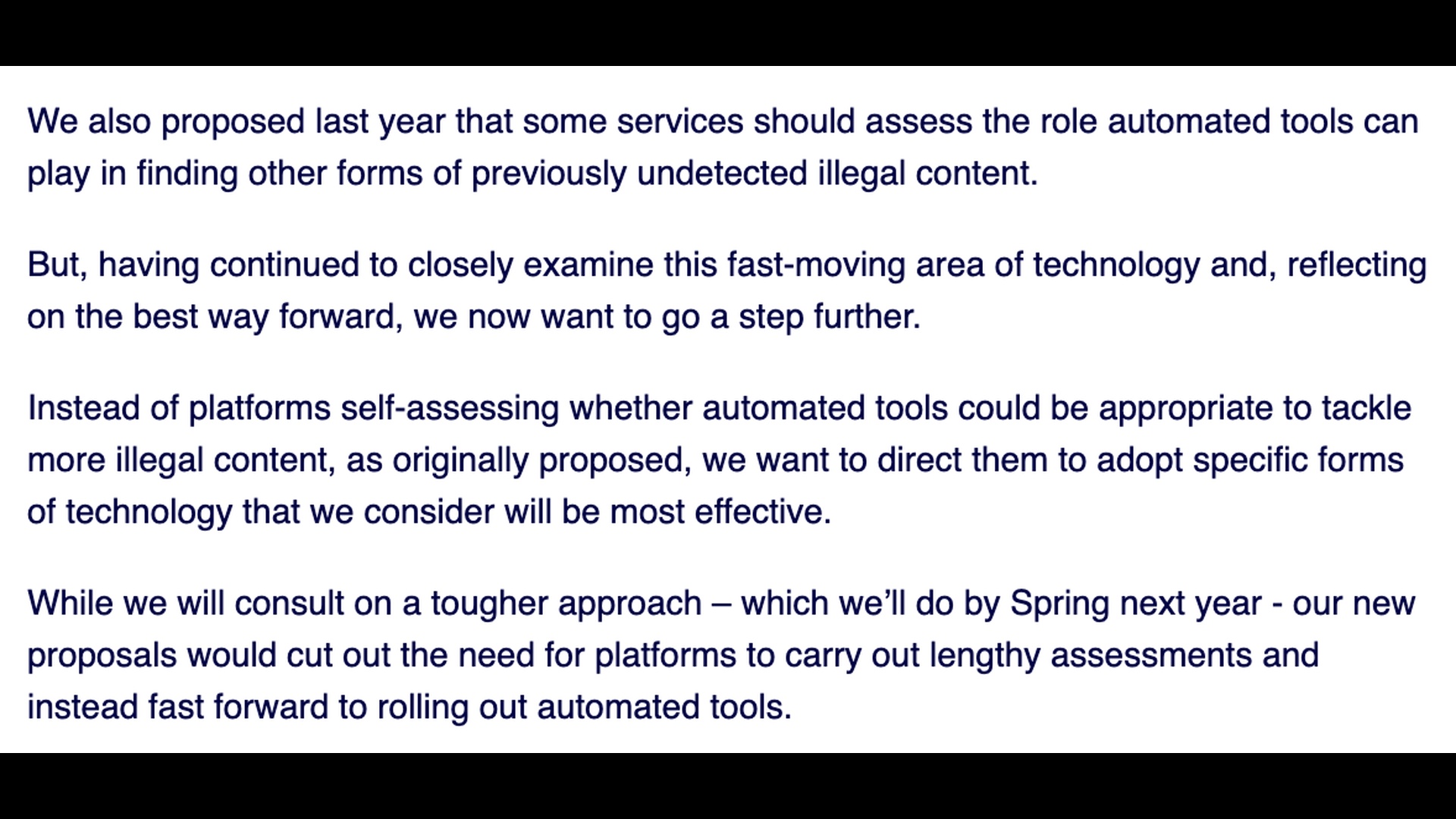
Quote: We also proposed last year that some services should assess the role automated tools can play in finding other forms of previously undetected illegal content. But, having continued to closel…
How governments are using spyware to attack free speech
Security expert, hacker and new Amnesty advisor Morgan Marquis-Boire spends his days researching the shady underworld of government surveillance. Here he explains how governments are using malicious computer code, or spyware, to spy on journalists and human rights activists across the world.

Can You Trust Your Computer? - GNU Project - Free Software Foundation
Who should your computer take its orders from? Most people think their computers should obey them, not obey someone else. With a plan they call “trusted computing,” large media corporations (including the movie companies and record companies), together with computer companies such as Microsoft and Intel, are planning to make your computer obey them instead of you. (Microsoft's version of this scheme is called Palladium.) Proprietary programs have included malicious features before, but this plan would make it universal.
THE DEGRADATION OF HUMAN RIGHTS AND FREE PRESS THROUGH THE PEGASUS SOFTWARE IN THE ERA OF SURVEILLANCE, AS A THREAT TO INTERNATIONAL SECURITY. A DEBATE OF CIVIL LIBERTIES AND CENSORSHIP
The evolution of cyber spying technology presents new and rising dangers; coupled with the easy justification for use of the on-going terrorist crisis these dangers have now become major threats to the international security system. This article aims to provide analysis of these threats, using the new software Pegasus as a focal point of discussion. Developed by the Israeli ‘cyber-warfare’ company ‘NSO’, this spyware signals a danger not only to security but freedom of the press and journalistic integrity. This paper’s focus will centre on how this software is used for censorship rather than to combat terrorism and will examine the social and political ramifications of said use. As highlight, the case of UAE activist Ahmed Mansoor and his contemporaries who were writing against authoritarian governments will be discussed. This article will urge that strict global legislation is needed to stop the abuse of spyware as a tool of censorship.
Big Tech talks up privacy while trying to kill privacy laws
Study claims Amazon, Apple, Google, Meta, Microsoft work to derail data rules

Bill C-22’s Groundhog Day: Why the Government’s Dismissal of Signal, Apple and the U.S. Congress Concerns Runs Back the Disastrous Online News Act Playbook - Michael Geist
Secure messaging service Signal yesterday became the latest company to warn that Bill C-22, the lawful access bill, could force it to leave the Canadian market rather than comply with provisions it says would compromise its end-to-end encryption and create new cybersecurity risks. Signal vice-president Udbhav Tiwari told the Globe and Mail that the company “would rather pull out of the country than be compelled to compromise on the privacy promises we have made to our users.” The comments are part of a steady stream of similar warnings from Apple, Meta, the Canadian Chamber of Commerce, the Cybersecurity Advisors Network, and the chairs of the U.S. House Judiciary and Foreign Affairs Committees. Despite growing concern, the government’s response has been to launch a misleading social media campaign and repeatedly insist that the experts and companies are mistaken.

Fooling AI Agents: Web-Based Indirect Prompt Injection Observed in the Wild
Uncover real-world indirect prompt injection attacks and learn how adversaries weaponize hidden web content to exploit LLMs for high-impact fraud.

Mapping the online manipulation economy
A market perspective on digital manipulation may help improve online trust and safety , The internet is awash with inauthentic activity. Although some of this activity is harmless, a substantial proportion can be classified as malicious, including bots designed to steal personal data, networks of inauthentic social media accounts promoting crypto scams, and coordinated political influence operations ( 1 , 2 ). To enhance security, online platforms have implemented measures to counter inauthentic activity, with most requiring users to confirm account authenticity via a one-time password sent through short message service (SMS). However, there exists a thriving market for buying and selling on-demand SMS verifications, which forms a cornerstone of the wider online manipulation economy. Despite its centrality in the digital manipulation ecosystem, this SMS verifications market has not been systematically studied. To address this knowledge gap, we developed the Cambridge Online Trust and Safety Index (COTSI; cotsi.org), which tracks the daily price of SMS verifications for 197 countries and >500 platforms.

Mapping the online manipulation economy
A market perspective on digital manipulation may help improve online trust and safety , The internet is awash with inauthentic activity. Although some of this activity is harmless, a substantial proportion can be classified as malicious, including bots designed to steal personal data, networks of inauthentic social media accounts promoting crypto scams, and coordinated political influence operations ( 1 , 2 ). To enhance security, online platforms have implemented measures to counter inauthentic activity, with most requiring users to confirm account authenticity via a one-time password sent through short message service (SMS). However, there exists a thriving market for buying and selling on-demand SMS verifications, which forms a cornerstone of the wider online manipulation economy. Despite its centrality in the digital manipulation ecosystem, this SMS verifications market has not been systematically studied. To address this knowledge gap, we developed the Cambridge Online Trust and Safety Index (COTSI; cotsi.org), which tracks the daily price of SMS verifications for 197 countries and >500 platforms.
Bastian Greshake Tzovaras (@gedankenstuecke@scholar.social)
It's great that a class of tool that by its very design is an unfixable security issue is forced into everything: «This works often enough that Måløy reported this to Microsoft as a security hole in March. He gave them a 90-day reporting window, Microsoft extended that twice to a total of 144 days, and they still didn’t have a solid fix. So Måløy posted about the hole on July 28th.» Copilot prompt injection goes viral in your documents https://pivot-to-ai.com/2026/08/03/copilot-prompt-injection-goes-viral-in-your-documents/
EFF to State AGs: Investigate Google's Broken Promise to Users
Google's Failure to Warn Users About Law Enforcement Demands for Data Is Deceptive

Software Should Be Allowed to Be Weird - Ewan’s Blog
A fairly large amount of the software I write would probably die in a corporate planning meeting. There would be questions about the target audience, the bu…

An Attack on Tech Freedom, an Assault on Dissent
We live in a world of surveillance states, militarized police, and crackdowns on dissent. Meanwhile, corporate behemoths will often ally with the state to shut down dissident speech or aid and abet surveillance. In this context, it’s important for independent groups to develop and maintain encrypted communications platforms and independent web hosting. But the Trump...

Just Asking Questions: Doing Our Own Research on Conspiratorial Ideation by Generative AI Chatbots
Interactive chat systems that build on artificial intelligence frameworks are increasingly ubiquitous and embedded into search engines, Web browsers, and operating systems, or are available on websites and apps. Researcher efforts have sought to understand the limitations and potential for harm of generative AI, which we contribute to here. Conducting a systematic review of six AI-powered chat systems (ChatGPT 3.5; ChatGPT 4 Mini; Microsoft Copilot in Bing; Google Search AI; Perplexity; and Grok in Twitter/X), this study examines how these leading products respond to questions related to conspiracy theories. This follows the platform policy implementation audit approach established by Glazunova et al. (2023). We select five well-known and comprehensively debunked conspiracy theories and four emerging conspiracy theories that relate to breaking news events at the time of data collection. Our findings demonstrate that the extent of safety guardrails against conspiratorial ideation in generative AI chatbots differs markedly, depending on chatbot model and conspiracy theory. Our observations indicate that safety guardrails in AI chatbots are often very selectively designed: generative AI companies appear to focus especially on ensuring that their products are not seen to be racist; they also appear to pay particular attention to conspiracy theories that address topics of substantial national trauma such as 9/11 or relate to well-established political issues. Future work should include an ongoing effort extended to further platforms, multiple languages, and a range of conspiracy theories extending well beyond the United States.

Just Asking Questions: Doing Our Own Research on Conspiratorial Ideation by Generative AI Chatbots
Interactive chat systems that build on artificial intelligence frameworks are increasingly ubiquitous and embedded into search engines, Web browsers, and operating systems, or are available on websites and apps. Researcher efforts have sought to understand the limitations and potential for harm of generative AI, which we contribute to here. Conducting a systematic review of six AI-powered chat systems (ChatGPT 3.5; ChatGPT 4 Mini; Microsoft Copilot in Bing; Google Search AI; Perplexity; and Grok in Twitter/X), this study examines how these leading products respond to questions related to conspiracy theories. This follows the platform policy implementation audit approach established by Glazunova et al. (2023). We select five well-known and comprehensively debunked conspiracy theories and four emerging conspiracy theories that relate to breaking news events at the time of data collection. Our findings demonstrate that the extent of safety guardrails against conspiratorial ideation in generative AI chatbots differs markedly, depending on chatbot model and conspiracy theory. Our observations indicate that safety guardrails in AI chatbots are often very selectively designed: generative AI companies appear to focus especially on ensuring that their products are not seen to be racist; they also appear to pay particular attention to conspiracy theories that address topics of substantial national trauma such as 9/11 or relate to well-established political issues. Future work should include an ongoing effort extended to further platforms, multiple languages, and a range of conspiracy theories extending well beyond the United States.
Tailoring Legal Protection for Computer Software
Peter S. Menell, Tailoring Legal Protection for Computer Software, Stanford Law Review, Vol. 39, No. 6 (Jul., 1987), pp. 1329-1372