Reasoning as pathfinding in token space.
Position: Stop Anthropomorphizing Intermediate Tokens as Reasoning/Thinking Traces!
Intermediate token generation (ITG), where a model produces output before the solution, has become a standard method to improve the performance of language models on reasoning tasks. These intermediate tokens have been called \say{reasoning traces} or even \say{thinking traces} -- implicitly anthropomorphizing the traces, and implying that these traces resemble steps a human might take when solving a challenging problem, and as such can provide an interpretable window into the operation of the model's thinking process to the end user. In this position paper, we present evidence that this anthropomorphization isn't a harmless metaphor, and instead is quite dangerous -- it confuses the nature of these models and how to use them effectively, and leads to questionable research. We call on the community to avoid such anthropomorphization of intermediate tokens.
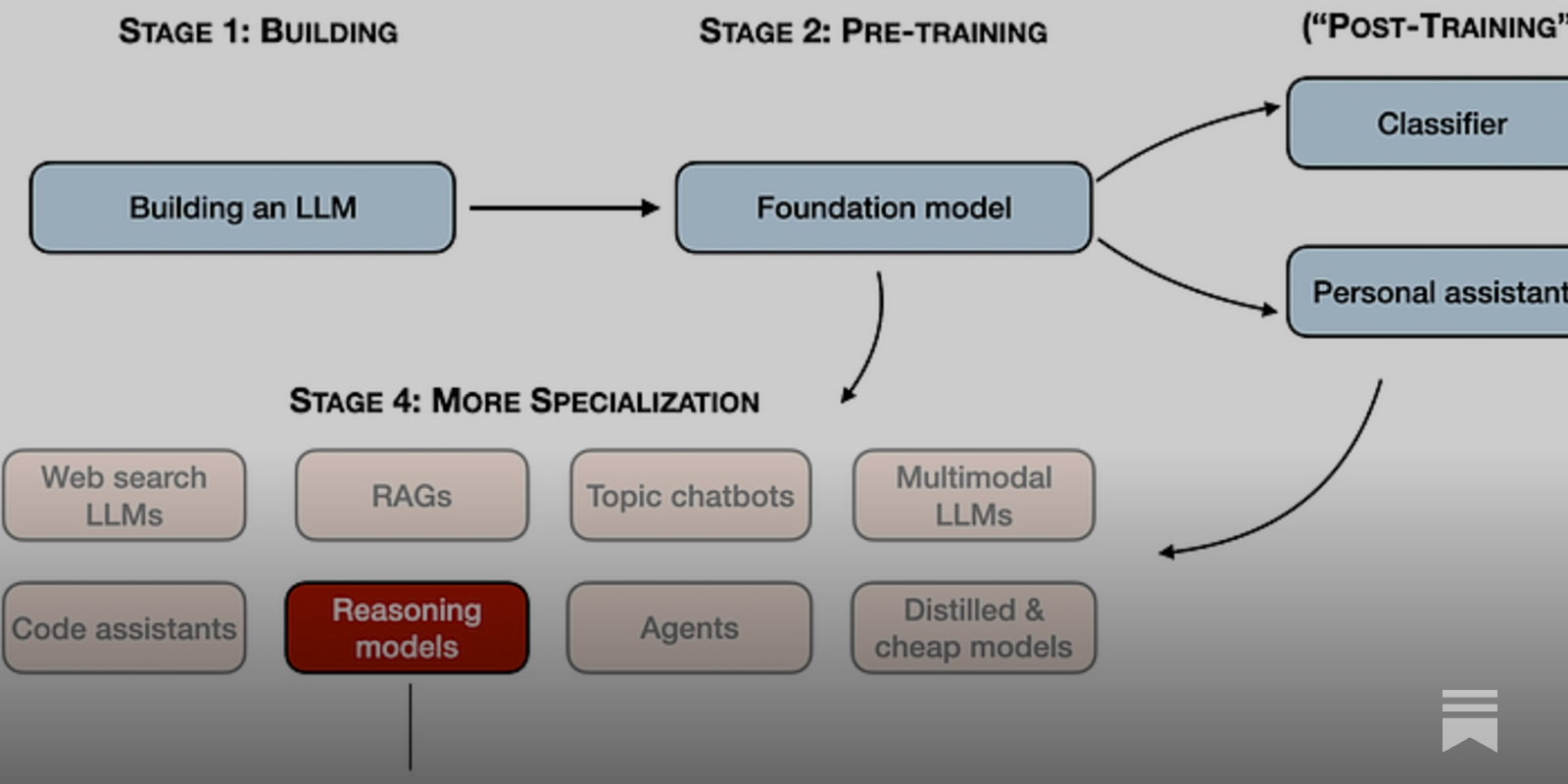
Understanding Reasoning LLMs
Methods and Strategies for Building and Refining Reasoning Models
The LLM Reasoning Debate Heats Up
Three recent papers examine the robustness of reasoning and problem-solving in large language models

Crafting a good (reasoning) model
A recent talk I gave on model training, reasoning, and the next frontier.
Performative Thinking? The Brittle Correlation Between CoT Length and Problem Complexity
Intermediate token generation (ITG), where a model produces output before the solution, has been proposed as a method to improve the performance of language models on reasoning tasks. While these reasoning traces or Chain of Thoughts (CoTs) are correlated with performance gains, the mechanisms underlying them remain unclear. A prevailing assumption in the community has been to anthropomorphize these tokens as "thinking", treating longer traces as evidence of higher problem-adaptive computation. In this work, we critically examine whether intermediate token sequence length reflects or correlates with problem difficulty. To do so, we train transformer models from scratch on derivational traces of the A* search algorithm, where the number of operations required to solve a maze problem provides a precise and verifiable measure of problem complexity. We first evaluate the models on trivial free-space problems, finding that even for the simplest tasks, they often produce excessively long reasoning traces and sometimes fail to generate a solution. We then systematically evaluate the model on out-of-distribution problems and find that the intermediate token length and ground truth A* trace length only loosely correlate. We notice that the few cases where correlation appears are those where the problems are closer to the training distribution, suggesting that the effect arises from approximate recall rather than genuine problem-adaptive computation. This suggests that the inherent computational complexity of the problem instance is not a significant factor, but rather its distributional distance from the training data. These results challenge the assumption that intermediate trace generation is adaptive to problem difficulty and caution against interpreting longer sequences in systems like R1 as automatically indicative of "thinking effort".
The Illusion of Thinking: Understanding the Strengths and Limitations of Reasoning Models via the Lens of Problem Complexity
Recent generations of frontier language models have introduced Large Reasoning Models (LRMs) that generate detailed thinking processes…

Is AI Reasoning Right for the Wrong Reasons? | Quanta Magazine
The idea that artificial intelligence can “reason” is more intuitive than ever. But intuitions can be wrong, and the science is far from settled.
With the launch of o3-pro, let’s talk about what AI “reasoning” actually does
New studies reveal pattern-matching reality behind the AI industry's reasoning claims.

On the Paradox of Learning to Reason from Data
Logical reasoning is needed in a wide range of NLP tasks. Can a BERT model be trained end-to-end to solve logical reasoning problems presented in natural language? We attempt to answer this...
Exploring the interplay between AI and human logic in mathematical problem-solving
This paper investigates the dynamic interplay between Artificial Intelligence (AI) and human logic in the domain of mathematical problem-solving. By critically examining a series of case studies, we compare the efficacy of AI-generated solutions, particularly those offered by ChatGPT, against traditional human problem-solving methods. The study employs various mathematical challenges, ranging from abstract logical puzzles to applied numerical problems, to evaluate AI's problem-solving approach and alignment with human cognitive processes. Our analysis highlights instances where AI's computational strategies complement or diverge from human reasoning, shedding light on AI's potential and limitations in deciphering mathematical problems. Furthermore, we explore the implications of integrating AI tools in educational contexts, specifically their role in enhancing students' mathematical problem-solving skills. The paper aims to contribute to the ongoing discourse on the optimal utilization of AI in education, proposing a balanced approach that leverages AI's computational power while fostering the depth and creativity of human logic. Through this comparative study, we advocate for a collaborative model where AI and human reasoning merge to enrich the educational landscape, particularly in the teaching and learning of mathematics.

On the Paradox of Learning to Reason from Data
Proceedings of the Thirty-Second International Joint Conference on Artificial Intelligence. Main Track. Pages 3365-3373.
On the Paradox of Learning to Reason from Data
Proceedings of the Thirty-Second International Joint Conference on Artificial Intelligence. Main Track. Pages 3365-3373.
Commons · Reason Commons
Read shared goals and the reasoning groups build around them with the Reason Commons skill.
A taxonomy for next-generation reasoning models
Where we've been and where we're going with RLVR.