

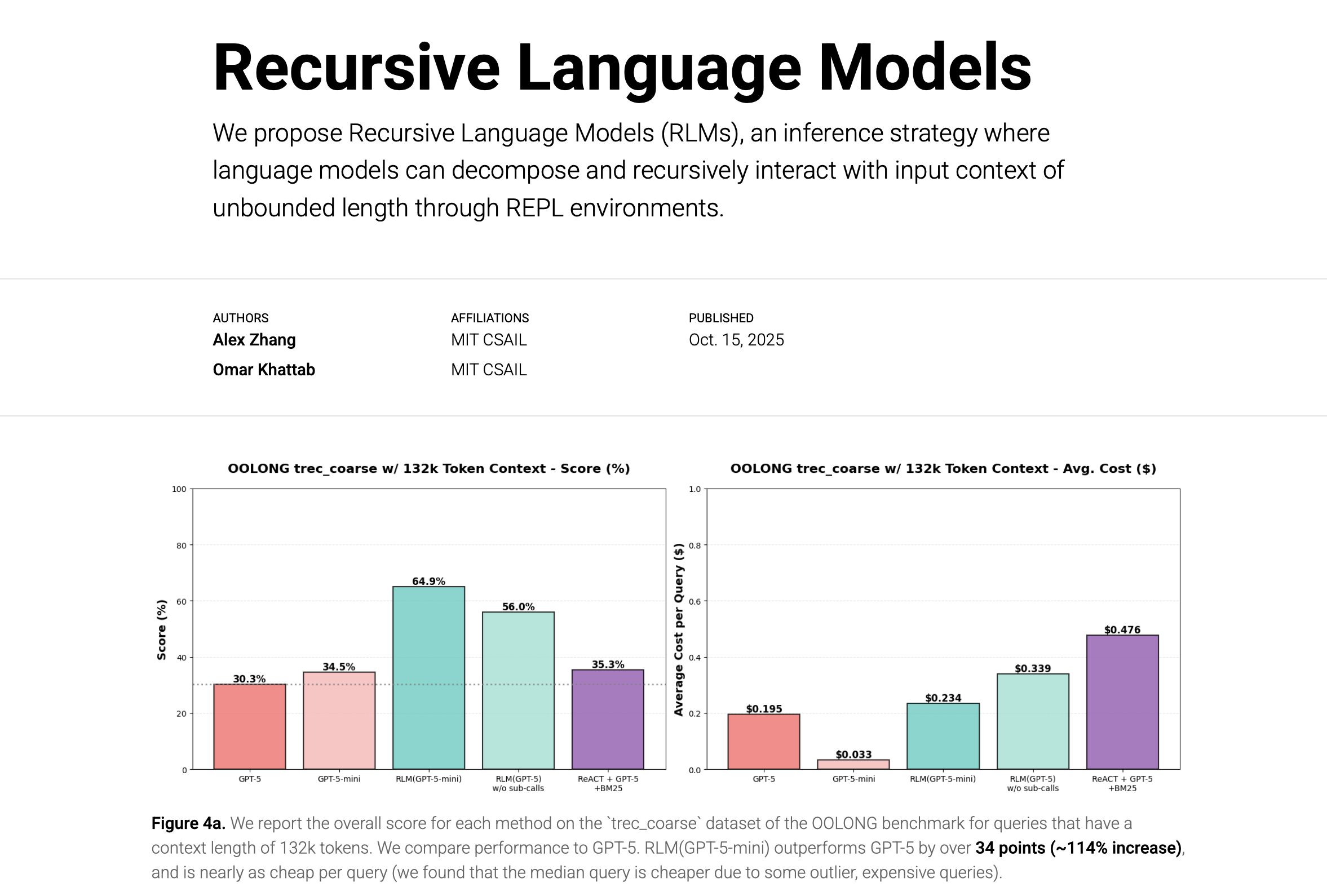
We propose Recursive Language Models (RLMs), an inference strategy where language models can decompose and recursively interact with input context of unbounded length through REPL environments.
Recursive Language Models: the paradigm of 2026
How we plan to manage extremely long contexts
.png?v=c8c07d4bf43b)
Recursive Language Models
We study allowing large language models (LLMs) to process arbitrarily long prompts through the lens of inference-time scaling. We propose Recursive Language Models (RLMs), a general inference paradigm that treats long prompts as part of an external environment and allows the LLM to programmatically examine, decompose, and recursively call itself over snippets of the prompt. We find that RLMs can successfully process inputs up to two orders of magnitude beyond model context windows and, even for shorter prompts, dramatically outperform the quality of vanilla frontier LLMs and common long-context and coding scaffolds (e.g., on GPT-5 by a median across the evaluated benchmarks of $26\%$ against compaction, $130\%$ against CodeAct with sub-calls, and $13\%$ against Claude Code) across four diverse long-context tasks while having comparable cost. At a small scale, we post-train the first model around the RLM. Our model, RLM-Qwen3-8B, outperforms the underlying Qwen3-8B model by $28.3\%$ on average and even approaches the quality of vanilla GPT-5 on three long-context tasks. Code is available at https://github.com/alexzhang13/rlm.

Hypothesis generation and updating in large language models
Large language models (LLMs) increasingly help people solve problems, from debugging code to repairing machinery. This process requires generating plausible hypotheses from partial descriptions,...
How Large Language Models Actually Work
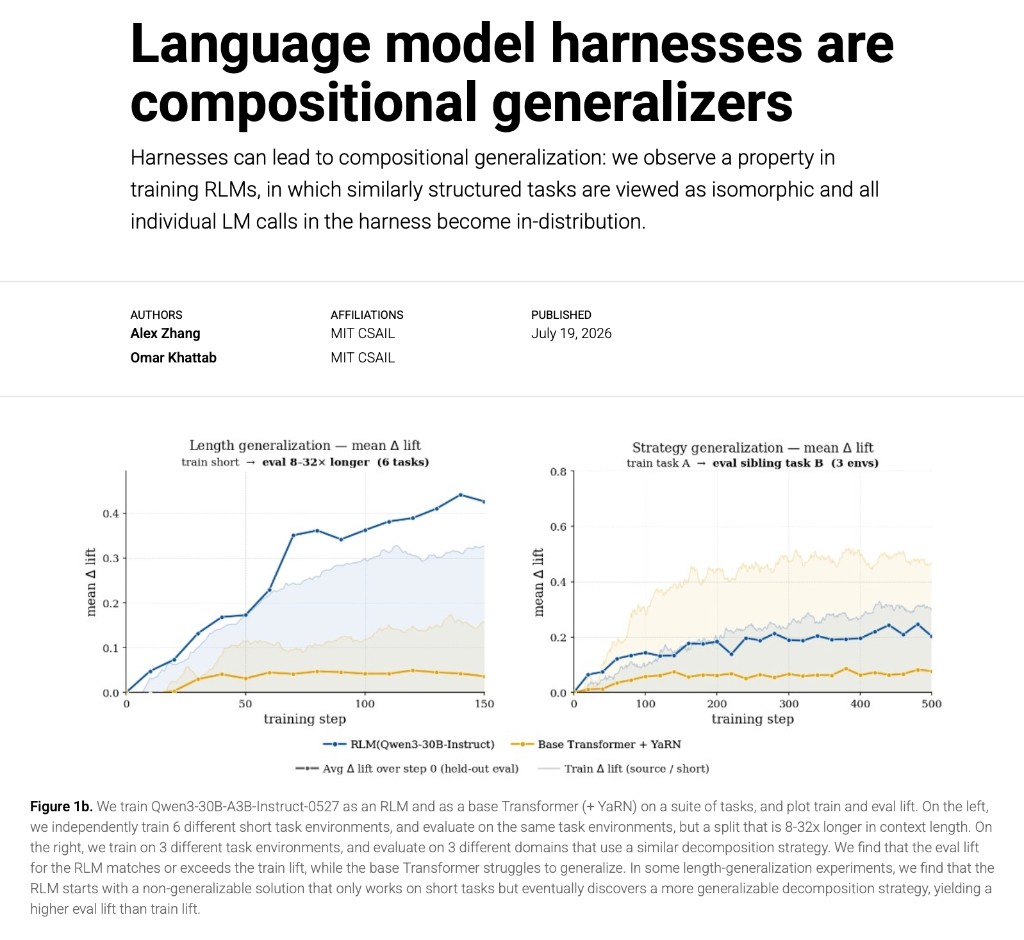
Language model harnesses are compositional generalizers
Harnesses can lead to compositional generalization: we observe a property in training RLMs, in which similarly structured tasks are viewed as isomorphic and all individual LM calls in the harness become in-distribution.
Stanford CS336 Language Modeling from Scratch I 2025
LLM in a Flash: Efficient Large Language Model Inference with Limited Memory
Large language models (LLMs) are central to modern natural language processing, delivering exceptional performance in various tasks…

Understanding Understanding: A Pragmatic Framework Motivated by...
Motivated by the rapid ascent of Large Language Models (LLMs) and debates about the extent to which they possess human-level qualities, we propose a framework for testing whether any agent (be it...
Systems programming the model
This paper examines the status of the language model object in generative AI, arguing that what we call a ‘model’ is inseparable from the systems deploying it. I first theorize how these objects emerge from systems-level interactions between trained artifacts, prompting mechanisms, and sampling methods, drawing on the philosophy of digital objects as well as software studies to show how models gain their objective character. Such interactions converge on programming, not prompting, language models, and I illustrate how critical code studies can therefore track these dynamics. In an overview of language model programming approaches, I discuss how prompt and program converge, demonstrating how this confluence tends toward the production of new feedback loops wherein models become models of and for themselves. Understanding these feedback loops is essential in view of recent efforts to infrastructuralize AI, in which multiple models cascade into compound systems that abstract toward a unified model of models. Thus the need, I argue, for a systems-level view that can address this new order of abstraction and complexity by identifying where and how the model emerges from the system.

Stanford CS336 | Language Modeling from Scratch (Spring 2025 Archive)
Archived course website for Stanford CS336: Language Modeling from Scratch (Spring 2025), including schedule, assignments, logistics, and materials.

Performative Thinking? The Brittle Correlation Between CoT Length and Problem Complexity
Intermediate token generation (ITG), where a model produces output before the solution, has been proposed as a method to improve the performance of language models on reasoning tasks. While these reasoning traces or Chain of Thoughts (CoTs) are correlated with performance gains, the mechanisms underlying them remain unclear. A prevailing assumption in the community has been to anthropomorphize these tokens as "thinking", treating longer traces as evidence of higher problem-adaptive computation. In this work, we critically examine whether intermediate token sequence length reflects or correlates with problem difficulty. To do so, we train transformer models from scratch on derivational traces of the A* search algorithm, where the number of operations required to solve a maze problem provides a precise and verifiable measure of problem complexity. We first evaluate the models on trivial free-space problems, finding that even for the simplest tasks, they often produce excessively long reasoning traces and sometimes fail to generate a solution. We then systematically evaluate the model on out-of-distribution problems and find that the intermediate token length and ground truth A* trace length only loosely correlate. We notice that the few cases where correlation appears are those where the problems are closer to the training distribution, suggesting that the effect arises from approximate recall rather than genuine problem-adaptive computation. This suggests that the inherent computational complexity of the problem instance is not a significant factor, but rather its distributional distance from the training data. These results challenge the assumption that intermediate trace generation is adaptive to problem difficulty and caution against interpreting longer sequences in systems like R1 as automatically indicative of "thinking effort".
Performative Thinking? The Brittle Correlation Between CoT Length and Problem Complexity
Intermediate token generation (ITG), where a model produces output before the solution, has been proposed as a method to improve the performance of language models on reasoning tasks. While these reasoning traces or Chain of Thoughts (CoTs) are correlated with performance gains, the mechanisms underlying them remain unclear. A prevailing assumption in the community has been to anthropomorphize these tokens as "thinking", treating longer traces as evidence of higher problem-adaptive computation. In this work, we critically examine whether intermediate token sequence length reflects or correlates with problem difficulty. To do so, we train transformer models from scratch on derivational traces of the A* search algorithm, where the number of operations required to solve a maze problem provides a precise and verifiable measure of problem complexity. We first evaluate the models on trivial free-space problems, finding that even for the simplest tasks, they often produce excessively long reasoning traces and sometimes fail to generate a solution. We then systematically evaluate the model on out-of-distribution problems and find that the intermediate token length and ground truth A* trace length only loosely correlate. We notice that the few cases where correlation appears are those where the problems are closer to the training distribution, suggesting that the effect arises from approximate recall rather than genuine problem-adaptive computation. This suggests that the inherent computational complexity of the problem instance is not a significant factor, but rather its distributional distance from the training data. These results challenge the assumption that intermediate trace generation is adaptive to problem difficulty and caution against interpreting longer sequences in systems like R1 as automatically indicative of "thinking effort".
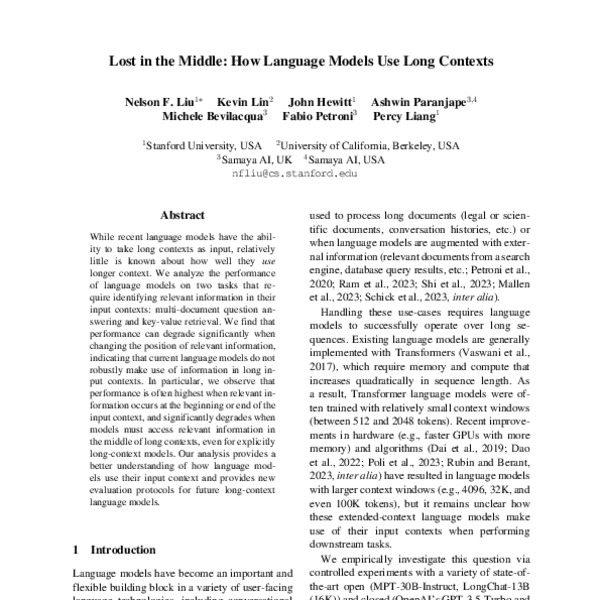
Lost in the Middle: How Language Models Use Long Contexts
While recent language models have the ability to take long contexts as input, relatively little is known about how well they use longer context. We analyze the performance of language models on two tasks that require identifying relevant information in their input contexts: multi-document question answering and key-value retrieval. We find that performance can degrade significantly when changing the position of relevant information, indicating that current language models do not robustly make use of information in long input contexts. In particular, we observe that performance is often highest when relevant information occurs at the beginning or end of the input context, and significantly degrades when models must access relevant information in the middle of long contexts, even for explicitly long-context models. Our analysis provides a better understanding of how language models use their input context and provides new evaluation protocols for future long-context language models.
Circuit Tracing: Revealing Computational Graphs in Language Models
We describe an approach to tracing the “step-by-step” computation involved when a model responds to a single prompt.

Measuring short-form factuality in large language models
We present SimpleQA, a benchmark that evaluates the ability of language models to answer short, fact-seeking questions. We prioritized two properties in designing this eval. First, SimpleQA is challenging, as it is adversarially collected against GPT-4 responses. Second, responses are easy to grade, because questions are created such that there exists only a single, indisputable answer. Each answer in SimpleQA is graded as either correct, incorrect, or not attempted. A model with ideal behavior would get as many questions correct as possible while not attempting the questions for which it is not confident it knows the correct answer. SimpleQA is a simple, targeted evaluation for whether models "know what they know," and our hope is that this benchmark will remain relevant for the next few generations of frontier models. SimpleQA can be found at https://github.com/openai/simple-evals.
Measuring short-form factuality in large language models
We present SimpleQA, a benchmark that evaluates the ability of language models to answer short, fact-seeking questions. We prioritized two properties in designing this eval. First, SimpleQA is challenging, as it is adversarially collected against GPT-4 responses. Second, responses are easy to grade, because questions are created such that there exists only a single, indisputable answer. Each answer in SimpleQA is graded as either correct, incorrect, or not attempted. A model with ideal behavior would get as many questions correct as possible while not attempting the questions for which it is not confident it knows the correct answer. SimpleQA is a simple, targeted evaluation for whether models "know what they know," and our hope is that this benchmark will remain relevant for the next few generations of frontier models. SimpleQA can be found at https://github.com/openai/simple-evals.