

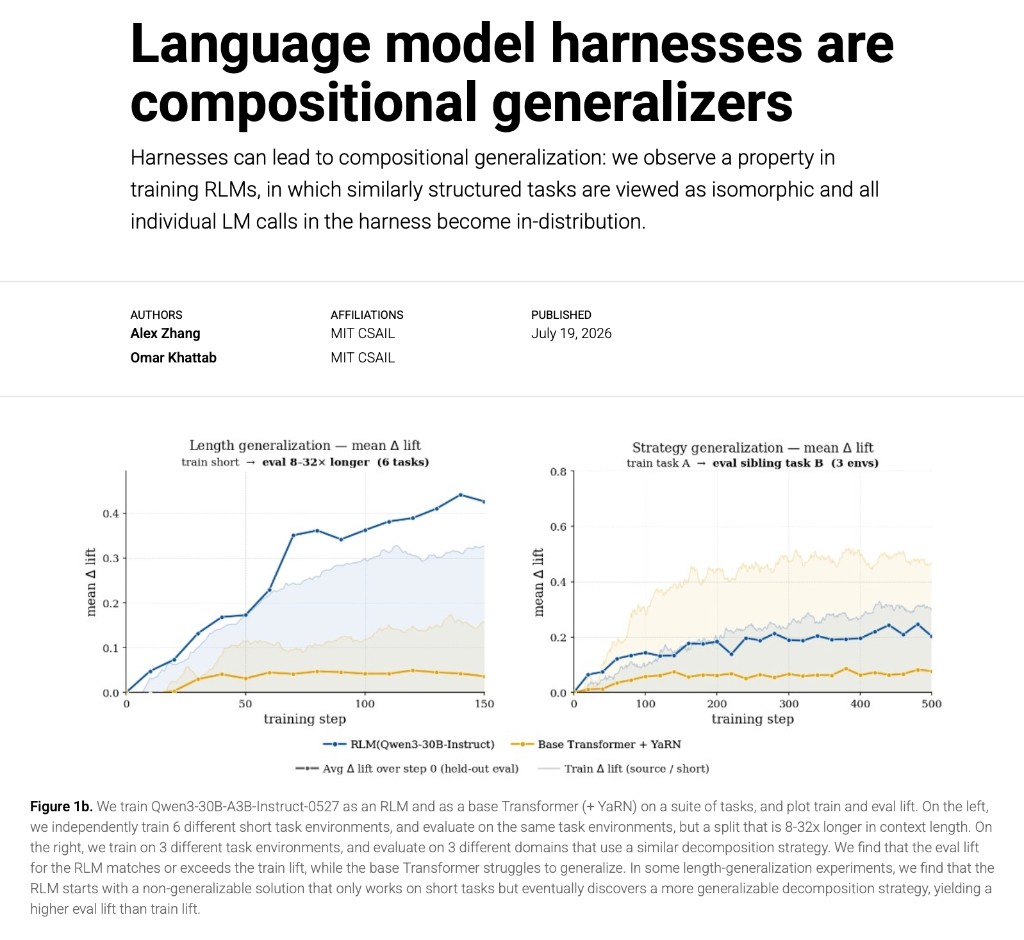
Harnesses can lead to compositional generalization: we observe a property in training RLMs, in which similarly structured tasks are viewed as isomorphic and all individual LM calls in the harness become in-distribution.
Language models struggle with compartmentalization
In the training data used by large language models (LLMs), the same latent concept is often presented in multiple distinct ways: the same facts appear in English and Swahili; many functions can be expressed in both Python and Haskell; we can express propositions in both formal and natural language. We show that LLMs can exhibit compartmentalization, where they fail to identify and share statistical strength between distinct presentations of unified concepts. In the worst case, LLMs simply learn parallel internal representations of each presentation of the concept, saturating model capacity with redundancies and decreasing sample efficiency with the number of such presentations. We also demonstrate that synthetic parallel data can fail to improve this despite being easily learned itself. Under this framework, we find that, for small models, early multilingual learning is nearly entirely compartmentalized. Finally, all interventions that we study exhibit a phase transition in which their effectiveness depends on the number of distinct presentations, suggesting that the language modeling objective may only inconsistently unify representations.

Recursive Language Models
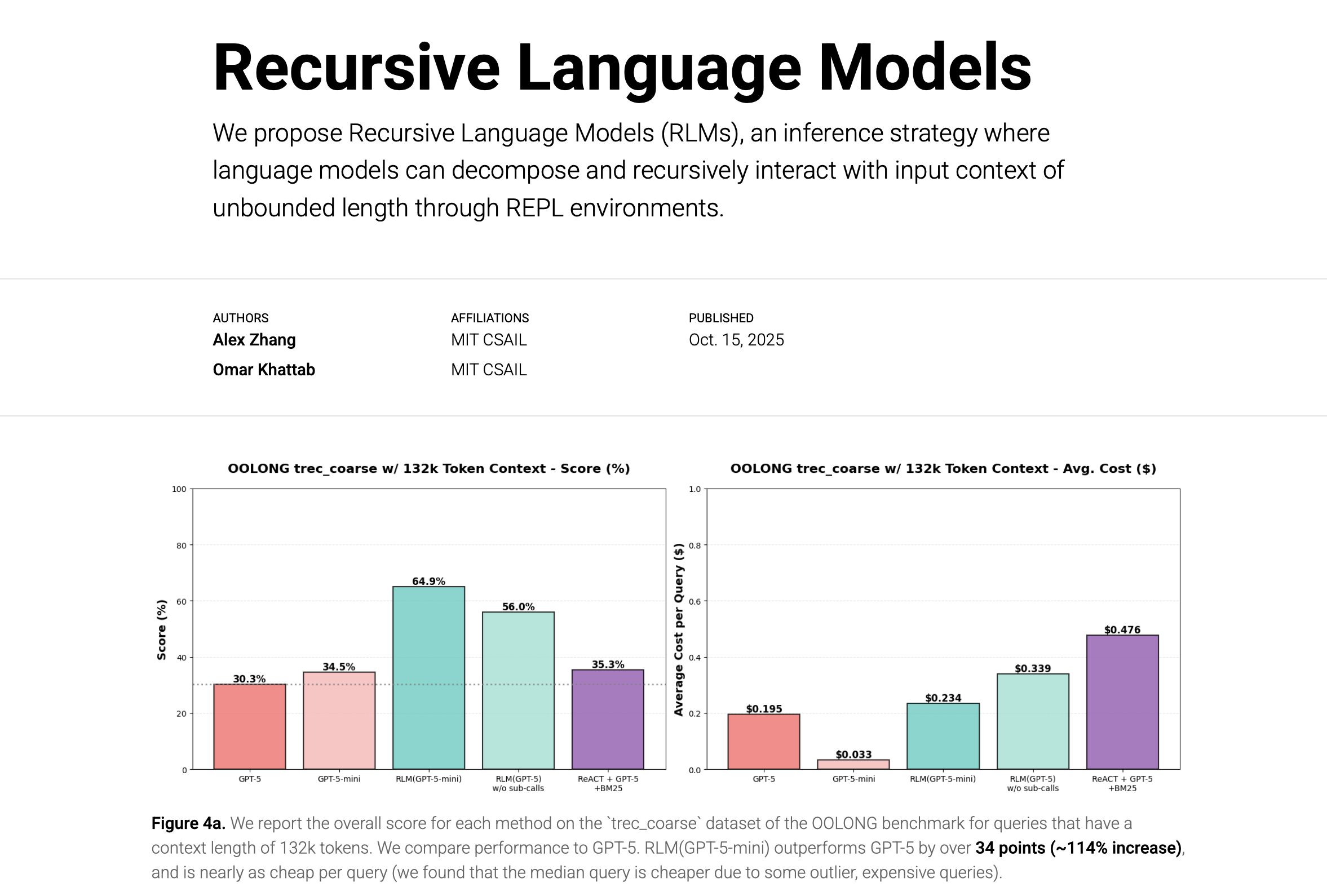
We propose Recursive Language Models (RLMs), an inference strategy where language models can decompose and recursively interact with input context of unbounded length through REPL environments.
Recursive Language Models
We study allowing large language models (LLMs) to process arbitrarily long prompts through the lens of inference-time scaling. We propose Recursive Language Models (RLMs), a general inference paradigm that treats long prompts as part of an external environment and allows the LLM to programmatically examine, decompose, and recursively call itself over snippets of the prompt. We find that RLMs can successfully process inputs up to two orders of magnitude beyond model context windows and, even for shorter prompts, dramatically outperform the quality of vanilla frontier LLMs and common long-context and coding scaffolds (e.g., on GPT-5 by a median across the evaluated benchmarks of $26\%$ against compaction, $130\%$ against CodeAct with sub-calls, and $13\%$ against Claude Code) across four diverse long-context tasks while having comparable cost. At a small scale, we post-train the first model around the RLM. Our model, RLM-Qwen3-8B, outperforms the underlying Qwen3-8B model by $28.3\%$ on average and even approaches the quality of vanilla GPT-5 on three long-context tasks. Code is available at https://github.com/alexzhang13/rlm.
An Observation on Generalization
Scaling Laws Across Model Architectures: A Comparative Analysis of...
The scaling of large language models (LLMs) is a critical research area for the efficiency and effectiveness of model training and deployment. Our work investigates the transferability and...
Small Language Models are the Future of Agentic AI
Large language models (LLMs) are often praised for exhibiting near-human performance on a wide range of tasks and valued for their ability to hold a general conversation. The rise of agentic AI systems is, however, ushering in a mass of applications in which language models perform a small number of specialized tasks repetitively and with little variation. Here we lay out the position that small language models (SLMs) are sufficiently powerful, inherently more suitable, and necessarily more economical for many invocations in agentic systems, and are therefore the future of agentic AI. Our argumentation is grounded in the current level of capabilities exhibited by SLMs, the common architectures of agentic systems, and the economy of LM deployment. We further argue that in situations where general-purpose conversational abilities are essential, heterogeneous agentic systems (i.e., agents invoking multiple different models) are the natural choice. We discuss the potential barriers for the adoption of SLMs in agentic systems and outline a general LLM-to-SLM agent conversion algorithm. Our position, formulated as a value statement, highlights the significance of the operational and economic impact even a partial shift from LLMs to SLMs is to have on the AI agent industry. We aim to stimulate the discussion on the effective use of AI resources and hope to advance the efforts to lower the costs of AI of the present day. Calling for both contributions to and critique of our position, we commit to publishing all such correspondence at https://research.nvidia.com/labs/lpr/slm-agents.
How linguistics learned to stop worrying and love the language models
Language models (LMs) can produce fluent, grammatical text. Nonetheless, some maintain that language models don’t really learn language and also, even if they did, that would not be informative for the study of human learning and processing. On the other side, there have been claims that the success of LMs obviates the need for studying linguistic theory and structure. We argue that both extremes are wrong. LMs can contribute to fundamental questions about linguistic structure, language processing, and learning. They force us to rethink arguments and ways of thinking that have been foundational in linguistics. While they do not replace linguistic structure and theory, they serve as model systems and working proofs of concept for gradient, usage-based approaches to language. We offer an optimistic take on the relationship between language models and linguistics.

The language of generalization.
Recursive Language Models: the paradigm of 2026
How we plan to manage extremely long contexts
.png?v=c8c07d4bf43b)
Mitigating Cross-Lingual Cultural Inconsistencies in LLMs via...
Despite their impressive capabilities, multilingual large language models (MLLMs) frequently exhibit inconsistent behaviour when the prompt's language changes. While such adaptation is generally...
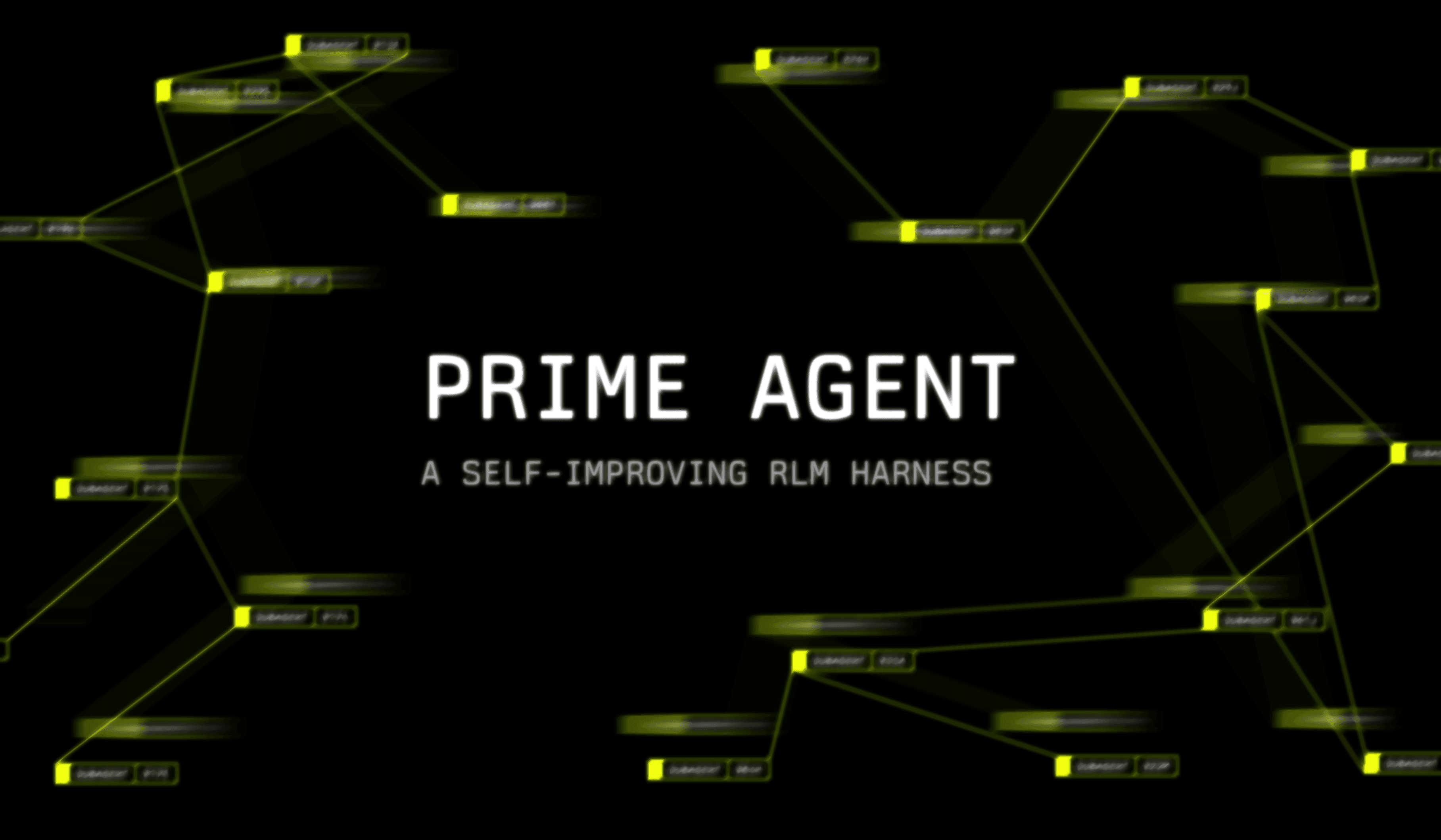
Prime Agent: A self-improving RLM agent
Prime Agent is our open-source, self-improving coding harness built around two abstractions: the Recursive Language Model (RLM) and the Continual Harness. With Opus 5, it achieves 95.5% on ARC-AGI-3, surpassing the reported human expert baseline.
Understanding Understanding: A Pragmatic Framework Motivated by...
Motivated by the rapid ascent of Large Language Models (LLMs) and debates about the extent to which they possess human-level qualities, we propose a framework for testing whether any agent (be it...
Is Model Collapse Inevitable? Breaking the Curse of Recursion by Accumulating Real and Synthetic Data
The proliferation of generative models, combined with pretraining on web-scale data, raises a timely question: what happens when these models are trained on their own generated outputs? Recent investigations into model-data feedback loops proposed that such loops would lead to a phenomenon termed model collapse, under which performance progressively degrades with each model-data feedback iteration until fitted models become useless. However, those studies largely assumed that new data replace old data over time, where an arguably more realistic assumption is that data accumulate over time. In this paper, we ask: what effect does accumulating data have on model collapse? We empirically study this question by pretraining sequences of language models on text corpora. We confirm that replacing the original real data by each generation's synthetic data does indeed tend towards model collapse, then demonstrate that accumulating the successive generations of synthetic data alongside the original real data avoids model collapse; these results hold across a range of model sizes, architectures, and hyperparameters. We obtain similar results for deep generative models on other types of real data: diffusion models for molecule conformation generation and variational autoencoders for image generation. To understand why accumulating data can avoid model collapse, we use an analytically tractable framework introduced by prior work in which a sequence of linear models are fit to the previous models' outputs. Previous work used this framework to show that if data are replaced, the test error increases with the number of model-fitting iterations; we extend this argument to prove that if data instead accumulate, the test error has a finite upper bound independent of the number of iterations, meaning model collapse no longer occurs.
Is Model Collapse Inevitable? Breaking the Curse of Recursion by Accumulating Real and Synthetic Data
The proliferation of generative models, combined with pretraining on web-scale data, raises a timely question: what happens when these models are trained on their own generated outputs? Recent investigations into model-data feedback loops proposed that such loops would lead to a phenomenon termed model collapse, under which performance progressively degrades with each model-data feedback iteration until fitted models become useless. However, those studies largely assumed that new data replace old data over time, where an arguably more realistic assumption is that data accumulate over time. In this paper, we ask: what effect does accumulating data have on model collapse? We empirically study this question by pretraining sequences of language models on text corpora. We confirm that replacing the original real data by each generation's synthetic data does indeed tend towards model collapse, then demonstrate that accumulating the successive generations of synthetic data alongside the original real data avoids model collapse; these results hold across a range of model sizes, architectures, and hyperparameters. We obtain similar results for deep generative models on other types of real data: diffusion models for molecule conformation generation and variational autoencoders for image generation. To understand why accumulating data can avoid model collapse, we use an analytically tractable framework introduced by prior work in which a sequence of linear models are fit to the previous models' outputs. Previous work used this framework to show that if data are replaced, the test error increases with the number of model-fitting iterations; we extend this argument to prove that if data instead accumulate, the test error has a finite upper bound independent of the number of iterations, meaning model collapse no longer occurs.
Emergence of Grounded Compositional Language in Multi-Agent Populations
By capturing statistical patterns in large corpora, machine learning has enabled significant advances in natural language processing, including in machine translation, question answering, and sentiment analysis. However, for agents to intelligently interact with humans, simply capturing the statistical patterns is insufficient. In this paper we investigate if, and how, grounded compositional language can emerge as a means to achieve goals in multi-agent populations. Towards this end, we propose a multi-agent learning environment and learning methods that bring about emergence of a basic compositional language. This language is represented as streams of abstract discrete symbols uttered by agents over time, but nonetheless has a coherent structure that possesses a defined vocabulary and syntax. We also observe emergence of non-verbal communication such as pointing and guiding when language communication is unavailable.
GLaM: Efficient Scaling of Language Models with Mixture-of-Experts
Scaling language models with more data, compute and parameters has driven significant progress in natural language processing. For example, thanks to scaling, GPT-3 was able to achieve strong results on in-context learning tasks. However, training these large dense models requires significant amounts of computing resources. In this paper, we propose and develop a family of language models named GLaM (Generalist Language Model), which uses a sparsely activated mixture-of-experts architecture to scale the model capacity while also incurring substantially less training cost compared to dense variants. The largest GLaM has 1.2 trillion parameters, which is approximately 7x larger than GPT-3. It consumes only 1/3 of the energy used to train GPT-3 and requires half of the computation flops for inference, while still achieving better overall zero-shot and one-shot performance across 29 NLP tasks.