


When you write about your work, it makes all of us smarter for the effort, including you. Done well, this kind of sharing means you’re contributing signal, instead of noise. But writers are made, n…
Writing is Thinking: Learning to Write with Confidence
Learning to write is learning to think, because writing is thinking. They are two peas in a powerful pod. This article goes over my writing process, focused on minimizing the activation energy to get started.


Writing by Hand is Good for your Brain - Here's how to do it
Because I am known to write using a fountain pen on paper, a number of people have pointed me to this post and its underlying research. I won’t rehash what is said in those sources, but the gist of it is that when you write things down by hand you’re recruiting more of your brain, which is a good thing.
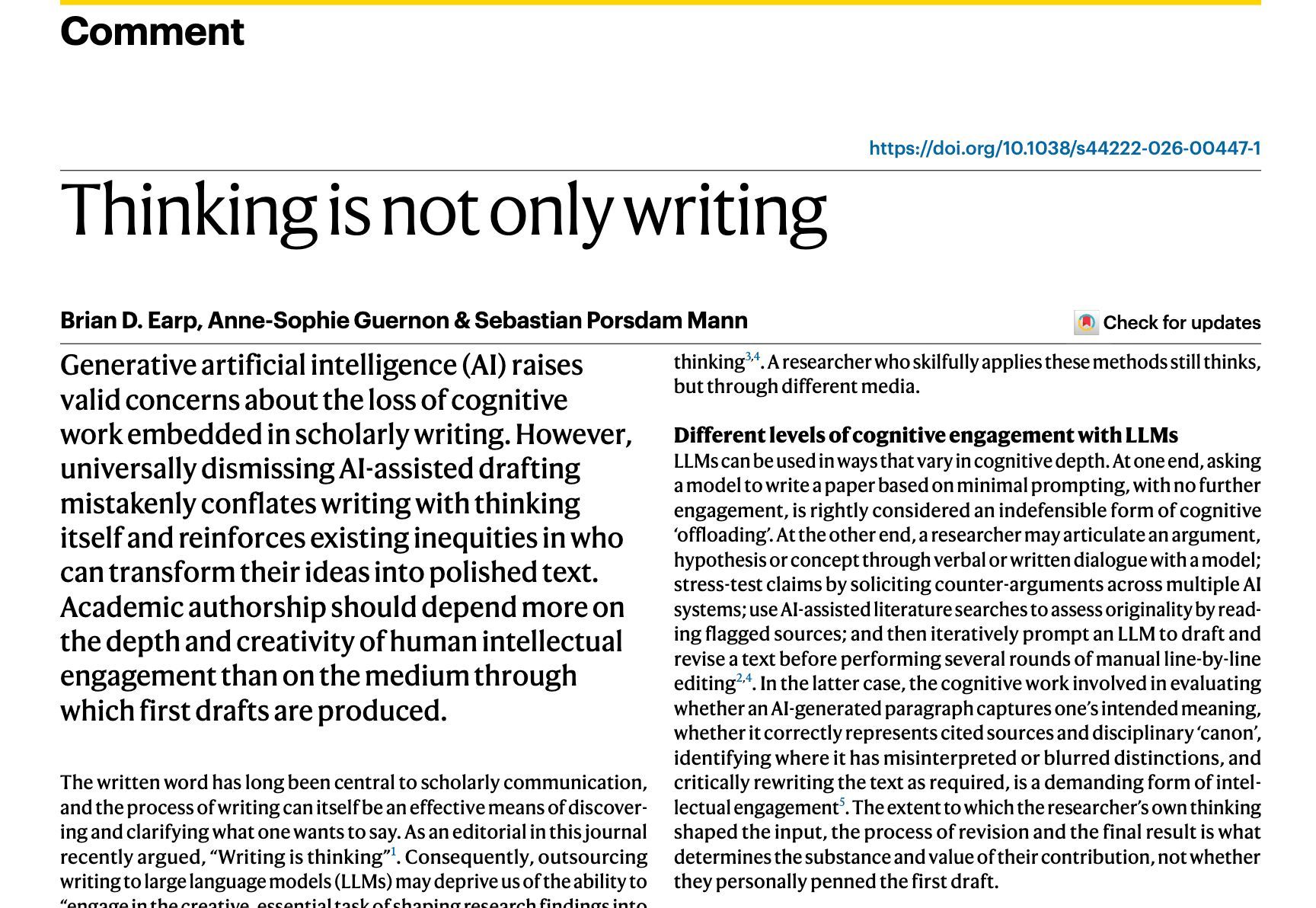
Thinking is not only writing
Generative artificial intelligence (AI) raises valid concerns about the loss of cognitive work embedded in scholarly writing. However, universally dismissing AI-assisted drafting mistakenly conflates writing with thinking itself and reinforces existing inequities in who can transform their ideas into polished text. Academic authorship should depend more on the depth and creativity of human intellectual engagement than on the medium through which first drafts are produced.
From bench to bot: Why AI-powered writing may not deliver on its promise
Efficiency isn’t everything. The cognitive work of struggling with prose may be a crucial part of what drives scientific progress.

Wherein I Find Myself Writing About Writing
Most everyone finds writing to be challenging (especially those who say they enjoy it). This is because writing is an intentional, thoughtful act. This is as it should be, but “AI” has recently exacerbated the misbelief that writing is simply an output. In fact, it's a creative process that has merit in and of itself.

Write Things Down
Writing things down is powerful, for humans and for AI; what comes first, however, is what to write, why to do it, and actually getting things done.

Writers Who Use AI Are Not Real Writers
Dorothy Parker famously (but probably not really) said, “I hate to write, but I love having written,” which is a sentiment I don’t largely understand or agree with in the broader …
The Golden Rule for Becoming a Better Writer - T.R Napper
I’m obsessed with the craft of writing. I write every day, I read about the craft often, and in my...

The social contract of writing | jola.dev
About the value of genuine writing in a world being drowned in slop.
Brian D. Earp, Ph.D. on Twitter / X
"Writing is thinking." This phrase went viral recently (from https://t.co/EQqohfhUMd), often quoted in the context of objections to use of AI in drafting academic prose. In Nature Reviews Bioengineering we respond: "Thinking is not only writing." Preview below. Shareable full… pic.twitter.com/cZtGdoSwqV— Brian D. Earp, Ph.D. (@briandavidearp) May 15, 2026
Writing With and Beyond AI: Fieldnotes from Computer-Mediated Poetry
Apr 10, 2026, 12:15 pm - Large language models can make writing mind-numbingly efficient — but the point of writing with AI should be to write what we couldn’t have written alone (without generating bland, derivative “slop”).

Why writing matters in remote work — Tim Casasola
In remote work, we communicate primarily through writing. We send messages in Slack. We document projects in Notion. We send meeting invites with a written description of the purpose. We’re writing all the time. Many organizations are working from home at the moment. Thus, writing is even

A.I. Is Homogenizing Our Thoughts
Recent studies suggest that tools such as ChatGPT make our brains less active and our writing less original.

How to write well with AI
Why people who pledge never to write with AI are telling on themselves

Writing Is Designing By Michael J. Metts & Andy Welfle
Discover how words shape UX with Writing Is Designing. Learn to craft clear, human-centered content for apps, chatbots, and software interfaces.
