


We introduce Deep Research Tulu (DR Tulu), an open post-training recipe and framework for long-form deep research agents.
OpenThoughts: Data Recipes for Reasoning Models — Ryan Marten, Bespoke Labs
swyx on Twitter / X
icymi, openai also open sourced how their deep research prompt rewriter works + the full prompts todayyou can now build your own deep research agent - with full o3/o4-mini deep research quality - in 20LOCif you're a fan of Claude Research they ALSO dropped how to add… pic.twitter.com/5moxXjzqTj— swyx (@swyx) June 27, 2025

Find Open Datasets for AI and Research | Kaggle
Browse and download hundreds of thousands of open datasets for AI research, model training, and analysis. Join a community of millions of researchers, developers, and builders to share and collaborate on Kaggle.
Turn 10,994 Notes Into Memory - Paul Iusztin, Decoding AI & Louis-François Bouchard, Towards AI
Deep-Research Agents Can Be Poisoned via User-Generated Content
Deep-research agents, i.e., systems that rely on multi-agent pipelines to iteratively retrieve, synthesize, and cite Web content in order to produce structured reports, are rapidly replacing...

OpenAI launches new AI model for life sciences research
Researchers are drowning in data. AI could help.
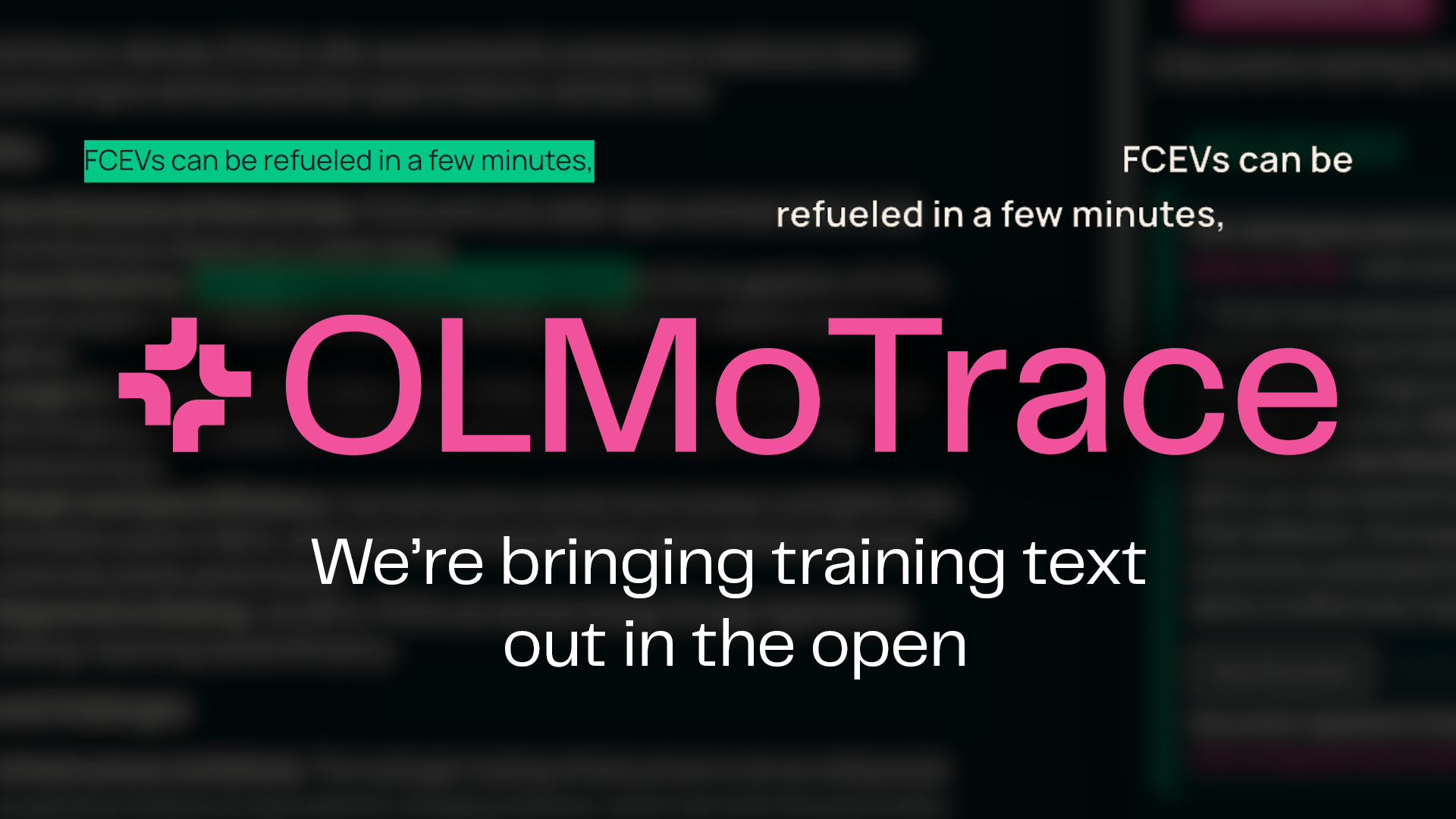
Going beyond open data – increasing transparency and trust in language models with OLMoTrace | Ai2
Ai2, a non-profit research institute founded by Paul Allen, is committed to breakthrough AI to solve the world’s biggest problems.
Jan-Nano : 1st Deep Research LLM
OpenScience.ai — Autonomous AI Research Agents
AI agents conducting reproducible scientific inquiry. Full provenance, executable notebooks, peer validation.

ScientistTwo: Pioneering the Human Knowledge Frontier with Autonomous AI
Scientific discovery is defined by the ability to identify the boundaries of existing knowledge and venture into unexplored territory. The ultimate vision for AI in science is problem-driven autonomous research: given a fundamental challenge by a human expert, the AI independently navigates the scientific landscape, uncovers theoretical and empirical bottlenecks, and systematically expands the frontier of knowledge. In this paper, we introduce ScientistTwo, a fully autonomous multi-agent framework designed to realize this vision. Specifically, ScientistTwo takes an initial problem as input, establishes state-of-the-art baselines, formulates novel hypotheses, and coordinates specialized agents to orchestrate an end-to-end discovery cycle without human intervention. Moreover, the framework rigorously conducts experiments using diverse datasets and metrics, refines methodologies through automated ablation studies, and validates research findings via a closed-loop simulated peer-review rebuttal engine. To evaluate ScientistTwo's capabilities against the highest standards of human scientific achievement, we benchmark it across papers accepted at top-tier conferences such as ICLR, ICML, and NeurIPS. As a result, ScientistTwo autonomously generates expert-level, publishable papers and fully verified, executable codebases. Its solutions consistently outperform human state-of-the-art models, and achieve higher average review ratings than human-authored papers under automated AI review agents. These results show that ScientistTwo is not merely an assistive tool but an autonomous scientific pioneer capable of pushing the frontiers of human discovery. Project website: https://scientist-two.github.io/
Deep Research, information vs. insight, and the nature of science
What AI will accelerate in the scientific process, what it cannot do, and how we can prepare for new manners of scientific investigation.
DeepMind Institute
Bold, well-evidenced thinking on AGI from the lab that pioneered the field. Read the latest essays from the DeepMind Institute.

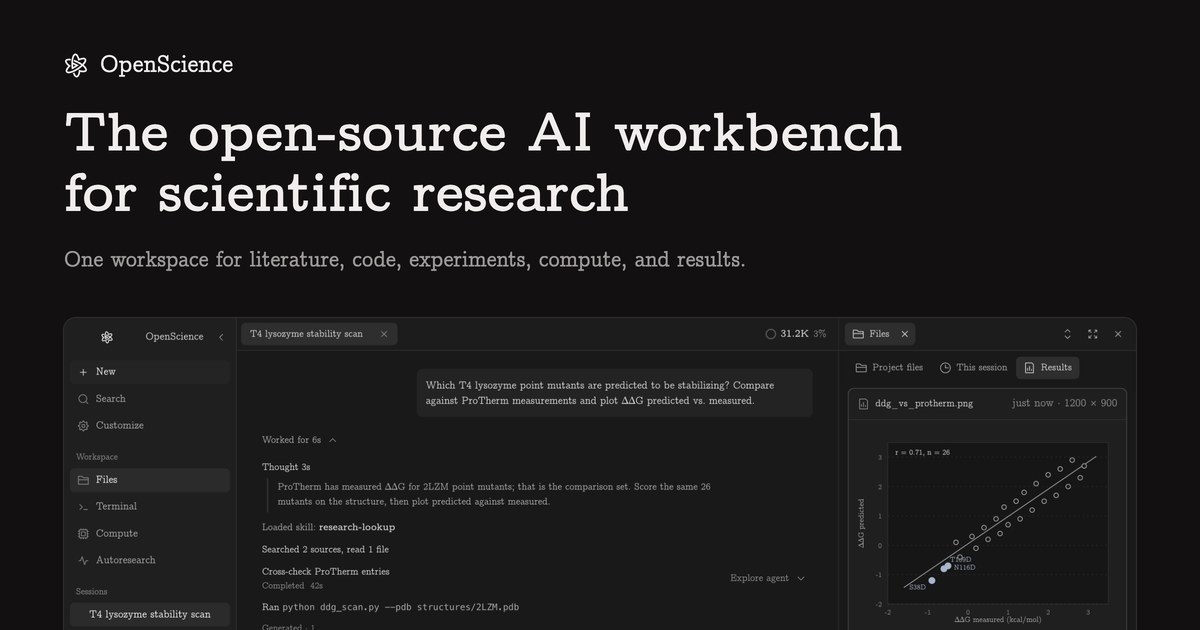
OpenScience | Open-source AI co-scientist for research
OpenScience is the open-source AI co-scientist. Free models included or connect any model from any provider, including Claude, GPT, Gemini and more.
Towards End-to-End Automation of AI Research
The automation of science is a long-standing ambition in the field of AI. While the community has made significant progress in automating individual components of the scientific process, a system that autonomously navigates the entire research lifecycle -- from conception to publication -- has remained out of reach. Here, we present the strongest demonstration to date toward automating the entire process end-to-end. We present The AI Scientist, which creates research ideas, writes code, runs experiments, plots and analyzes data, writes the entire scientific manuscript and performs its own peer review. Its ideas, execution, and presentation are of sufficient quality to produce a manuscript generated by an AI system that passes the first round of peer review at a major machine learning conference workshop. The workshop has an acceptance rate of 70 percent. Our system leverages modern foundation models within a complex agentic system. We evaluate The AI Scientist in two settings: a focused mode using human-provided code templates as an initial scaffold to conduct research on a specific topic, and a template-free, open-ended mode that leverages agentic search for wider scientific exploration. Both settings produce diverse ideas and automatically test, report on, and evaluate them. This achievement demonstrates AI's growing capacity for scientific contribution and signifies a potential paradigm shift in how research is conducted. As with any impactful new technology, there could be significant risks, including taxing overwhelmed review systems and adding noise to scientific literature. However, if developed responsibly, such autonomous systems could greatly accelerate scientific discovery.
