


Flanderization is the process of taking a single (often minor) action or trait of a character within a work and exaggerating it more and more over time until it...
Flâneur
Flâneur is a type of urban male "stroller", "lounger", "saunterer", or "loafer". This French term was popularized in the 19th century and has some nuanced additional meanings. Traditionally depicted as male, a flâneur is an ambivalent figure of urban affluence and modernity, representing the ability to wander detached from society, for an entertainment from the observation of the urban life. Flânerie is the act of strolling, with all of its accompanying associations. A near-synonym of the noun is boulevardier.


Food, foragers, and folklore: the role of narrative in human subsistence
Narrative is a species-typical, reliably developing, complex cognitive process whose design is unlikely to have emerged by chance. Moreover, the folklore record indicates that narrative content is consistent across widely divergent cultures. I have argued elsewhere that a storyteller may use narrative to manipulate an audience's representations of the social and/or physical environment to serve his or her own fitness ends. However, my subsequent research suggests that such manipulation results from a broader selection pressure which narrative effectively alleviates: information acquisition. By substituting verbal representations for potentially costly first-hand experience, narrative enables an individual to safely and efficiently acquire information pertinent to the pursuit of fitness in local habitats. If this hypothesis is true, narrative should be rich with information useful to the pursuit of fitness. One class of information integral to the accomplishment of this task is foraging knowledge. In this paper, then, I present evidence that foraging peoples use narrative to transmit subsistence information: specifically, I demonstrate how various narrative devices (e.g., setting, description, mimicry, anthropomorphism) are used to communicate foraging knowledge.
The Flâneur and Turtle on-a-leash: Exploring Flânerie as a Metaphorical Approach to Harmonizing Human-AI Interaction for Playful Placemaking
As part of the Digital Library's transition to Open Access, new features for researchers are available in the Premium Edition. Click here to learn more.

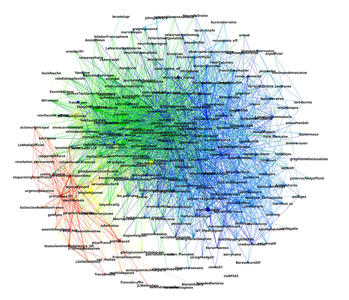
Extrême droite et complotisme, l’épreuve des chiffres | Reflets.info
Armé de quelques compétences techniques, il est possible de récupérer l’intégralité des conversations sur des boucles publiques du réseau social. Résultat: une enquête quantitative sur plus de 200 boucles de discussions,...
TV Tropes
TV Tropes, the all-devouring pop-culture wiki, catalogs and cross-references recurrent plot devices, archetypes, and tropes in all forms of media.

Revenge of the Dilettantes
Book club and AI adventures, age of bespokeness, study groups, new rules of engagement

Revenge of the Dilettantes
Book club and AI adventures, age of bespokeness, study groups, new rules of engagement
Ludonarrative dissonance
Ludonarrative dissonance is the conflict between a video game's narrative told through the non-interactive elements and the narrative told through the gameplay. Ludonarrative refers to the intersection of a video game's ludic elements (gameplay) and narrative elements. The term was coined by game designer Clint Hocking in 2007 in a blog post.

Entretien avec Jérôme Gautié et Denis Ferrand : « Le tassement des salaires est générateur de fortes frustrations »
[Le Smic à perpétuité ?] Les économistes Denis Ferrand et Jérôme Gautié dégonflent la dramatisation du débat autour de la « smicardisation » mais s’inquiètent …

Metacrisis - an Introduction | Metacrisis
In an era defined by global catastrophic risk, polycrisis describes a collection of escalating crises and their complex interactions. Metacrisis points to the common, foundational conditions that generate and sustain these crises.This site offers an accessible introduction to metacrisis: what it is, how it relates to polycrisis, and why it matters. The emphasis is on clarity and rigor rather than drama: presenting the key ideas in a calm, factual way.

Home - FLI Worldbuilding Contest
It is frequently practiced by creative writers and scriptwriters, providing the context and backdrop for stories that take place in future, fantasy or alternative realities. Worldbuilding is a tool that can help us explore possible futures for our own world. It helps us better understand what sorts of worlds we may find more or less desirable, and how we might get to there. World builds don’t always have to be grounded in reality, but for our worldbuilding contest we asked contestants to make their imagined worlds plausible and aspirational. To better understand the constraints and ground rules that were used for this contest, visit the Rules page prior to exploring the worlds.
Setting aside all the absurdity of thinking we need to have scientific papers with risks of hallucination, I'm flabbergasted this was taken as sufficiently novel to warrant publication in Nature. It's just sort of stitching things together with MCP...

Ran Blekhman
This is the future of scientific papers. Instead of a PDF, the paper is an AI agent that you can talk to, ask questions, run analyses. No more digging through supplements - just ask the paper directly: "what p-value cutoff was used in Fig 3B? Re-run at 0.01." nature.com/articles/s41586-026-11044-y
