Large language models (LLMs) trained predominantly on English data encode substantial world knowledge, yet often fail to express it reliably in other languages, a phenomenon known as cross-lingual...
Cross-Lingual Exploration for Parametric Knowledge | Idan Szpektor
Accepted to EMNLP Findings! While Large Language Models encode vast amounts of multicultural and factual information, this parametric knowledge is often unevenly accessible across languages. Standard inference frequently fails to surface localized facts, creating persistent gaps in cross-lingual knowledge transfer and consistency. We address this challenge in our paper "Cross-Lingual Exploration for Parametric Knowledge" (https://lnkd.in/drf36bV7), a collaboration between Elisha Diskind, Itamar Trainin, and Omri Abend from The Hebrew University of Jerusalem, Leshem Choshen from the Weizmann Institute of Science, alongside Uri Shaham and myself from our Google Research IL group. We formalize cross-lingual exploration as a structured search process across four core dimensions: language selection, exploration routing, answer aggregation, and inference budget. Evaluating across 17 typologically diverse languages on the ECLeKTic and CLIKE benchmarks, we show that allowing models to autonomously navigate alternative linguistic paths yields up to a 21% gain in knowledge transfer and a 16% boost in factual recall over native baselines, surpassing both standard English-pivot routing and native-language reasoning. Crucially, cross-lingual exploration defines a significantly more efficient compute Pareto frontier than scaling within the native query language, while driving intrinsic cross-lingual consistency gains beyond what accuracy improvements alone explain. Technically, this moves the needle for multilingual inference and knowledge elicitation pipelines, demonstrating that strategic language switching is a powerful, training-free mechanism for unlocking latent parametric knowledge.

Mitigating Cross-Lingual Cultural Inconsistencies in LLMs via...
Despite their impressive capabilities, multilingual large language models (MLLMs) frequently exhibit inconsistent behaviour when the prompt's language changes. While such adaptation is generally...

Post-Training Language Models for Crosslingual Consistency
Language models often respond inconsistently to translation-equivalent prompts across languages, undermining the reliability of multilingual systems. To quantify this, we give an information-theoretic definition of crosslingual consistency as a divergence bound between a model's response distribution and its round-trip pushforward across languages. We then introduce penalized consistency optimization (PCO), a post-training procedure that couples this divergence with a Kullback-Leibler penalty to a fixed reference language model. Because direct optimization of PCO requires expensive on-policy roll-outs, we propose a tractable surrogate, direct consistency optimization (DCO), which can be optimized off-policy. Across diverse language models and 26 languages, DCO significantly improves crosslingual consistency, outperforms existing methods, and enables targeted alignment of low-resource languages.
Learning to Route Languages for Multilingual Policy Optimization
Large language models~(LLMs) are trained on heterogeneous multilingual corpora, yet existing policy optimization methods often implicitly restrict each training question to a single response language or rely on a fixed dominant language for supervision. We propose language-routed policy optimization (LRPO), an online policy optimization framework that treats language as a selectable variable. LRPO elicits multilingual rollouts for each training question and integrates their relative quality into preference-based policy updates, increasing the diversity and informativeness of training signals under the fixed rollout budget. To adaptively determine which languages to explore during reinforcement learning, we introduce a trainable language router formulated as a multi-armed bandit, balancing exploration of underutilized languages with exploitation of more informative ones. Extensive experiments show that LRPO consistently improves multilingual performance, demonstrating that adaptive language routing enables effective cross-lingual knowledge exploitation for training. We release all the resources at https://github.com/Guochry/LRPO.
Cross-Lingual Exploration for Parametric Knowledge
Parametric knowledge in Large Language Models is not equally accessible across languages. As a result, standard inference techniques often struggle to surface localized facts, leading to failures in...
LLM in a Flash: Efficient Large Language Model Inference with Limited Memory
Large language models (LLMs) are central to modern natural language processing, delivering exceptional performance in various tasks…

Language models struggle with compartmentalization
In the training data used by large language models (LLMs), the same latent concept is often presented in multiple distinct ways: the same facts appear in English and Swahili; many functions can be expressed in both Python and Haskell; we can express propositions in both formal and natural language. We show that LLMs can exhibit compartmentalization, where they fail to identify and share statistical strength between distinct presentations of unified concepts. In the worst case, LLMs simply learn parallel internal representations of each presentation of the concept, saturating model capacity with redundancies and decreasing sample efficiency with the number of such presentations. We also demonstrate that synthetic parallel data can fail to improve this despite being easily learned itself. Under this framework, we find that, for small models, early multilingual learning is nearly entirely compartmentalized. Finally, all interventions that we study exhibit a phase transition in which their effectiveness depends on the number of distinct presentations, suggesting that the language modeling objective may only inconsistently unify representations.
Large language model
A large language model (LLM) is a neural network trained on a vast amount of text for natural language processing tasks, especially language generation. LLMs can typically generate, summarize, translate, and analyze text in many contexts, and are a foundational technology behind modern chatbots.[1] Biased or inaccurate training data can make an LLM's output less reliable.[2]
On the Way to LLM Personalization: Learning to Remember User Conversations
This paper was accepted at the Workshop on Large Language Model Memorization (L2M2) 2025. Large Language Models (LLMs) have quickly become…
When Trivia Is Not Trivial: Everyday Knowledge Failures in Multilingual LLMs
Quiz rooms, trivia nights, and quiz shows challenge human knowledge across a wide range of topics, from canonical facts to everyday culture. In this paper, we examine whether large language models (LLMs) can perform competitively in such settings, using quiz-style questions to test them on both common and niche topics. We introduce TriviaRoomQA, a multilingual benchmark designed to evaluate everyday, culturally grounded, and long-tail knowledge across 288 topics. The benchmark contains 3,300 parallel multiple-choice questions in six European languages and additional 5,340 French-only questions for a more fine-grained case study. We evaluate 30 open-weight LLMs from European, Asian, and North American providers, covering models from 7 to 70B parameters. We find that models are strong on knowledge-intensive topics such as history, geography, and mathematics, but substantially weaker on everyday popular-culture topics such as celebrities, music, movies, and news. Moreover, model performance varies across languages even for the same underlying questions, suggesting that access to factual knowledge is not always language-independent. In sum, our dataset and experiments demonstrate an important knowledge gap which is not captured by existing academic-based saturated benchmarks.
What and Whose Knowledge? Measuring Epistemic Diversity in Large Language Models
Large language models (LLMs) are increasingly used as primary knowledge sources, yet their epistemic diversity - defined as the diversity of real-world claims in their outputs - has never been measured. Low epistemic diversity would pose a risk of knowledge collapse as homogeneous LLMs mediate a shrinking in the range of accessible information over time. The dominant paradigm is that overall LLM diversity is low, but this is always with respect to a single point in time, with no reference baseline or consideration for variation across countries. We address this gap in knowledge by performing the first systematic study of epistemic diversity in LLMs across time and cultural context, testing 27 LLMs on 155 topics covering 12 countries, resulting in 1.7M responses and 70M individual claims. We find that epistemic diversity has increased substantially over the past three years, a positive counter to recent diversity pessimism. However, despite progress, we find that every system is less diverse than a search baseline. This gap is not uniform: RAG can improve diversity, while large models are counterintuitively less diverse than smaller ones. Moreover, LLM parametric knowledge systematically reflects English over local-language knowledge for country specific topics. Together, these results demonstrate that while progress on epistemic diversity is tangible, it is insufficient and unevenly distributed.
Hypothesis generation and updating in large language models
Large language models (LLMs) increasingly help people solve problems, from debugging code to repairing machinery. This process requires generating plausible hypotheses from partial descriptions,...
Rethinking the Multilingual Reasoning Gap with Layer Swap
Recent reasoning Large Language Models produce a chain-of-thought (CoT) predominantly in English, even when prompted in non-English languages. Prior work suggests that forcing the CoT to remain in the input language (\emph{native reasoning}) substantially degrades performance relative to allowing the model to reason in English before answering in the input language (\emph{English-pivoted reasoning}). However, most studies of this native reasoning gap rely on inference-time interventions or limited native-language training data. We revisit this comparison at a larger scale and under comparable supervision. We construct long multilingual reasoning datasets across six languages (English, French, German, Spanish, Chinese and Swahili); fine-tune specialists in both native and English-pivoted regimes on top of \texttt{Qwen/Qwen3-8B-Base}, and evaluate across mathematics, science, general knowledge, and code. In this setting, the average native reasoning gap shrinks to 1.9--3.5\% across the five non-English languages, considerably smaller than previously reported. Weight-space analysis of the native specialists reveals aligned fine-tuning updates in the middle layers and divergence in the outer layers. This points to a largely language-agnostic reasoning core surrounded by language-specific layers. Exploiting this structure, we introduce a Layer Swap: transferring the English specialist's stronger reasoning mid-layers into each native specialist, closing most of the native reasoning gap across the five non-English languages while preserving CoT in the target language. We release all models and datasets.
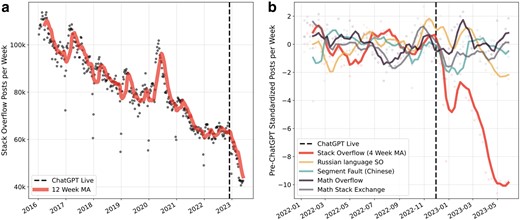
Large language models reduce public knowledge sharing on online Q&A platforms
Abstract. Large language models (LLMs) are a potential substitute for human-generated data and knowledge resources. This substitution, however, can present
The Case Against LLMs as Rerankers
Authors: Apoorva Joshi, Zhenmei Shi, Akshay Goindani, Hong LiuResearch Leads: Zhenmei Shi, Akshay Goindani, Hong Liu Large language models are increasingly being used for a broad range of tasks, in…

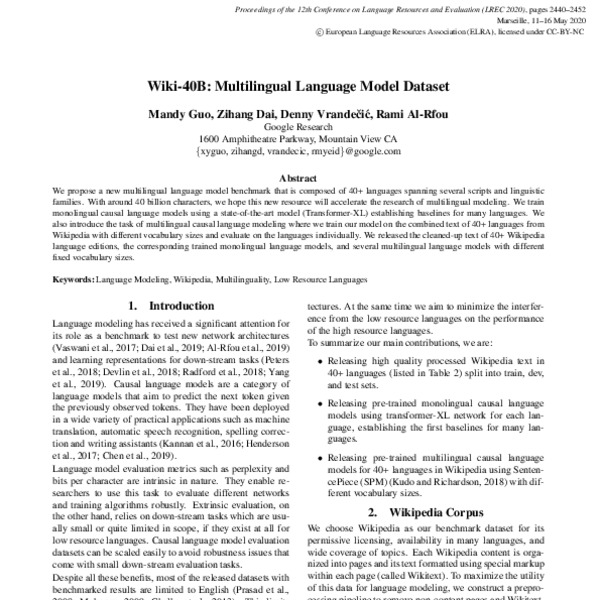
Wiki-40B: Multilingual Language Model Dataset
We propose a new multilingual language model benchmark that is composed of 40+ languages spanning several scripts and linguistic families. With around 40 billion characters, we hope this new resource will accelerate the research of multilingual modeling. We train monolingual causal language models using a state-of-the-art model (Transformer-XL) establishing baselines for many languages. We also introduce the task of multilingual causal language modeling where we train our model on the combined text of 40+ languages from Wikipedia with different vocabulary sizes and evaluate on the languages individually. We released the cleaned-up text of 40+ Wikipedia language editions, the corresponding trained monolingual language models, and several multilingual language models with different fixed vocabulary sizes.