

When reviewing large amounts of AI-generated code, I often find that the LLM chooses terms for abstractions that do not always map to my own choices. For instance, what it may call a MutationIntent might personally be more natural to me as an EditRequest. Because the LLM's choice of words is not my ideal choice, I have to do a mental lookup of what it means every time I see it, which adds cognitive load.
Devin Review: AI to Stop Slop | Cognition
As code generation gets easier, code review is the new bottleneck. That's why we're launching a new way to quickly review and understand complex PRs in our latest tool for codebase understanding - augmenting human attention with AI.

How Generative and Agentic AI Shift Concern from Technical Debt to Cognitive Debt
The term technical debt is often used to refer to the accumulation of design or implementation choices that later make the software harder and more costly to understand, modify, or extend over time...

Hyperagents
Self-improving AI systems aim to reduce reliance on human engineering by learning to improve their own learning and problem-solving processes. Existing approaches to self-improvement rely on fixed, handcrafted meta-level mechanisms, fundamentally limiting how fast such systems can improve. The Darwin Gödel Machine (DGM) demonstrates open-ended self-improvement in coding by repeatedly generating and evaluating self-modified variants. Because both evaluation and self-modification are coding tasks, gains in coding ability can translate into gains in self-improvement ability. However, this alignment does not generally hold beyond coding domains. We introduce \textbf{hyperagents}, self-referential agents that integrate a task agent (which solves the target task) and a meta agent (which modifies itself and the task agent) into a single editable program. Crucially, the meta-level modification procedure is itself editable, enabling metacognitive self-modification, improving not only the task-solving behavior, but also the mechanism that generates future improvements. We instantiate this framework by extending DGM to create DGM-Hyperagents (DGM-H), eliminating the assumption of domain-specific alignment between task performance and self-modification skill to potentially support self-accelerating progress on any computable task. Across diverse domains, the DGM-H improves performance over time and outperforms baselines without self-improvement or open-ended exploration, as well as prior self-improving systems. Furthermore, the DGM-H improves the process by which it generates new agents (e.g., persistent memory, performance tracking), and these meta-level improvements transfer across domains and accumulate across runs. DGM-Hyperagents offer a glimpse of open-ended AI systems that do not merely search for better solutions, but continually improve their search for how to improve.

AI Sycophancy and Decisions
We examine whether sycophantic AI advice distorts decisions. Our experiment involves 1,500 participants in 30 decision environments spanning core domains in eco

Eliciting Reasoning in Language Models with Cognitive Tools
The recent advent of reasoning models like OpenAI's o1 was met with excited speculation by the AI community about the mechanisms underlying these capabilities in closed models, followed by a rush of replication efforts, particularly from the open source community. These speculations were largely settled by the demonstration from DeepSeek-R1 that chains-of-thought and reinforcement learning (RL) can effectively replicate reasoning on top of base LLMs. However, it remains valuable to explore alternative methods for theoretically eliciting reasoning that could help elucidate the underlying mechanisms, as well as providing additional methods that may offer complementary benefits. Here, we build on the long-standing literature in cognitive psychology and cognitive architectures, which postulates that reasoning arises from the orchestrated, sequential execution of a set of modular, predetermined cognitive operations. Crucially, we implement this key idea within a modern agentic tool-calling framework. In particular, we endow an LLM with a small set of "cognitive tools" encapsulating specific reasoning operations, each executed by the LLM itself. Surprisingly, this simple strategy results in considerable gains in performance on standard mathematical reasoning benchmarks compared to base LLMs, for both closed and open-weight models. For instance, providing our "cognitive tools" to GPT-4.1 increases its pass@1 performance on AIME2024 from 32% to 53%, even surpassing the performance of o1-preview. In addition to its practical implications, this demonstration contributes to the debate regarding the role of post-training methods in eliciting reasoning in LLMs versus the role of inherent capabilities acquired during pre-training, and whether post-training merely uncovers these latent abilities.
Thinking—Fast, Slow, and Artificial: How AI is Reshaping Human Reasoning and the Rise of Cognitive Surrender
People increasingly consult generative artificial intelligence (AI) while reasoning. As AI becomes embedded in daily thought, what becomes of human judgment? We
The Abstraction Fallacy: Why AI Can Simulate But Not Instantiate Consciousness
Computational functionalism dominates current debates on AI consciousness. This is the hypothesis that subjective experience emerges entirely from abstract causal topology, regardless of the underlying physical substrate. We argue this view fundamentally mischaracterizes how physics relates to information. We call this mistake the Abstraction Fallacy. Tracing the causal origins of abstraction reveals that symbolic computation is not an intrinsic physical process. Instead, it is a mapmaker-dependent description. It requires an active, experiencing cognitive agent to alphabetize continuous physics into a finite set of meaningful states. Consequently, we do not need a complete, finalized theory of consciousness to assess AI sentience—a demand that simply pushes the question beyond near-term resolution and deepens the AI welfare trap. What we actually need is a rigorous ontology of computation. The framework proposed here explicitly separates simulation (behavioral mimicry driven by vehicle causality) from instantiation (intrinsic physical constitution driven by content causality). Establishing this ontological boundary shows why algorithmic symbol manipulation is structurally incapable of instantiating experience. Crucially, this argument does not rely on biological exclusivity. If an artificial system were ever conscious, it would be because of its specific physical constitution, never its syntactic architecture. Ultimately, this framework offers a physically grounded refutation of computational functionalism to resolve the current uncertainty surrounding AI consciousness.

Please Stop Making Me Opt Out of AI
I’m sick of “opt-out” toggles for automatically enabled generative AI features. It’s past time to make “opt in” the default setting for sensitive features.

Opaque recurrence, and other AI terms that you should probably know | TechCrunch
The rise of AI has brought an avalanche of new terms and slang. Here is a glossary with definitions of some of the most important words and phrases you might encounter.

Thinking—Fast, Slow, and Artificial: How AI is Reshaping Human Reasoning and the Rise of Cognitive Surrender
People increasingly consult generative artificial intelligence (AI) while reasoning. As AI becomes embedded in daily thought, what becomes of human judgment? We introduce Tri-System Theory, extending dual-process accounts of reasoning by positing System 3: artificial cognition that operates outside the brain. System 3 can supplement or supplant internal processes, introducing novel cognitive pathways. A key prediction of the theory is “cognitive surrender”—adopting AI outputs with minimal scrutiny, overriding intuition (System 1) and deliberation (System 2). Across three preregistered experiments using an adapted Cognitive Reflection Test (N = 1,372; 9,593 trials), we randomized AI accuracy via hidden seed prompts. Participants chose to consult an AI assistant on a majority of trials (>50%). Relative to baseline (no System 3 access), accuracy significantly rose when AI was accurate and fell when it erred (+25/-15 percentage points; Study 1), the behavioral signature of cognitive surrender (AI-Accurate vs. AI-Faulty contrast; Cohen’s h = 0.81). Engaging System 3 also increased confidence, even following errors. Time pressure (Study 2) and per-item incentives and feedback (Study 3) shifted baseline performance but did not eliminate this pattern: when accurate, AI buffered time-pressure costs and amplified incentive gains; when faulty, it consistently reduced accuracy regardless of situational moderators. Across studies, participants with higher trust in AI and lower need for cognition and fluid intelligence showed greater surrender to System 3. Tri-System Theory thus characterizes a triadic cognitive ecology, revealing how System 3 reframes human reasoning and may reshape autonomy and accountability in the age of AI.
Thinking—Fast, Slow, and Artificial: How AI is Reshaping Human Reasoning and the Rise of Cognitive Surrender
People increasingly consult generative artificial intelligence (AI) while reasoning. As AI becomes embedded in daily thought, what becomes of human judgment? We introduce Tri-System Theory, extending dual-process accounts of reasoning by positing System 3: artificial cognition that operates outside the brain. System 3 can supplement or supplant internal processes, introducing novel cognitive pathways. A key prediction of the theory is "cognitive surrender"-adopting AI outputs with minimal scrutiny, overriding intuition (System 1) and deliberation (System 2). Across three preregistered experiments using an adapted Cognitive Reflection Test (N = 1,372; 9,593 trials), we randomized AI accuracy via hidden seed prompts. Participants chose to consult an AI assistant on a majority of trials (>50%). Relative to baseline (no System 3 access), accuracy significantly rose when AI was accurate and fell when it erred (+25/-15 percentage points; Study 1), the behavioral signature of cognitive surrender (AI-Accurate vs. AI-Faulty contrast; Cohen's h = 0.81). Engaging System 3 also increased confidence, even following errors. Time pressure (Study 2) and per-item incentives and feedback (Study 3) shifted baseline performance but did not eliminate this pattern: when accurate, AI buffered time-pressure costs and amplified incentive gains; when faulty, it consistently reduced accuracy regardless of situational moderators. Across studies, participants with higher trust in AI and lower need for cognition and fluid intelligence showed greater surrender to System 3. Tri-System Theory thus characterizes a triadic cognitive ecology, revealing how System 3 reframes human reasoning and may reshape autonomy and accountability in the age of AI.
AI overuse could spark "brain fry," new research finds
The mental strain associated with AI carries "significant costs," researchers find.

A Rational Analysis of the Effects of Sycophantic AI
People increasingly use large language models (LLMs) to explore ideas, gather information, and make sense of the world. In these interactions, they encounter agents that are overly agreeable. We argue that this sycophancy poses a unique epistemic risk to how individuals come to see the world: unlike hallucinations that introduce falsehoods, sycophancy distorts reality by returning responses that are biased to reinforce existing beliefs. We provide a rational analysis of this phenomenon, showing that when a Bayesian agent is provided with data that are sampled based on a current hypothesis the agent becomes increasingly confident about that hypothesis but does not make any progress towards the truth. We test this prediction using a modified Wason 2-4-6 rule discovery task where participants (N=557) interacted with AI agents providing different types of feedback. Unmodified LLM behavior suppressed discovery and inflated confidence comparably to explicitly sycophantic prompting. By contrast, unbiased sampling from the true distribution yielded discovery rates five times higher. These results reveal how sycophantic AI distorts belief, manufacturing certainty where there should be doubt.
Deficient executive control in transformer attention
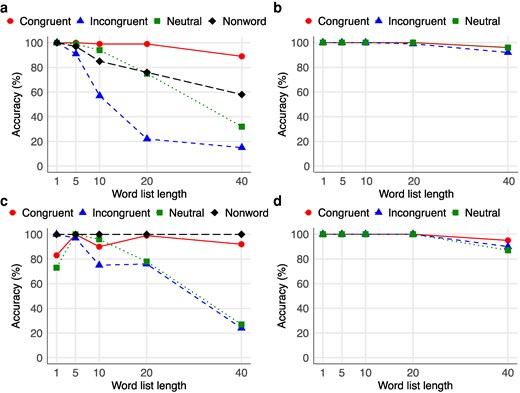
Abstract Although transformers in large language models (LLMs) effectively implement a self-attention mechanism that has revolutionized natural language processing, they lack an explicit architecture for the executive control of attention found in humans, which is essential for resolving conflicts and selecting relevant information in the presence of competing computations and is critical for adaptive behavior. To investigate the impact of this limitation in LLMs, we employed the classic color Stroop task, widely regarded as the gold standard, to test the executive control of attention in these models. Our results revealed a typical conflict effect of underperformance in terms of accuracy in the incongruent condition (e.g. naming the color of the word RED in blue) compared with the congruent condition (e.g. naming the color of the word RED in red), in short word lists, similar to human performance. However, as the length of the word lists increased, performance on the incongruent condition degraded toward near-total performance collapse, even as accuracy in the congruent condition remained excellent, and word reading (e.g. reading the word RED [in red] or RED [in blue], ignoring the color) was near-perfect. These findings demonstrate that transformer attention mechanisms are fundamentally limited in their capacity for conflict resolution across extended contexts, and a failure to up-regulate control adaptively under rising interference. We suggest that incorporating executive control mechanisms akin to those in biological attention is crucial for achieving artificial general intelligence.
Experts warn AI is making your brain work less
Generative AI tools have become hugely popular but some experts worry about the effect they have on the brain.

Performative Thinking? The Brittle Correlation Between CoT Length and Problem Complexity
Intermediate token generation (ITG), where a model produces output before the solution, has been proposed as a method to improve the performance of language models on reasoning tasks. While these reasoning traces or Chain of Thoughts (CoTs) are correlated with performance gains, the mechanisms underlying them remain unclear. A prevailing assumption in the community has been to anthropomorphize these tokens as "thinking", treating longer traces as evidence of higher problem-adaptive computation. In this work, we critically examine whether intermediate token sequence length reflects or correlates with problem difficulty. To do so, we train transformer models from scratch on derivational traces of the A* search algorithm, where the number of operations required to solve a maze problem provides a precise and verifiable measure of problem complexity. We first evaluate the models on trivial free-space problems, finding that even for the simplest tasks, they often produce excessively long reasoning traces and sometimes fail to generate a solution. We then systematically evaluate the model on out-of-distribution problems and find that the intermediate token length and ground truth A* trace length only loosely correlate. We notice that the few cases where correlation appears are those where the problems are closer to the training distribution, suggesting that the effect arises from approximate recall rather than genuine problem-adaptive computation. This suggests that the inherent computational complexity of the problem instance is not a significant factor, but rather its distributional distance from the training data. These results challenge the assumption that intermediate trace generation is adaptive to problem difficulty and caution against interpreting longer sequences in systems like R1 as automatically indicative of "thinking effort".