


Amp uses the best model for each task: leading generalist foundation models for complex reasoning and planning, and smaller specialized models for fast, accurate responses in specific domains.
Crafting a good (reasoning) model
A recent talk I gave on model training, reasoning, and the next frontier.

Mental Models: The Best Way to Make Intelligent Decisions (~100 Models Explained)
The smartest people in the world use mental models to make intelligent decisions, avoid stupidity, and increase productivity. Let's take a look at how ...

The Great Mental Models
The Great Mental Models project is the clearest way to change the way you see the world, avoid problems before they happen, and make better decisions.

A taxonomy for next-generation reasoning models
Where we've been and where we're going with RLVR.

The Hitchhiker's Guide to Agentic AI: From Foundations to Systems
The Hitchhiker's Guide to Agentic AI is a comprehensive practitioner's reference for building autonomous AI systems. The book covers the full stack from first principles to production deployment, organized around a central thesis: building great agentic systems requires understanding every layer of the pipeline, not just one. The book opens with the LLM substrate -- transformer architecture, GPU systems, training and fine-tuning (SFT,LoRA, MoE), model compression, and inference optimization -- treated as essential foundations rather than the primary focus. It then develops the alignment and reasoning layer: reinforcement learning from human feedback (RLHF), PPO, DPO and its variants, GRPO, reward modeling, and RL for large reasoning models including chain-of-thought and test-time scaling. The second half is devoted to agentic AI proper. Topics include agentic training and trajectory-based RL, retrieval-augmented generation (RAG and Agentic RAG), memory systems (in-context, external, episodic, and semantic), agent harness design and context management, and a taxonomy of agent design patterns. Inter-agent coordination is covered in depth: the Model Context Protocol (MCP), agent skills and tool use, the Agent-to-Agent (A2A) communication protocol, and multi-agent architectures spanning centralized, decentralized, and hierarchical topologies. The book concludes with agent development frameworks, agentic UI design, evaluation methodology for agentic tasks, and production deployment. Each chapter pairs rigorous theoretical foundations with implementation guidance, code examples, and references to the primary literature.

Models.dev — An open-source database of AI models
Models.dev is a comprehensive open-source database of AI model specifications, pricing, and features.

The Illusion of Thinking: Understanding the Strengths and Limitations of Reasoning Models via the Lens of Problem Complexity
Recent generations of frontier language models have introduced Large Reasoning Models (LRMs) that generate detailed thinking processes…

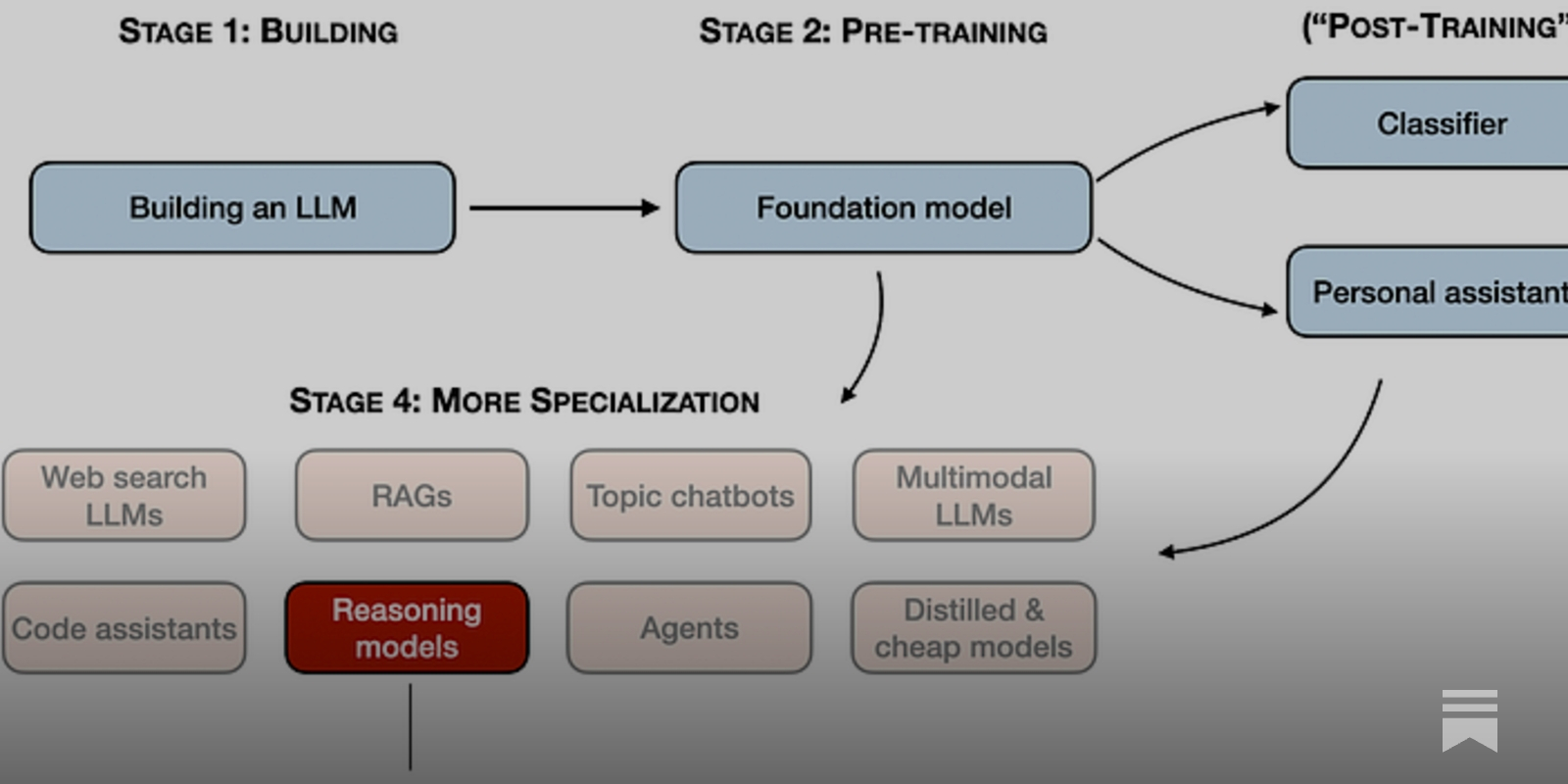
Understanding Reasoning LLMs
Methods and Strategies for Building and Refining Reasoning Models
What are Mental Models? — updated 2026
Harness the power of understanding and predicting user behavior with mental models. Simplify systems and enhance decision-making in your designs.

Muse Glimmer: Meta’s 30B Model Built for Efficient Inference
Inside Meta’s 30B local reasoning model and its tiny KV cache

Inkling: Our Open-Weights Model
Our first open-weights model: multimodal, Mixture-of-Experts, with controllable reasoning effort. Available to fine-tune on Tinker.

Gemma 4 Technical Report
We introduce Gemma 4, a new generation of open-weight, natively multimodal language models in the Gemma model family. Designed to advance compute efficiency and reasoning, the Gemma 4 model suite features dense and Mixture-of-Experts architectures, ranging from 2.3B to 31B parameters. Alongside improved vision and audio encoders for all model sizes, we propose a unified, encoder-free architecture for our 12B model, which ingests raw audio and image patches. Furthermore, we integrate a thinking mode, enabling Gemma models to generate reasoning traces prior to responding. We improve inference speed, memory, and compute efficiency, as well as long-context abilities through critical design choices. Gemma 4 establishes a leap in performance across STEM, multimodal, and long-context benchmarks, and rivals larger, frontier open models in human-rated tasks.
Build a Reasoning Model (From Scratch)
"An exceptional deep dive into the next frontier of AI.” —Aman Chadha, Google Build a Reasoning Model (From Scratch) is a practical guide to understanding how modern reasoning-oriented LLMs work by building their core methods step by step. The book tells a clear engineering story: start with a conventional pre-trained LLM, learn how text generation works, build reliable evaluation tools, improve reasoning through inference-time methods, then move into training-based approaches such as reinforcement learning and distillation. The progression is deliberate. Early chapters establish the baseline model and explain text generation, KV caching, and evaluation with math verifiers. The middle chapters show how reasoning can be improved without changing model weights, using chain-of-thought prompting, sampling, self-consistency, response scoring, and self-refinement. Later chapters move to changing the model itself through reinforcement learning with verifiable rewards, GRPO improvements, format rewards, and finally distillation from stronger reasoning models into smaller ones. The book is especially useful because it implements the core methods from scratch rather than treating them as black-box library calls. Readers see how self-consistency, self-refinement, Best-of-N, and training-based methods actually work, including their cost and latency trade-offs. It also discusses common failure modes, including cases where refinement can make answers worse. Difficult concepts such as softmax, temperature, and top-p sampling are clarified with code-linked explanations and diagrams, and visual workflows make pipelines and scoring methods easier to follow. Reading the book feels like following a guided technical build rather than a loose survey of AI topics. Each concept is introduced because the project now needs it. Diagrams, roadmaps, code listings, exercises, and repeated workflow summaries help readers stay oriented through advanced material. This structure reflects Sebastian Raschka’s professional strength: explaining complex machine learning topics by making every detail concrete and showing exactly where each section fits in the larger story. He does not treat mechanisms like evaluation, log-probabilities, KL regularization, or distillation as isolated abstractions; he connects them to the goal of making reasoning models understandable and implementable. Physically and organizationally, the book has eight chapters and seven substantial appendixes. That design keeps the main narrative focused while moving supporting material like references, exercise solutions, model source code, larger models, batching, evaluation alternatives, and chat interfaces into ordered appendixes. The result is a logically flowing book that remains hands-on, navigable, and technically deep without constantly interrupting the central build.
gpt-oss:20b
OpenAI’s open-weight models designed for powerful reasoning, agentic tasks, and versatile developer use cases.

Hierarchical Reasoning Model: Substance or Hype?
