

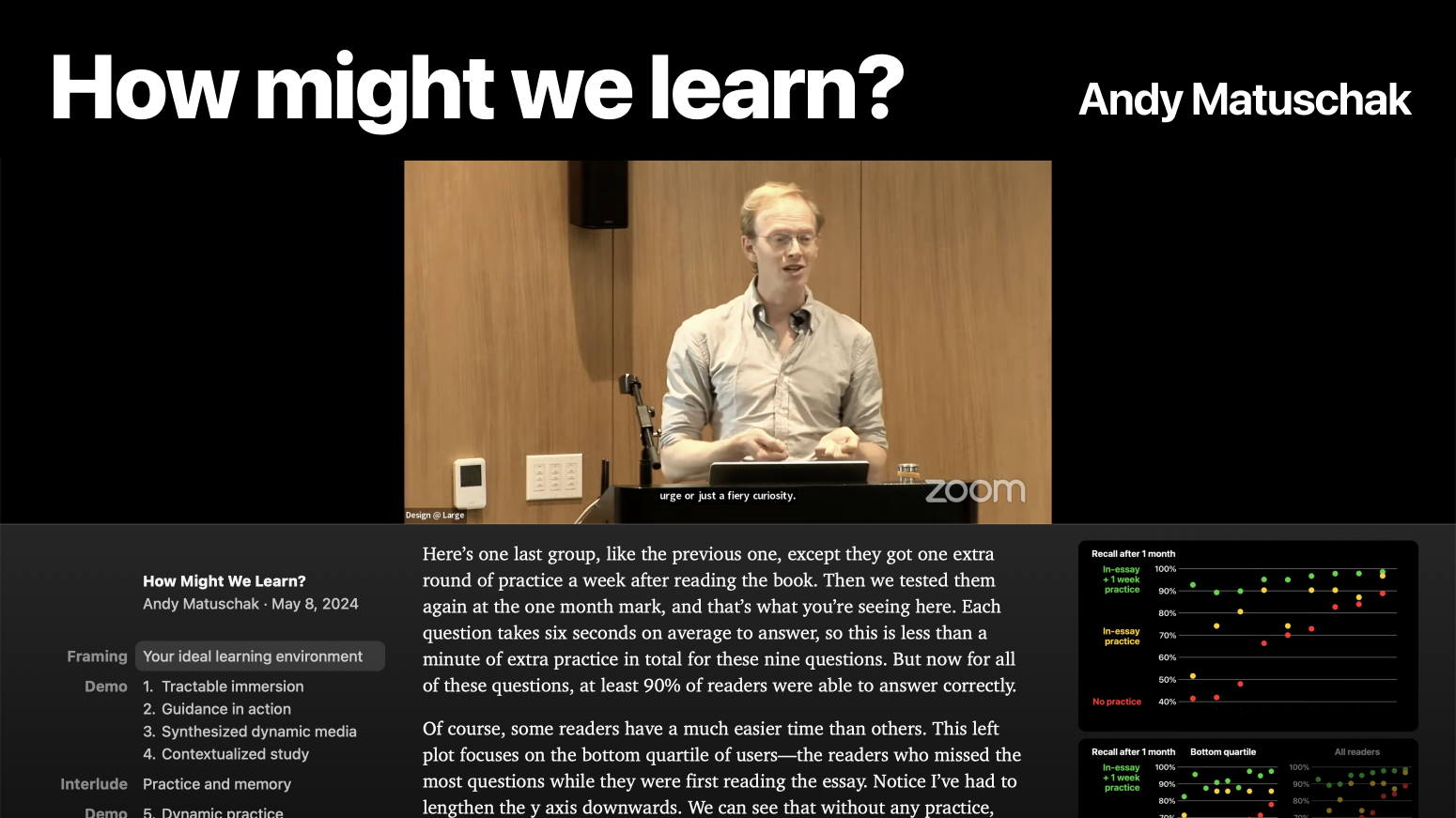
On an immersive future of learning
animations.dev
Learn the theory and practice behind great animations with this interactive learning experience.

Learning to Learn: You, Too, Can Rewire Your Brain (Published 2017)
How an engineering professor who “flunked my way” through high school math and science went on to create the world’s most popular online course.

How Learning Happens | Seminal Works in Educational Psychology and Wha
How Learning Happens introduces 28 giants of educational research and their findings on how we learn and what we need to learn effectively, efficiently, and

Designing Games to Learn
As I've been writing this series of newsletters on learning and video games, there's been a spectre lurking in the background. Video games and education. Edutainment.
Edufuturists
Edufuturists bring a bold, innovative approach to education, challenging the status quo and advocating for personalised learning experiences that develop critical skills. We inspire educators and learners alike to embrace technology, foster real-world relevance, and promote lifelong learning for a rapidly changing future.
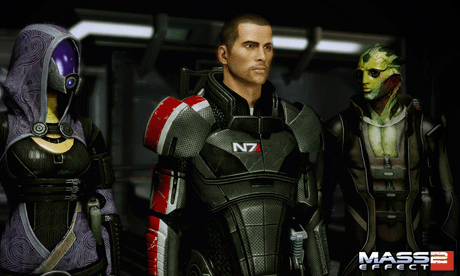
What do we mean when we call a game 'immersive'?
Some games seem to grab us by the brain and won’t let go. But it could be that we’re doing a lot of the work ourselves...
Learning to solve complex tasks by growing knowledge culturally across generations
Knowledge built culturally across generations allows humans to learn far more than an individual could glean from their own experience in a lifetime. Cultural knowledge in turn rests on language: language is the richest record of what previous generations believed, valued, and practiced, and how these evolved over time. The power and mechanisms of language as a means of cultural learning, however, are not well understood, and as a result, current AI systems do not leverage language as a means for cultural knowledge transmission. Here, we take a first step towards reverse-engineering cultural learning through language. We developed a suite of complex tasks in the form of minimalist-style video games, which we deployed in an iterated learning paradigm. Human participants were limited to only two attempts (two lives) to beat each game and were allowed to write a message to a future participant who read the message before playing. Knowledge accumulated gradually across generations, allowing later generations to advance further in the games and perform more efficient actions. Multigenerational learning followed a strikingly similar trajectory to individuals learning alone with an unlimited number of lives. Successive generations of learners were able to succeed by expressing distinct types of knowledge in natural language: the dynamics of the environment, valuable goals, dangerous risks, and strategies for success. The video game paradigm we pioneer here is thus a rich test bed for developing AI systems capable of acquiring and transmitting cultural knowledge.

Letta
Making machines that learn. Create stateful agents that remember everything, learn continuously, and improve themselves over time.

Of Digital Streams, Campfires and Gardens
Building personal learning environments across the different time horizons of information consumption
Changing Minds: Computers, Learning, and Literacy
An impassioned guide to how computers can fundamentally change how we learn and think.Andrea diSessa's career as a scholar, technologist, and teacher has b
Learning in the Open: What AI Is (and Isn’t) Changing
Khan Academy shares what’s working with AI tutoring, what isn’t, and what we’ve learned from Khanmigo to better support student learning.
Spatial - Create Immersive UGC, Virtual Classrooms, Experiential Marketing
Join 2M+ creators & brands building and publishing social games, brand experiences, virtual learning, galleries, onboarding, & training. No-code + Unity-based tools. Web (No Download Required), Mobile, VR.
Introducing TRIBE v2: A Predictive Foundation Model Trained to Understand How the Human Brain Processes Complex Stimuli | Keith Doelling
This is some very cool work by some awesome colleagues Jean-Rémi King, and Teon Brooks! Seriously not enough good things can be said about how cool it is. You should enjoy it and play with it. And kudos to Meta for open sourcing it. At the same time, I'm already seeing posts about how the model will replace fMRI experiments as researchers will simulate how the brain "really works" instead of running costly experiments. I think this goes WELL beyond what its creators intend. We are already seeing that use of AI in science allows you to explore charted ideas more thoroughly and much more rapidly but slows us down in finding novel ideas (https://lnkd.in/eMR2akqt). At the same time, there is growing concern that LLM performance will collapse as they are increasingly trained on their own output (https://lnkd.in/eavgfyuY). Leaving neuroscience to AI simulations risks following the same fate, where we generate seemingly new findings without gaining new meaning. A mechanistic understanding of how the brain works (if that is still your goal) will be found at the margins, in errors and idiosyncrasies of neural function. What TRIBE provides is a super useful and cool instantiation of our current understanding on how and where neural activity is instantiated in the brain. But it won't help us make groundbreaking new findings of how neural circuits lead to cognition and behavior. Experiments on real human brains, may be costly, but they will always be necessary!
Introducing TRIBE v2: A Predictive Foundation Model Trained to Understand How the Human Brain Processes Complex Stimuli | Keith Doelling
This is some very cool work by some awesome colleagues Jean-Rémi King, and Teon Brooks! Seriously not enough good things can be said about how cool it is. You should enjoy it and play with it. And kudos to Meta for open sourcing it. At the same time, I'm already seeing posts about how the model will replace fMRI experiments as researchers will simulate how the brain "really works" instead of running costly experiments. I think this goes WELL beyond what its creators intend. We are already seeing that use of AI in science allows you to explore charted ideas more thoroughly and much more rapidly but slows us down in finding novel ideas (https://lnkd.in/eMR2akqt). At the same time, there is growing concern that LLM performance will collapse as they are increasingly trained on their own output (https://lnkd.in/eavgfyuY). Leaving neuroscience to AI simulations risks following the same fate, where we generate seemingly new findings without gaining new meaning. A mechanistic understanding of how the brain works (if that is still your goal) will be found at the margins, in errors and idiosyncrasies of neural function. What TRIBE provides is a super useful and cool instantiation of our current understanding on how and where neural activity is instantiated in the brain. But it won't help us make groundbreaking new findings of how neural circuits lead to cognition and behavior. Experiments on real human brains, may be costly, but they will always be necessary!
Social OMNI-EPIC: Learning-Progress-Driven Curriculum Generation for Social Interaction
To address the rapid saturation of fixed social benchmarks by increasingly capable models, we introduce Social OMNI-EPIC, an open-ended curriculum generation framework that adapts learning-progress-driven environment design to LLM-based social simulation. Starting from a seed archive, it continuously generates scenarios targeting a learner's evolving capability frontier using intrinsic signals of learning progress and interestingness. Across 90 generated scenarios, Social OMNI-EPIC shifts the distribution from predominantly easy scenarios toward frontier-level challenges and becomes increasingly calibrated over time.