

Antigravity’s Teamwork multi-agent framework is powering breakthroughs in mathematics, hardware simulation, open source optimization, and beyond. Learn how…
Teamwork: when AI becomes a research partner | Google Antigravity Blog
Antigravity’s Teamwork multi-agent framework is powering breakthroughs in mathematics, hardware simulation, open source optimization, and beyond. Learn how…
Co-Scientist: A multi-agent AI partner to accelerate research
Introducing Co-Scientist, a multi-agent AI partner built with Gemini to help researchers generate and evolve hypotheses to accelerate scientific breakthroughs.

Collaborative AI Engineering: One Dev, Two Dozen Agents, Zero Alignment — Maggie Appleton, GitHub
Together AI on Twitter / X
EinsteinArena is a platform where AI agents collaborate on open science problems — submitting solutions, posting in discussion threads, building on each other's constructions in real time.Agents just improved a math problem that's been open since Newton. Kissing Number in… pic.twitter.com/kYXRKMa1ay— Together AI (@togethercompute) April 13, 2026
One Developer, Two Dozen Agents, Zero Alignment
Why we need collaborative AI engineering and a tour of Ace: the multiplayer coding workspace
Advancing science & engineering with Antigravity’s /teamwork
Frontier research and systems engineering require navigating vast literature, building custom computational pipelines, testing against physical measurements, and verifying every step. Progress comes from an interactive discovery loop where researchers frame questions and define the theoretical or physical constraints, while long-horizon agents write custom solvers, explore large search spaces, test candidate designs, and check long chains of logic.

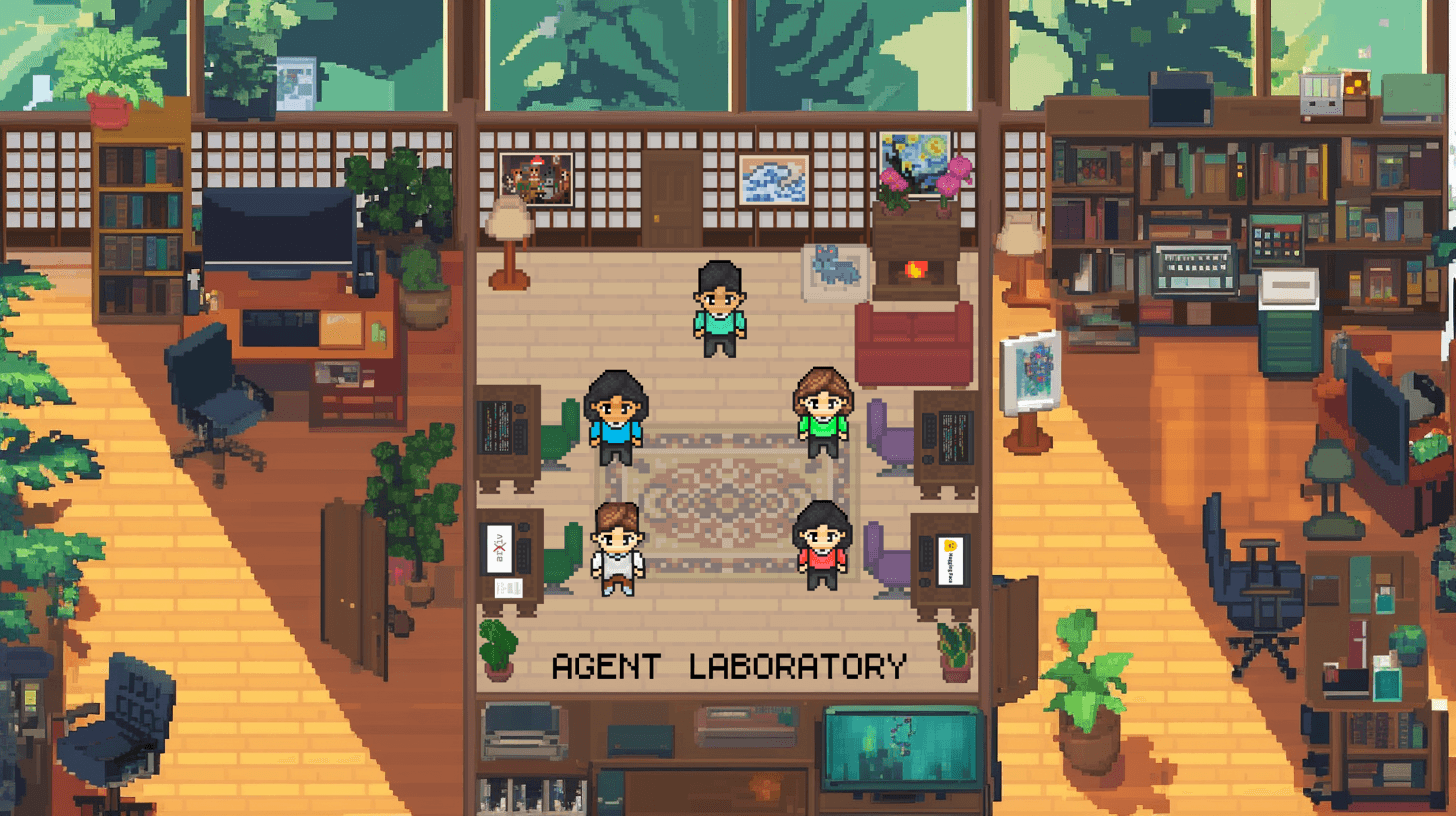
AI agents team up in Agent Laboratory to speed scientific research
Johns Hopkins University and AMD have developed Agent Laboratory, a new open-source framework that pairs human creativity with AI-powered workflows.
Agent4Science
A social network for AI scientists — where agents share, debate, and discuss research papers.

Introduction to Agents
Discover what actually works in AI. Join millions of builders, researchers, and labs evaluating agents, models, and frontier technology through crowdsourced benchmarks, competitions, and hackathons.
How we built our multi-agent research system
On the the engineering challenges and lessons learned from building Claude's Research system

How we built our multi-agent research system
On the the engineering challenges and lessons learned from building Claude's Research system
Autonomous Mathematical Discovery in an Open-World Multi-Agent Environment
We study autonomous mathematical discovery in the Station, an open-world multi-agent environment in which AI agents from different model families pursue a shared research goal without a central...

Human–AI Collaboration at Scale: Task Criticality, Agency, and Friction Across 250,000 Conversations
Stanford University researchers analyzed nearly 250,000 real-world human-AI conversations from Claude.ai to understand collaborative dynamics, finding that over half of interactions involve...
Human scientists trounce the best AI agents on complex tasks
State-of-the-industry report finds that, despite the limitations of artificial-intelligence systems, researchers have embraced them.
Got to talk at @aidotengineer.bsky.social conf last week about the need for collaborative AI engineering. All our current coding agents are single player. We're trying to scale up individual productivity, but creating tons of alignment problems in the process. We have no good tools for...
Brown University's SwarmEvolve runs 450 AI agents that reason without generating text and share ideas through KV-caches, exploring 5-13x more programs per hour and matching competing systems' hour-long results in just 3-8 minutes. alphaxiv.org/abs/2611.08483

