Six in 10 adults have ever used AI to search for information. People under 30 are more likely to use AI for a variety of tasks, especially to brainstorm ideas.
How US adults are using AI, according to AP-NORC polling
A new poll finds most Americans say they've used artificial intelligence to search for information. But it's younger adults who appear to be the generation leaning the most into AI, with many using it for brainstorming and work tasks.
Opinion: A gender gap is emerging in AI adoption, and women risk being left behind
Women appear less inclined to use AI tools, producing a disadvantage they can ill afford

The AI gender gap | Datawrapper Blog
In this Weekly Chart, we examine the gender gap in AI adoption.
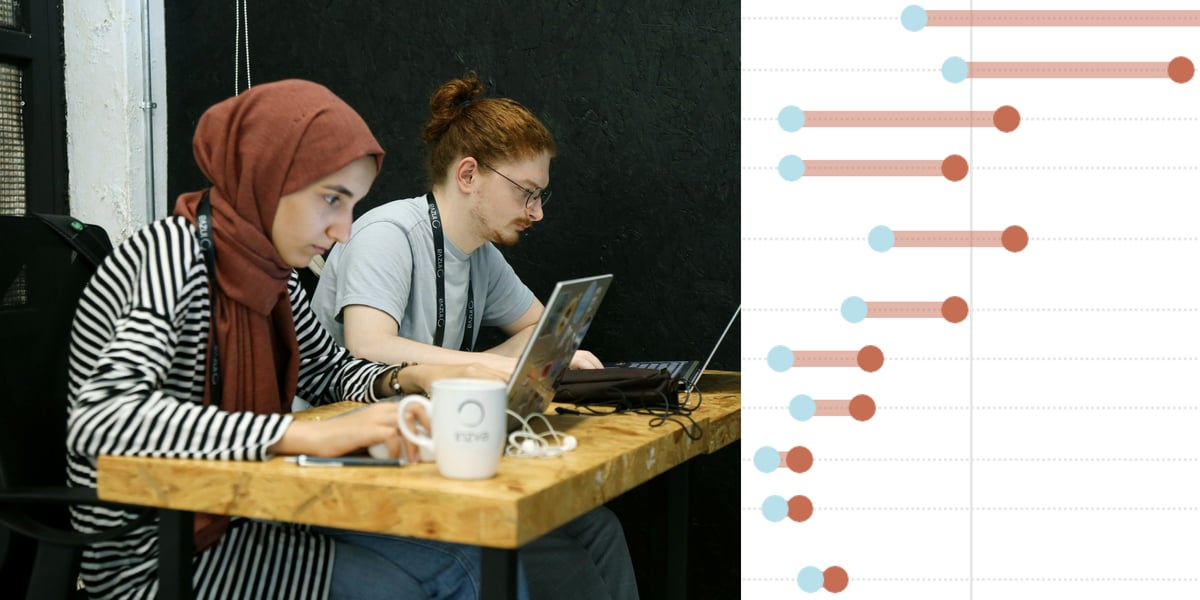
Women and AI: The Gender Gap in AI Adoption and Recognition [Data]
Lean In’s survey shows how women are losing out in the AI age. Learn how women and men compare in AI adoption in the workplace, recognition, and more.
AI Is a Waste of Time
The newest AI tools are accelerating basic research and scaring the general public. But many people are simply using them as toys.

Bridging the Divide: Addressing the Resistance to AI Adoption Among the Underrepresented
AI is increasingly integrating into our lives and educational settings by opening communication doors and providing limitless options for creativity. However, students, faculty, and staff of diverse backgrounds and access may vary in their adoption and application of AI technologies. Existing research has identified disparities in AI adoption. For example, a Pew Research survey indicated that men are more likely to use ChatGPT, with 29% versus 19% of women (PRC, 2023). Why is this? Additionally, many AI programs have been shown to sometimes have racial disparities built into their algorithms. ChatGPT demonstrated that the software “was more likely to associate European American names with pleasant words such as “gift” or “happy,” while African American names were more commonly associated with unpleasant words” (Guardian, 2017). Furthermore, there is evidence to suggest there are inequities ranging from issues with economic access with many premium AI features behind paywalls to concerns that people with disabilities have, which has dissuaded some people from adopting AI (APA, 2023). This presentation will explore the concerns and dynamics of adopting artificial intelligence (AI) in our lives and educational settings. We will engage and discuss these concerns and dynamics with attendees looking at issues with diversity, inclusion, and accessibility. Ultimately, this presentation seeks to foster an environment where all individuals can positively engage and feel included and empowerd by artificial intelligence in shaping the future of learning.
AI adoption higher among men than women: Survey
This large gap — 81.3% compared to 58.8% — stems from the higher representation of women in skilled trades, where AI usage remains extremely low.
Children of the Magenta Line
Why minimally guided AI does not work. Chatbots, novices, the automation of learning and the case for Alpha School
The CHATBOT Act Forces One Parenting Model On Every Family
Artificial intelligence is rapidly changing education, and the way people search for information. Parents, teenagers, teachers, and schools are struggling with tough questions about when AI should,

What Parents Need to Know About AI in the Classroom | Stanford HAI
From immersive learning and personalized tutors to lesson plans and grading, AI is everywhere in K-12 education.

Most Americans say AI development is moving too fast and twice as many are AI pessimists as AI optimists
Young adults are more likely than older Americans to believe that AI will create economic gains that benefit everyone, but they are also more likely to worry that AI will replace jobs they depend upon

Adults Lose Skills to AI. Children Never Build Them.
Discussions of cognitive offloading often miss a critical distinction: What AI does to a 45-year-old's brain is categorically different from what it does to a 14-year-old's.

People know AI is risky. They just don’t know what to do about it. | TrendLife Blog
New international research from TrendLife reveals a wide gap between AI adoption and awareness of AI-powered threats.
The Age Of Artificial Intelligence: Americans' AI Use Increases While Views On It Sour, Quinnipiac University Poll On AI Finds; 7 In 10 Think AI Will Cut Jobs With Gen Z The Most Pessimistic | Quinnipiac University Poll
"The contradiction between use and trust of AI is striking. Fifty-one percent say they use AI for research, and many also use it for writing, work, and data analysis. But only 21 percent trust AI-generated information most or almost all of the time. Americans are clearly adopting AI, but they are doing so with deep hesitation, not deep trust," said Chetan Jaiswal, Ph.D., Associate Professor of Computer Science and Associate Chair, Department of Computing, Quinnipiac University School of Computing and Engineering.

The Large Gender Gap in Who Uses AI
A recent study finds that AI usage tilts heavily toward men. Part of the reason: Women worried they might be penalized for using AI.

What matters in the age of AI is taste
the case for why a curated personal knowledge base has never mattered more