


Xuan-Son Nguyen, an engineer at Hugging Face, specializes in on-device large language models (LLMs) and runtime optimization, working extensively with llam...
The State of On-Device LLMs
Xuan-Son Nguyen, an engineer at Hugging Face, specializes in on-device large language models (LLMs) and runtime optimization, working extensively with llam...
On-Device LLM Throughput Calculator - a Hugging Face Space by FL33TW00D-HF
This tool estimates and visualizes the throughput of Large Language Models on devices with memory bandwidth constraints. Users input device and model configurations, and the tool generates a plot s...
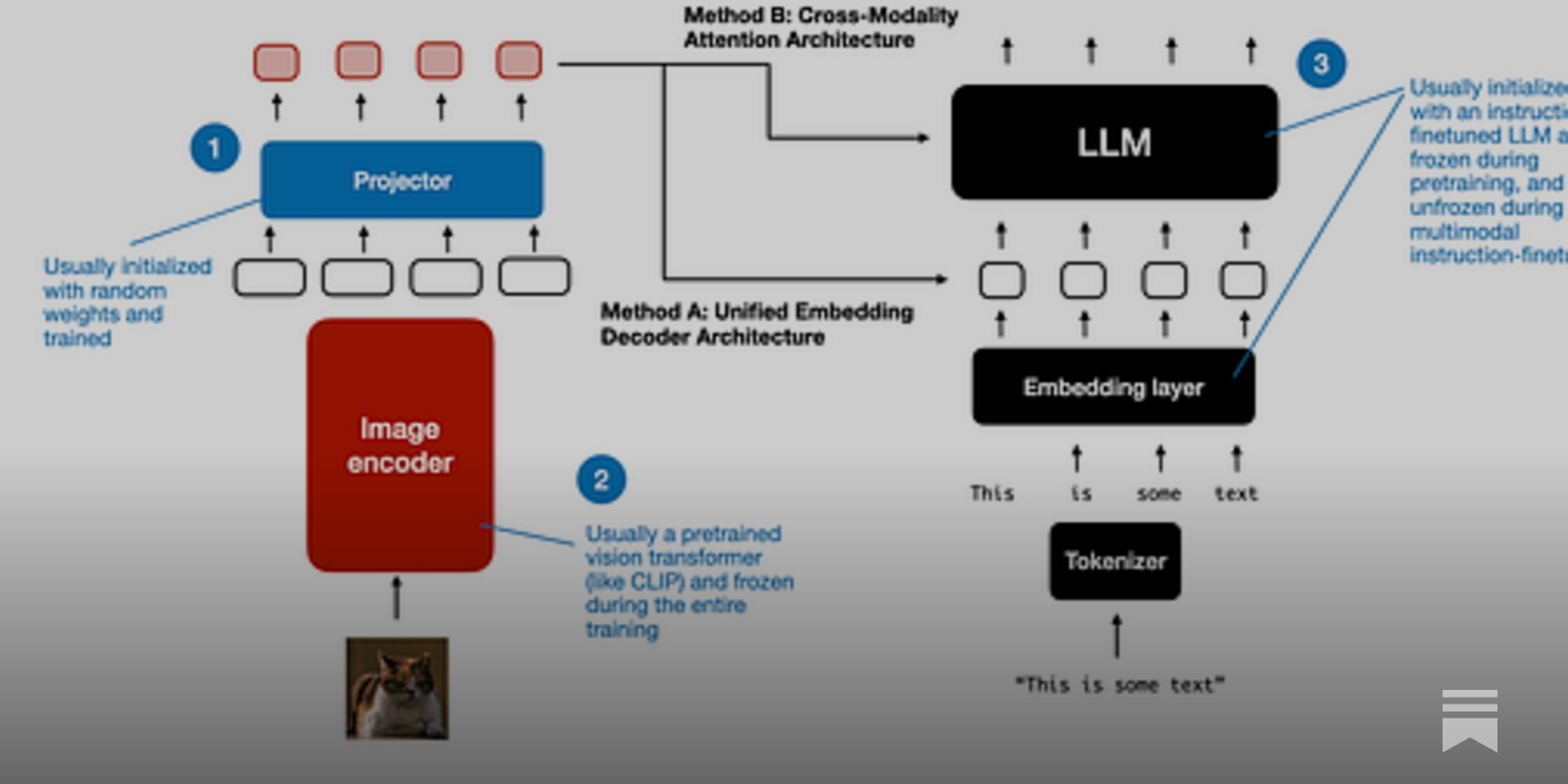
Understanding Multimodal LLMs
An introduction to the main techniques and latest models
Ellora: Enhancing LLMs with LoRA - Standardized Recipes for Capability Enhancement
A Blog post by Asankhaya Sharma on Hugging Face

576 - Using LLMs at Oxide | RFD | Oxide
Large language models (LLMs) are an indisputable breakthrough of the last five years, potentially profoundly changing the way that we work. As with any extraordinarily powerful tool, LLM use has both promise and peril — and that they are so general-purpose leaves real questions about how and when they should be used. The landscape is shifting so rapidly that static prescription is unlikely — but that LLMs are evolving so quickly also gives urgency to the question: how should LLMs be used at Oxide?
576 - Using LLMs at Oxide | RFD | Oxide
Large language models (LLMs) are an indisputable breakthrough of the last five years, potentially profoundly changing the way that we work. As with any extraordinarily powerful tool, LLM use has both promise and peril — and that they are so general-purpose leaves real questions about how and when they should be used. The landscape is shifting so rapidly that static prescription is unlikely — but that LLMs are evolving so quickly also gives urgency to the question: how should LLMs be used at Oxide?
mem-agent: Persistent, Human Readable Memory Agent Trained with Online RL
A Blog post by Dria on Hugging Face

The Kaitchup – AI on a Budget | Benjamin Marie | Substack
Weekly tutorials and news on adapting large language models (LLMs) to your tasks and hardware using the most recent techniques and models. The Kaitchup proposes a collection of 180+ AI notebooks regularly updated. Click to read The Kaitchup – AI on a Budget, by Benjamin Marie, a Substack publication with tens of thousands of subscribers.

Large language model
A large language model (LLM) is a neural network trained on a vast amount of text for natural language processing tasks, especially language generation. LLMs can typically generate, summarize, translate, and analyze text in many contexts, and are a foundational technology behind modern chatbots.[1] Biased or inaccurate training data can make an LLM's output less reliable.[2]
Introducing LFM2: The Fastest On-Device Foundation Models on the Market | Liquid AI
Today, we release LFM2, a new class of Liquid Foundation Models (LFMs) that sets a new standard in quality, speed, and memory efficiency for on-device deployment. Built on a hybrid architecture, LFM2 delivers 200% faster decode and prefill performance than Qwen3 and Gemma 3 on CPU. It also significantly outperforms models in each size class on instruction-following and function calling—the core capabilities that make LLMs reliable for building AI agents.

Beyond Model Collapse: Scaling Up with Synthesized Data Requires...
Large Language Models (LLM) are increasingly trained on data generated by other LLM, either because generated text and images become part of the pre-training corpus, or because synthetized data is...

The Ultimate Guide to Fine-Tuning LLMs from Basics to Breakthroughs: An Exhaustive Review of Technologies, Research, Best Practices, Applied Research Challenges and Opportunities (Version 1.0)
MiniMax-Intelligence with everyone
MiniMax is a leading global technology company and one of the pioneers of large language models (LLMs) in Asia. Our mission is to build a world where intelligence thrives with everyone.

Mitigating Cross-Lingual Cultural Inconsistencies in LLMs via...
Despite their impressive capabilities, multilingual large language models (MLLMs) frequently exhibit inconsistent behaviour when the prompt's language changes. While such adaptation is generally...
**An Edge-First Generalized LLM LoRA Fine-Tuning Framework for Heterogeneous GPUs**
A Blog post by QVAC on Hugging Face

Your Laptop Isn’t Ready for LLMs. That’s About to Change
The quest to run large AI models locally on an individual's machine are driving the biggest change in laptop architecture in decades.
