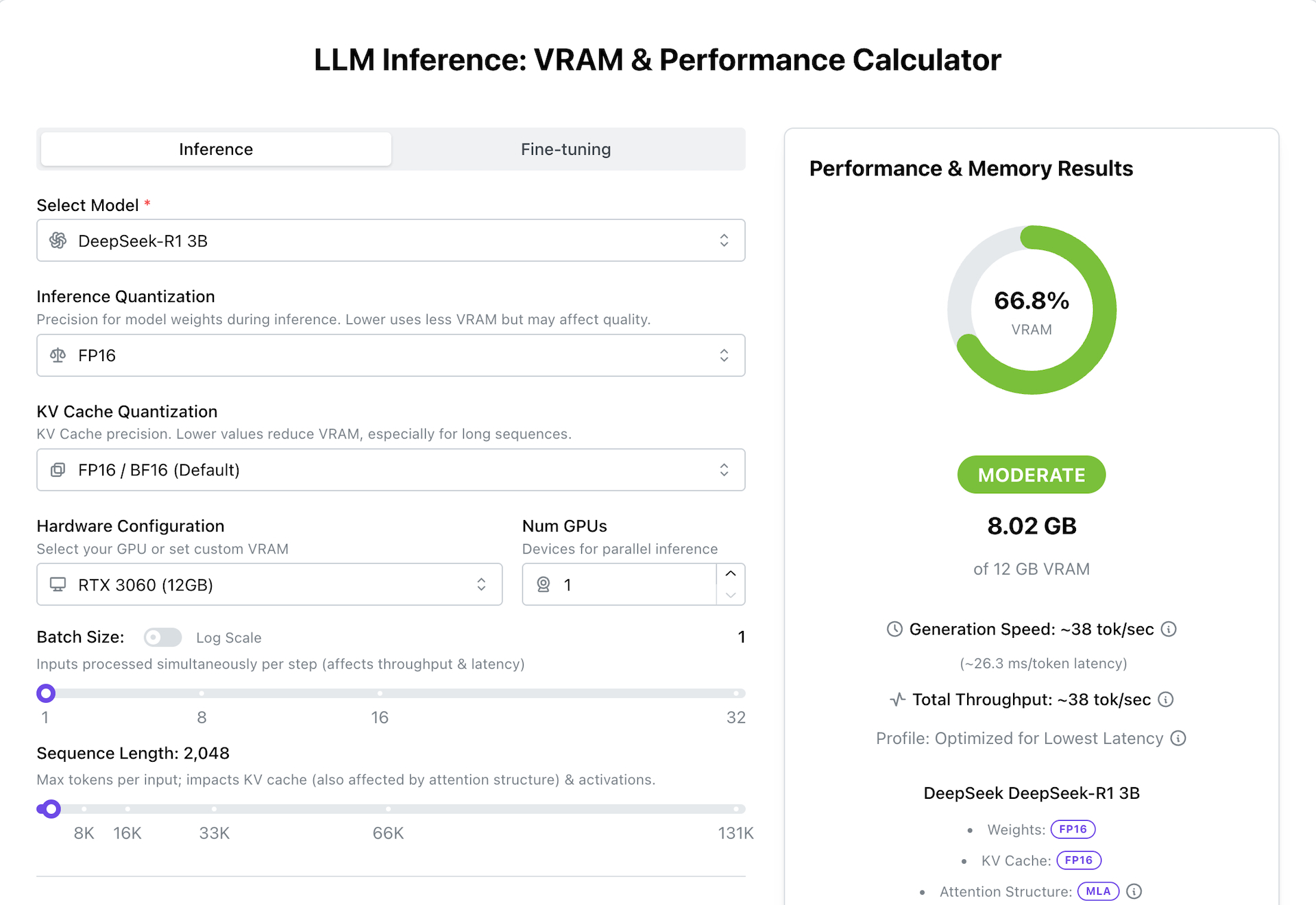
Calculate the VRAM required to run any large language model.
XiongjieDai/GPU-Benchmarks-on-LLM-Inference
Multiple NVIDIA GPUs or Apple Silicon for Large Language Model Inference?
On-Device LLM Throughput Calculator - a Hugging Face Space by FL33TW00D-HF
This tool estimates and visualizes the throughput of Large Language Models on devices with memory bandwidth constraints. Users input device and model configurations, and the tool generates a plot s...
Your Laptop Isn’t Ready for LLMs. That’s About to Change
The quest to run large AI models locally on an individual's machine are driving the biggest change in laptop architecture in decades.

LLM in a flash: Efficient Large Language Model Inference with Limited Memory
Large language models (LLMs) are central to modern natural language processing, delivering exceptional performance in various tasks. However, their substantial computational and memory requirements present challenges, especially for devices with limited DRAM capacity. This paper tackles the challenge of efficiently running LLMs that exceed the available DRAM capacity by storing the model parameters in flash memory, but bringing them on demand to DRAM. Our method involves constructing an inference cost model that takes into account the characteristics of flash memory, guiding us to optimize in two critical areas: reducing the volume of data transferred from flash and reading data in larger, more contiguous chunks. Within this hardware-informed framework, we introduce two principal techniques. First, "windowing" strategically reduces data transfer by reusing previously activated neurons, and second, "row-column bundling", tailored to the sequential data access strengths of flash memory, increases the size of data chunks read from flash memory. These methods collectively enable running models up to twice the size of the available DRAM, with a 4-5x and 20-25x increase in inference speed compared to naive loading approaches in CPU and GPU, respectively. Our integration of sparsity awareness, context-adaptive loading, and a hardware-oriented design paves the way for effective inference of LLMs on devices with limited memory.

Demystifying llm-d and vLLM: The race to production
Learn how vLLM and llm-d work together for efficient and scalable large language model (LLM) inference. Discover the benefits of disaggregated scaling, expert-parallel scheduling, and KV cache-aware routing.

How To Scale Your Model
Training LLMs often feels like alchemy, but understanding and optimizing the performance of your models doesn't have to. This book aims to demystify the science of scaling language models: how TPUs (and GPUs) work and how they communicate with each other, how LLMs run on real hardware, and how to parallelize your models during training and inference so they run efficiently at massive scale. If you've ever wondered “how expensive should this LLM be to train” or “how much memory do I need to serve this model myself” or “what's an AllGather”, we hope this will be useful to you.
Simulating Human Memory with Language Models
Language models are increasingly being deployed as user simulators, but their memory is far more reliable than that of real users. To measure this gap, we run a series of classic memory...
Alex Cheema on Twitter / X
.@karpathy shouted out my work on @exolabs at @ycombinator AI SUS!“we use LLMs similarly to mainframes in the ‘70s - compute is timeshared by having a slice in the batch dimension. models will compress over time, and with this we’ll be able to run more on-device” pic.twitter.com/UKSrquQGAL— Alex Cheema (@alexocheema) June 18, 2025
Exploring LLMs with MLX and the Neural Accelerators in the M5 GPU
Mac with Apple silicon is increasingly popular among AI developers and researchers interested in using their Mac to experiment with the…

How I fit a 28.9M LLM on an ESP32-S3 (~9 tok/s, fully on-chip)
1.2K votes, 69 comments. I wanted to see how big a language model I could actually run on an ESP32. Not the 260K-param TinyStories model that's been…
ModelScope on Twitter / X
🤯 400 Token/S on a MacBook? Yes, you read that right!Shaohong Chen just fine-tuned the Qwen3-0.6B LLM in under 2 minutes using Apple's MLX framework. This is how you turn your MacBook into a serious LLM development rig. A step-by-step guide and performance metrics inside! 🧵… pic.twitter.com/31Cmycy8Mh— ModelScope (@ModelScope2022) October 13, 2025
LLMs Can Now Write GPU Kernels That Beat torch.compile - Break AI Scaling Limits in 7 Days
We're now seeing multi-agent systems that take your PyTorch code and produce CUDA or Triton kernels with 2x to 14x speedups over torch.compile(mode='max-autotune-no-cudagraphs'). Not on toy benchmarks. On real models like Llama-3.1-8B, Whisper, and Stable Diffusion. Learn proven techniques to shift the scaling law intercept and achieve 10-50% performance gains.
Introducing LFM2: The Fastest On-Device Foundation Models on the Market | Liquid AI
Today, we release LFM2, a new class of Liquid Foundation Models (LFMs) that sets a new standard in quality, speed, and memory efficiency for on-device deployment. Built on a hybrid architecture, LFM2 delivers 200% faster decode and prefill performance than Qwen3 and Gemma 3 on CPU. It also significantly outperforms models in each size class on instruction-following and function calling—the core capabilities that make LLMs reliable for building AI agents.

vllm-project/vllm
A high-throughput and memory-efficient inference and serving engine for LLMs
Running local models on an M4 with 24GB memory | jola.dev
Experiments with getting usable outputs out of local models on a standard Macbook