

2014: 70% of the links within legal journals and 50% of the URLs from Supreme Court decisions did not contain the originally cited material.
Supreme Court - Recently Posted Judgments
This webpage lists judgments recently released by the Supreme Court and provides links to copies of those judgments.
Websites change. Perma Links don't.
Perma.cc helps scholars, journals, courts, and others create permanent records of the web sources they cite.

Court Filings in A.I. Suit Invoke Copyright Law, Culture and Sports
Filings made Friday in The New York Times’s closely watched lawsuit against OpenAI and Microsoft included a range of copyright law and cultural references.

Who's downloading pirated papers? Everyone
Data from the controversial website Sci-Hub reveal that the whole world turns to it for journal articles.

Wikipedia Is Battling for the Soul of the Internet
The internet’s largest stockpile of free knowledge is under threat from MAGA, A.I. and foreign autocrats. A bibliophile ex-ambassador is here to help.

Book publishers sue Meta over AI’s ‘word-for-word’ copying
Meta is accused of ripping copyrighted works from piracy websites.

Law.com | The Premier Source for Global Legal News & Analysis
Law.com delivers news, insights and resources that allow legal professionals to anticipate opportunities, adapt to change, and prepare for future success.
Hallucination-Free? Assessing the Reliability of Leading AI Legal Research Tools
Legal practice has witnessed a sharp rise in products incorporating artificial intelligence (AI). Such tools are designed to assist with a wide range of core legal tasks, from search and summarization of caselaw to document drafting. But the large language models used in these tools are prone to "hallucinate," or make up false information, making their use risky in high-stakes domains. Recently, certain legal research providers have touted methods such as retrieval-augmented generation (RAG) as "eliminating" (Casetext, 2023) or "avoid[ing]" hallucinations (Thomson Reuters, 2023), or guaranteeing "hallucination-free" legal citations (LexisNexis, 2023). Because of the closed nature of these systems, systematically assessing these claims is challenging. In this article, we design and report on the first preregistered empirical evaluation of AI-driven legal research tools. We demonstrate that the providers' claims are overstated. While hallucinations are reduced relative to general-purpose chatbots (GPT-4), we find that the AI research tools made by LexisNexis (Lexis+ AI) and Thomson Reuters (Westlaw AI-Assisted Research and Ask Practical Law AI) each hallucinate between 17% and 33% of the time. We also document substantial differences between systems in responsiveness and accuracy. Our article makes four key contributions. It is the first to assess and report the performance of RAG-based proprietary legal AI tools. Second, it introduces a comprehensive, preregistered dataset for identifying and understanding vulnerabilities in these systems. Third, it proposes a clear typology for differentiating between hallucinations and accurate legal responses. Last, it provides evidence to inform the responsibilities of legal professionals in supervising and verifying AI outputs, which remains a central open question for the responsible integration of AI into law.

Two billion citation links in Crossref help research travel further - Crossref
We’ve recently reached an important milestone for the research nexus: the works in our metadata corpus are now connected with over 2 billion citation links! This is a great opportunity to share a dedicated dataset and discuss why these are important for science.

SILO Language Models: Isolating Legal Risk In a Nonparametric Datastore
The legality of training language models (LMs) on copyrighted or otherwise restricted data is under intense debate. However, as we show, model performance significantly degrades if trained only on low-risk text (e.g., out-of-copyright books or government documents), due to its limited size and domain coverage. We present SILO, a new language model that manages this risk-performance tradeoff during inference. SILO is built by (1) training a parametric LM on the Open License Corpus (OLC), a new corpus we curate with 228B tokens of public domain and permissively licensed text and (2) augmenting it with a more general and easily modifiable nonparametric datastore (e.g., containing copyrighted books or news) that is only queried during inference. The datastore allows use of high-risk data without training on it, supports sentence-level data attribution, and enables data producers to opt out from the model by removing content from the store. These capabilities can foster compliance with data-use regulations such as the fair use doctrine in the United States and the GDPR in the European Union. Our experiments show that the parametric LM struggles on its own with domains not covered by OLC. However, access to the datastore greatly improves out of domain performance, closing 90% of the performance gap with an LM trained on the Pile, a more diverse corpus with mostly high-risk text. We also analyze which nonparametric approach works best, where the remaining errors lie, and how performance scales with datastore size. Our results suggest that it is possible to build high quality language models while mitigating legal risk.
Archiving web sites
I recently took a deep dive into web site archival for friends who were worried about losing co [...]
Supreme Connections: Search Supreme Court Disclosures — ProPublica
Search Supreme Court financial disclosures for organizations and people that have paid justices, reimbursed them for travel, given them gifts and more.

Jared Goering on Twitter / X
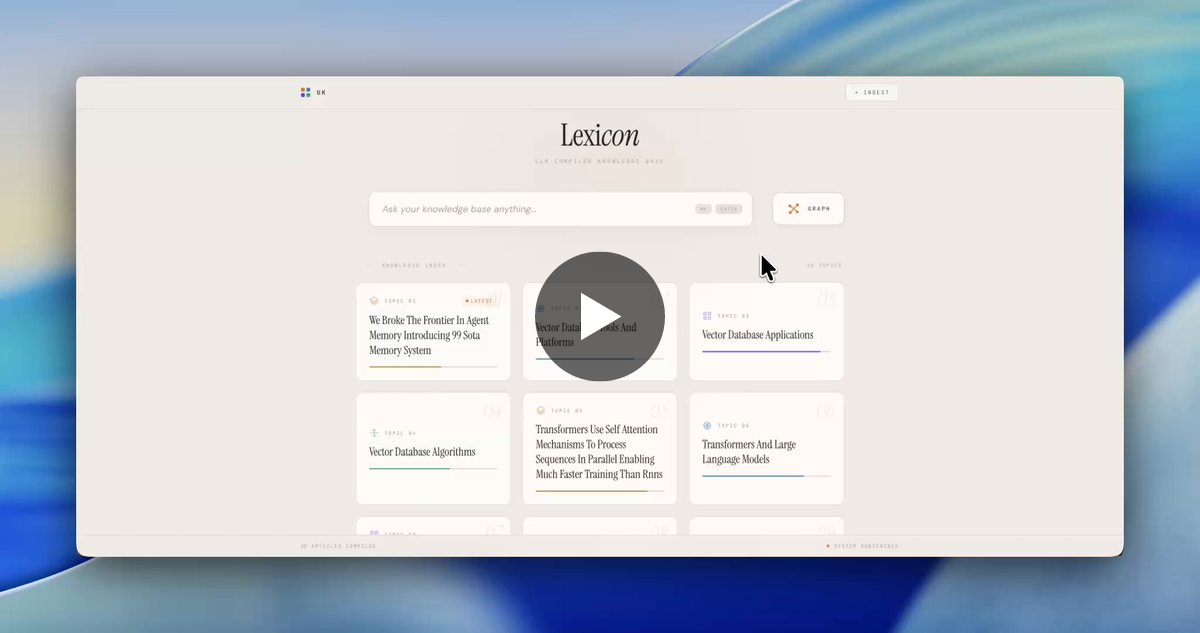
Saw this and immediately built it. Open-sourced the whole thing:Ingest URLs, PDFs, tweets, images → LLM compiles a linked markdown wiki → Q&A with citations, knowledge graph, contradiction linting, auto-research, export to HTML/PDF/slides.Been using it nonstop as a personal… https://t.co/ypaXlEA7pn pic.twitter.com/8Z2DLAyQjH— Jared Goering (@jaredgoering) April 4, 2026
‘Plain and aggregated search results such as URLs, snippets, and factual index data, are publicly accessible facts and are not "works protected under the Copyright Act." Google cannot use copyright law to block scraping of uncopyrighted search result data.’ seroundtable.com/google-lawsuit-serpapi-dismis…

Google Lawsuit Against SerpApi Over Scraping Search Results Has Been Dismissed
www.seroundtable.comI was just thinking this as I was scrolling arXiv recently, how cool it would be to have those papers published as at://records and to be able to see all the links between them.

Ronen Tamari
"The properties that make AT Protocol compelling for social networking are the same properties the research community has been asking for" Exciting vision for the future of science publishing on ATProto @row1.ca @opensci.dev @nokome.bsky.social #ATScience

