SYSTEM TEMPLATE FOR RAPID CODEBASE COMPREHENSION - HAVE YOUR AGENT TO FILL IN FOR YOUR REPO
AGENTS.md
AGENTS.md is a simple, open format for guiding coding agents. Think of it as a README for agents.
OpenWiki: Open Source Repo Documentation for Coding Agents
OpenWiki generates and maintains codebase documentation so coding agents can find the repo context they need without loading everything into one instruction file.
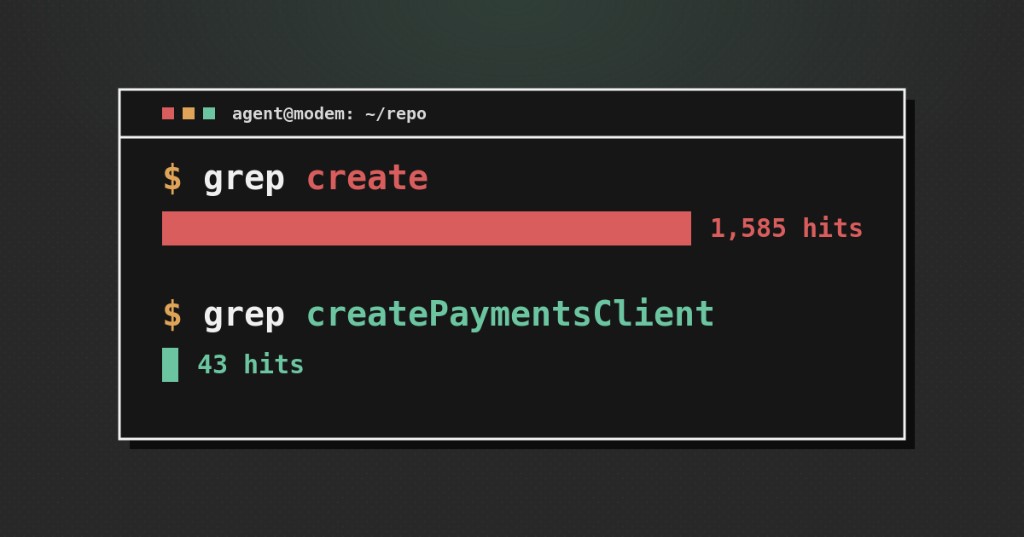
How coding agents read your code (and how to write for them)
Modem's codebase is roughly 99.9% written by AI agents. Here's what that taught us about how agents actually navigate a repo, and the three levers you control: the names you choose, the types you define, and where you put your explanations.
Evaluating AGENTS.md: Are Repository-Level Context Files Helpful for Coding Agents?
A widespread practice in software development is to tailor coding agents to repositories using context files, such as AGENTS.md, by either manually or automatically generating them. Although this practice is strongly encouraged by agent developers, there is currently no rigorous investigation into whether such context files are actually effective for real-world tasks. In this work, we study this question and evaluate coding agents' task completion performance in two complementary settings: established SWE-bench tasks from popular repositories, with LLM-generated context files following agent-developer recommendations, and a novel collection of issues from repositories containing developer-committed context files. Across multiple coding agents and LLMs, we find that context files tend to reduce task success rates compared to providing no repository context, while also increasing inference cost by over 20%. Behaviorally, both LLM-generated and developer-provided context files encourage broader exploration (e.g., more thorough testing and file traversal), and coding agents tend to respect their instructions. Ultimately, we conclude that unnecessary requirements from context files make tasks harder, and human-written context files should describe only minimal requirements.


How our agents build on-brand pages with design.md
How we built design.md, a single public file any coding agent can load to build on-brand Vercel pages, and the eval loop that decided every rule inside it.

Repositories Are Human/Agent Knowledge Factories
Repositories aren’t where code lives anymore—they’re where **knowledge is manufactured**. And increasingly, it’s not humans doing the work—it’s agents, with humans supervising the factory.…

GitHub - MrLesk/Backlog.md: Backlog.md - A tool for managing project collaboration between humans and AI Agents in a git ecosystem
Backlog.md - A tool for managing project collaboration between humans and AI Agents in a git ecosystem - MrLesk/Backlog.md
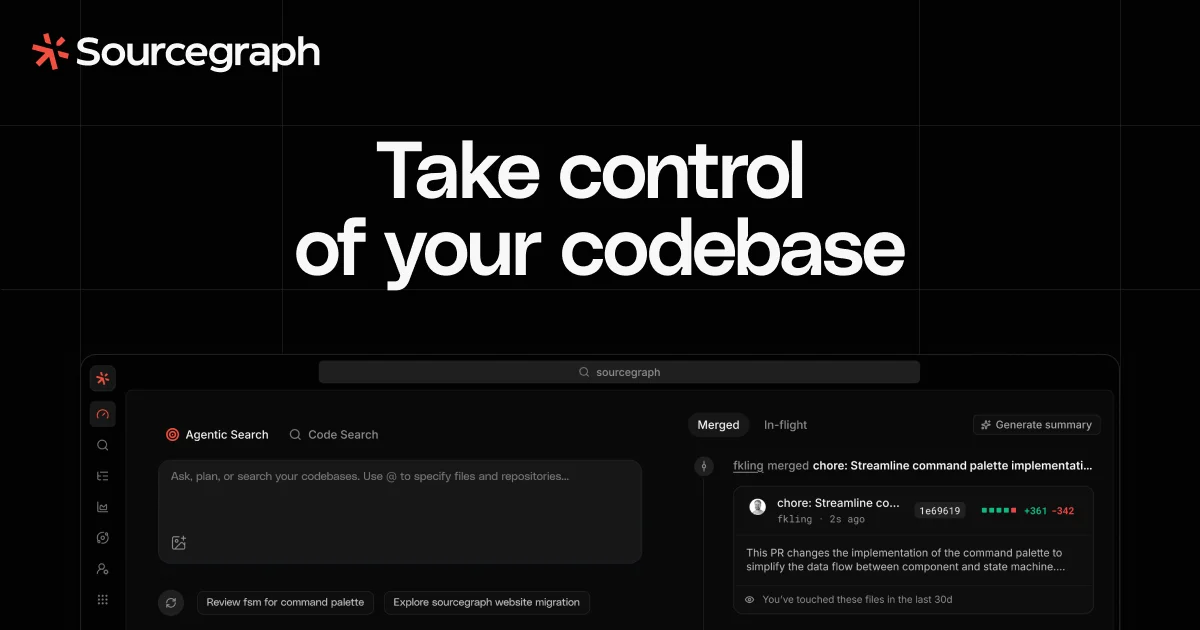
Sourcegraph — Code Understanding, Oversight and Evolution
Give humans and agents complete context to understand, oversee, and evolve the world's largest, most complex codebases.

agentOS — A faster, lighter, cheaper alternative to sandboxes
A portable open-source operating system for agents. Stateful runtime, universal agent interface, and secure code execution. One SDK, deploy anywhere.

Agent READMEs: An Empirical Study of Context Files for Agentic Coding
Agentic coding tools receive goals written in natural language, break them down into specific tasks, and write or execute code with minimal human intervention. Central to this process are agent context files (e.g., AGENTS.md and CLAUDE.md) that provide persistent, project-level instructions. In this paper, we conduct the first large-scale empirical study of 2,303 agent context files from 1,925 repositories to characterize their structure, maintenance, and content. We find that these files are not static documentation but complex, difficultto-read artifacts that evolve like configuration code through frequent, small additions. Our content analysis of 16 instruction types shows that developers prioritize functional context, such as test procedures (75.9%), implementation details (70.8%), and architecture (68.1%). We also identify a significant gap: non-functional requirements such as security (14.8%) and performance (14.5%) are rarely specified. These findings indicate that while developers use context files to make agents functional, they provide few guardrails to ensure that agent-written code is secure or performant, highlighting the need for improved tools and practices.
Agents Done Right: A Framework Vision for 2026
Agents choke on context, loop on failures, and dump walls of code for review. It's time to rethink the architecture.