


xxix, 381 p. : 24 cm; Includes bibliographical references (p. 349-375) and index
Introducing the Knowledge Graph: things, not strings
We hope this will give you a more complete picture of your interest, provide smarter search results, and pique your curiosity.


IVEO Knowledge Matrix | START.umd.edu
University of Maryland, College Park 301.405.6600 | infostart@umd.edu
AutoSchemaKG: Autonomous Knowledge Graph Construction through Dynamic Schema Induction from Web-Scale Corpora
In the current era of information abundance, transforming vast amounts of unstructured data into structured, machine-readable knowledge remains one of the most significant challenges in artificial intelligence. Knowledge Graphs (KGs) have emerged as the cornerstone technology for this transformation Zhao et al. (2024), providing the semantic backbone for applications ranging from search engines and question answering Wu et al. (2024); Chen et al. (2024c); Zong et al. (2024); Sun et al. (2024b) to recommendation systems Lyu et al. (2024) and complex reasoning tasks Li et al. (2024b). Yet despite their critical importance, current KG construction approaches remain hampered by an inherent paradox: they require predefined schemas created by domain experts, which fundamentally limits their scalability, adaptability, and domain coverage.
Triple Pattern Fragments: a Low-cost Knowledge Graph Interface for the Web
Does this article spark your interest? Then we should work together!
Higher-Order Knowledge Representations for Agentic Scientific Reasoning
Scientific inquiry requires systems-level reasoning that integrates heterogeneous experimental data, cross-domain knowledge, and mechanistic evidence into coherent explanations. While Large Language Models (LLMs) offer inferential capabilities, they often depend on retrieval-augmented contexts that lack structural depth. Traditional Knowledge Graphs (KGs) attempt to bridge this gap, yet their pairwise constraints fail to capture the irreducible higher-order interactions that govern emergent physical behavior. To address this, we introduce a methodology for constructing hypergraph-based knowledge representations that faithfully encode multi-entity relationships. Applied to a corpus of ≈\approx 1,100 manuscripts on biocomposite scaffolds, our framework constructs a global hypergraph of 161,172 nodes and 320,201 hyperedges, revealing a scale-free topology (power law exponent ≈\approx 1.23) organized around highly connected conceptual hubs. This representation prevents the combinatorial explosion typical of pairwise expansions and explicitly preserves the co-occurrence context of scientific formulations. We further demonstrate that equipping agentic systems with hypergraph traversal tools, specifically using node-intersection constraints, enables them to bridge semantically distant concepts. By exploiting these higher-order pathways, the system successfully generates grounded mechanistic hypotheses for novel composite materials, such as linking cerium oxide to PCL scaffolds via chitosan intermediates. This work establishes a “teacherless” agentic reasoning system where hypergraph topology acts as a verifiable guardrail, accelerating scientific discovery by uncovering relationships obscured by traditional graph methods.
lmmx/exegenius
Build evidence linked knowledge graphs and optimise explanation paths through simulated readers
Knowledge doesn't just accumulate. It develops between people. - Marginalia
Announcing Assemblage, the visual builder for Semble.so collections
Santiago on Twitter / X
Knowledge graphs for representing information are unbeatable.After this, you will never build a RAG system without knowledge graphs.It will take you five lines of code to build a knowledge graph with your data.I recorded a video to show you how you can do this.I used… pic.twitter.com/1jQ6Gejczq— Santiago (@svpino) September 26, 2025


Why LLM Wiki? 🧠 Future Of Knowledge For Agentic AI & Humans
Knowledge Graphs
In this article, we provide a comprehensive introduction to knowledge graphs, which have recently garnered significant attention from both industry and academia in scenarios that require exploiting diverse, dynamic, large-scale collections of data. After some opening remarks, we motivate and contrast various graph-based data models, as well as languages used to query and validate knowledge graphs. We explain how knowledge can be represented and extracted using a combination of deductive and inductive techniques. We conclude with high-level future research directions for knowledge graphs.

Orrery, a Knowledge Graph That Adapts to Its Corpus
Orrery is our open-source knowledge graph that gets deeper as you feed it: domains that hit critical mass earn their own custom extraction specs, agents get an API, and humans get a galaxy. The whole …

Agentic knowledge workflows

LLM Wikis

AI-compiled knowledge bases
kerpopule/hermes-jev-skills

Planning with Agents: Divided Worlds, Boundary Objects, and Thicker Interfaces
Introducing Radial: Agent orchestration on the Atmosphere

miyo: Stop re-explaining yourself to every AI
LLM Wikis (by Gavi Schneider) — Semble

Buzz! 🐝

Jared Goering on Twitter / X
OpenWiki: Open Source Repo Documentation for Coding Agents
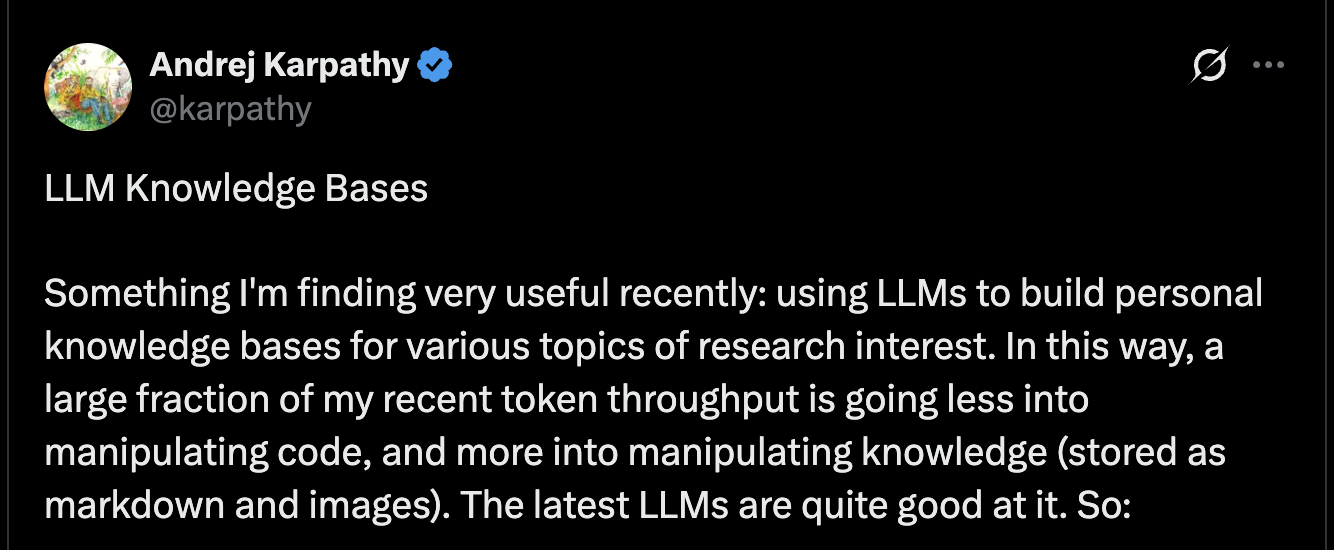
Wiki Memory

The Obsidian heads were right.
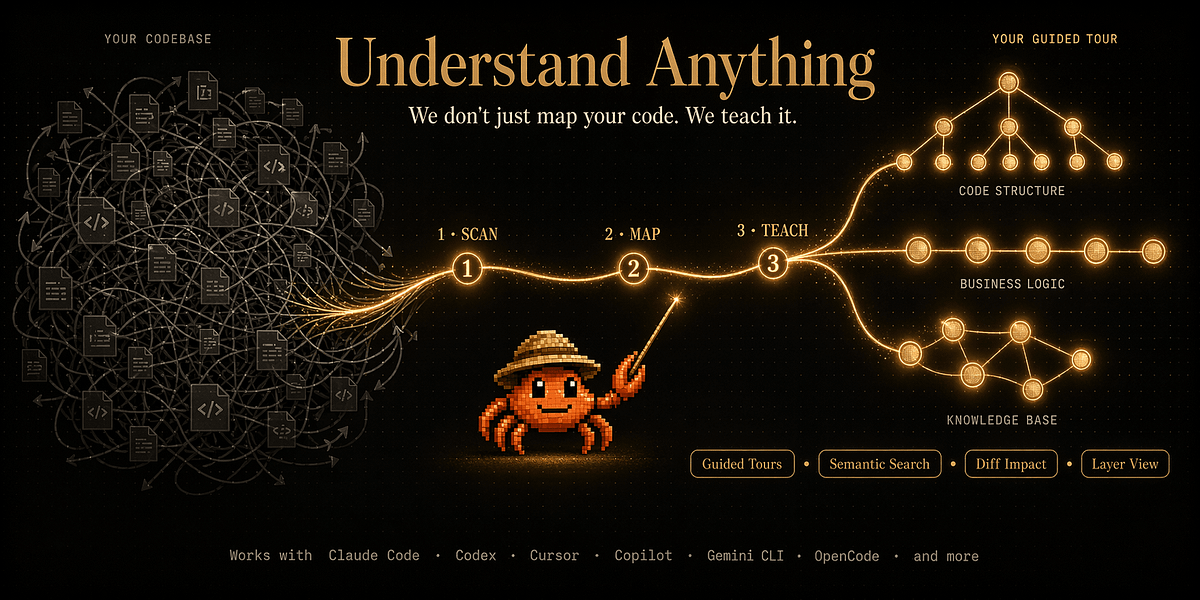
The Definitive Guide to Understand Anything: Turning Code and Knowledge Into Graphs That Teach
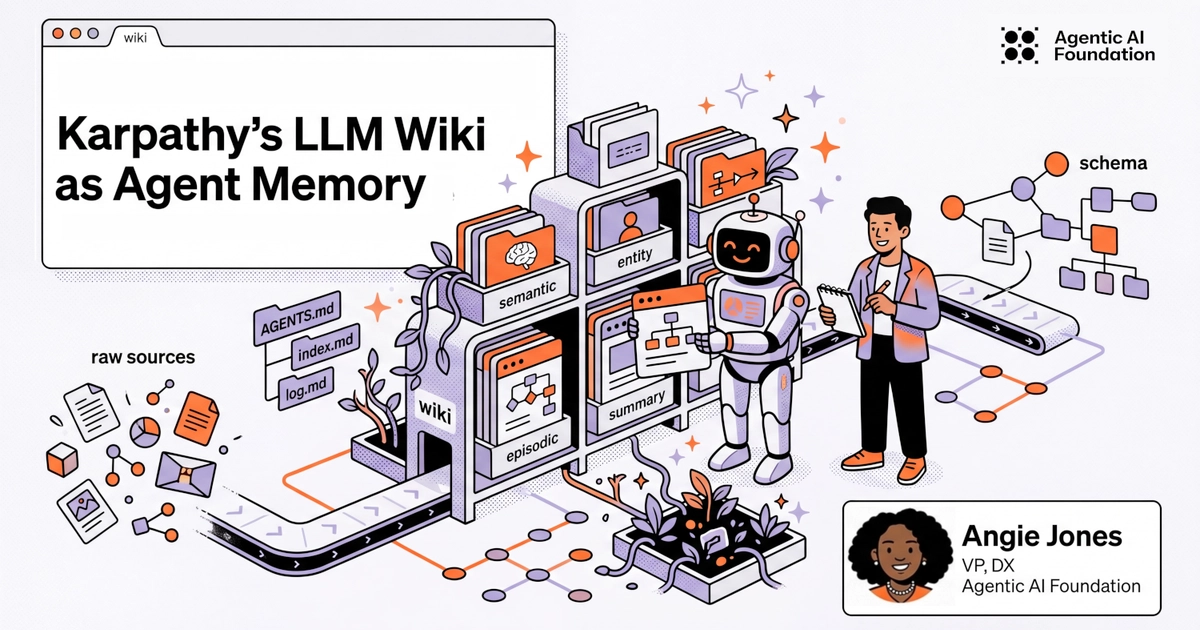
Karpathy's LLM Wiki as Agent Memory - Agentic AI Foundation (AAIF)