337 pages ; 24 cm; "Exploring the genesis of neoliberalism, and the political and economic circumstances of its deployment, Pierre Dardot and Christian Laval dispel numerous common misconceptions. Neoliberalism is neither a return to classical liberalism nor the restoration of "pure" capitalism. To misinterpret neoliberalism is to fail to understand what is new about it: far from viewing the market as a natural given that limits state action, neoliberalism seeks to construct the market and make the firm a model for governments. Only once this is grasped will its opponents be able to meet the unprecedented political and intellectual challenge it poses"--; Includes index; Includes bibliographical references and index
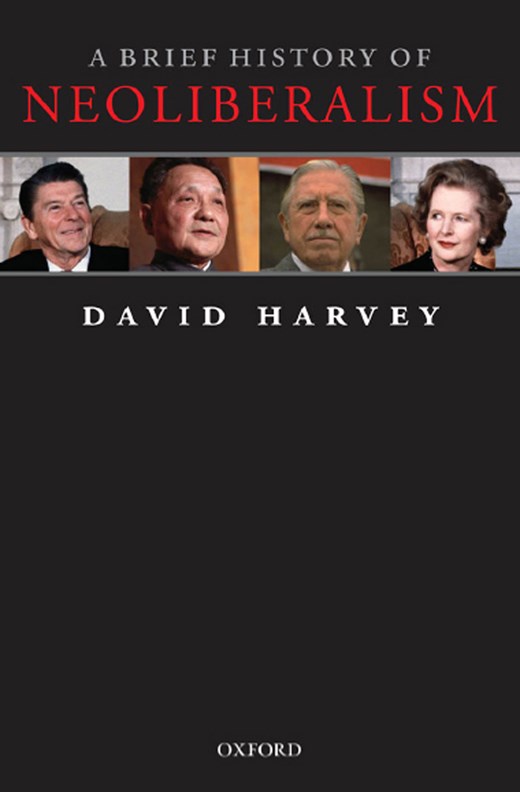
A Brief History of Neoliberalism
Abstract. Neoliberalism--the doctrine that market exchange is an ethic in itself, capable of acting as a guide for all human action--has become dominant in
Neoliberalism | The Paper Pilot
The Paper Pilot's digital garden of thoughts on philosophy, politics, and sociology
Neoliberalism – the ideology at the root of all our problems
Financial meltdown, environmental disaster and even the rise of Donald Trump – neoliberalism has played its part in them all. Why has the left failed to come up with an alternative?
Welcome to the new age of geoeconomics
Tech, trade, finance and military policies are mingling in a manner not seen during the neoliberal era

annotations: Le néolibéralisme et l’austérité
Blog de sciences économiques et sociales de Martin Anota. Traductions, revues de presse.
Neoliberal Fascism as the Endpoint of Casino Capitalism
This article explores neoliberal fascism as a distinctive political formation within the current historical moment. In doing so, it first analyzes neoliberalism as a project that has since the 1970s destroyed all the commanding institutions of democracy while consolidating power in the hands of a financial elite. In addition, it analyzes neoliberalism as a movement, that produces and legitimates massive economic inequality and suffering, privatizes public goods, dismantles essential government agencies, and individualizes all social problems. Under such circumstances, neoliberalism creates the conditions for right wing extremists to mobilize the anger of white disenfranchised working class populations by both appealing to the economic injustices they experience while simultaneously blaming and directing their frustrations towards non-white minority groups such as immigrants, blacks, and Muslims. It is precisely this merging of the social, political, and economic hardships produced by neoliberal capitalism and its appropriation of the discourse of white supremacy to divert attention from its worst excesses and failures that a neoliberal fascism is produced. Â More specifically, I argue that in the face of 40 years of neoliberalism with its production of massive inequality, a frontal attack on the welfare state, and the erosion of civic institutions and culture, there has been a resurgence of fascist discourses and a populist fascist political movement. Neoliberal fascism represents the conjoining of the most extreme elements of casino capitalism with the discourses of racial cleansing, and white nationalism. The article concludes by examining how atomization, fear, and anxiety have become the breeding grounds of fascism and what it means to revive education as a central tenet of politics so as to address the task of not simply resisting oppressive economic structures, but also what it means to engage in the massive challenge of changing individual and collective consciousness as a precondition for collective struggle and the building of new social movements. Author Biography Henry Giroux, McMaster University Chair for Scholarship in the Public Interest The Paulo Freire Distinguished Scholar in Critical Pedagogy
Le néolibéralisme, le libéralisme classique et l’économie néoclassique
Traduction du billet de blog "Neoliberalism, classical liberalism and neoclassical economics" de Matías Vernengo
.png)
Capitalist Realism: Is There No Alternative?
It is easier to imagine the end of the world than the end of capitalism. After 1989, capitalism has successfully presented itself as the only realistic political-economic system - a situation that the bank crisis of 2008, far from ending, actually compounded. The book analyses the development and principal features of this capitalist realism as a lived ideological framework. Using examples from politics, film (Children Of Men, Jason Bourne, Supernanny), fiction (Le Guin and Kafka), work and education, it argues that capitalist realism colors all areas of contemporary experience, is anything but realistic and asks how capitalism and its inconsistencies can be challenged. It is a sharp analysis of the post-ideological malaise that suggests that the economics and politics of free market neo-liberalism are givens rather than constructions. New Edition includes:Forward by Zoe Fisher, Mark’s wife, talking about Mark as a personIntroduction by Alex Niven, his friend and colleague, talking about the political significance of the book thirteen years after it was writtenAfterword by Tariq Goddard, the original editor and publisher, describing the writing and editing of the book, its original reception, and Mark’s own view of it"A quick and entertaining read." Socialist Standard "A provocative and necessary read...for anyone wanting to talk seriously about the politics of education today. " Times Higher Educational Supplement
The Liberalism to Fascism Pipeline (Neoliberalism Explained)
Preface | The World After Capital
Since publishing the previous version of The World After Capital, I have met with people across the political spectrum to discuss the ideas from the book. When I present these in person, I emphasize that the ideas are neither left nor right but forward (credit to Scott Santens who first used this phrase about Universal Basic Income). My writing, however, at times has alienated readers who identify as being more on the right. In this new edition, I am therefore making an extra effort to emphasize how both my diagnosis of where we are at and my suggestions for how to move forward do not map onto the existing political divides. Instead this is a new way of understanding our challenges and opportunities that can be the basis for movements and parties that are not trapped in Industrial Age ideology.
The Alternative to Capitalism Nobody Talks About | Eleanor Finley & Camila Vergara
Re-enchanting the world : feminism and the politics of the commons
xviii, 227 pages ; 23 cm; "Silvia Federici is one of the most important contemporary theorists of capitalism and feminist movements. In this collection of her work spanning over twenty years, she provides a detailed history and critique of the politics of the commons from a feminist perspective. In her clear and combative voice, Federici provides readers with an analysis of some of the key issues and debates in contemporary thinking on this subject. Drawing on rich historical research, she maps the connections between the previous forms of enclosure that occurred with the birth of capitalism and the destruction of the commons and the "new enclosures" at the heart of the present phase of global capitalist accumulation. Considering the commons from a feminist perspective, this collection centers on women and reproductive work as crucial to both our economic survival and the construction of a world free from the hierarchies and divisions capital has planted in the body of the world proletariat. Federici is clear that the commons should not be understood as happy islands in a sea of exploitative relations but rather autonomous spaces from which to challenge the existing capitalist organization of life and labor"--; Foreward by Peter Linebaugh; Includes bibliographical references (pages198-216) and index; On primitive accumulation, globalization, and reproduction -- Introduction to the new enclosures -- The debt crisis, Africa, and the new enclosures -- China: breaking the iron rice bowl -- From commoning to debt: financialization, microcredit, and the changing architecture of capital accumulation -- Beneath the United States, the Commons -- Commons against and beyond Capitalism -- The University: a knowledge common? -- Feminism and the politics of the commons in an era of primitive accumulation -- Women's struggles for land in Africa and the reconstruction of the commons -- Women's struggles for land and the common good in Latin America -- Marxism, feminism, and the commons -- From crisis to commons: reproductive work, affective labor and technology, and the transformation of everyday life -- Re-enchanting the world: technology, the body, and the construction of the commons

New Latin American Perspectives on the History of Neoliberalism — History & Political Economy Project
A roundtable discussion with César Castillo-García, Matilde Ciolli, and José Antonio Galindo Domínguez

Radical markets: uprooting capitalism and democracy for a just society
Many blame today's economic inequality, stagnation, and political instability on the free market. The solution is to rein in the market, right? Radical Markets turns this thinking on its head. With a new foreword by Ethereum creator Vitalik Buterin and virtual reality pioneer Jaron Lanier as well as a new afterword by Eric Posner and Glen Weyl, this provocative book reveals bold new ways to organize markets for the good of everyone. It shows how the emancipatory force of genuinely open, free, and competitive markets can reawaken the dormant nineteenth-century spirit of liberal reform and lead to greater equality, prosperity, and cooperation. Only by radically expanding the scope of markets can we reduce inequality, restore robust economic growth, and resolve political conflicts. But to do that, we must replace our most sacred institutions with truly free and open competition Radical Markets shows how

Exocapitalism: economies with absolutely no limits
There is a touch of destiny with this one. We have real…

Further Back to the Future: Neo-Royalism, the Trump Administration, and the Emerging International System
With the Liberal International Order (LIO) in decline, scholars have focused increasingly on the possible return to a Westphalian great power system marked by sovereigntist claims and balancing among states. The actions of the Trump administration, however, raise a number of significant puzzles for such accounts—the US seems willing to sign deals with traditional adversaries including Russia and China, while targeting long-standing allies like Canada and Denmark. At the same time, transactional politics often serve narrow personalist interests rather than national objectives. In short, a Westphalian lens focused on states and sovereignty may generate intellectual blinders that misreads the emerging international order. To overcome these limitations, we propose an alternative account, which we label neo-royalism. The neo-royalist order centers on an international system structured by a small group of hyper elites, which we term cliques. Such cliques seek to legitimize their authority through appeals to their exceptionalism in order to generate durable material and status hierarchies based on the extraction of financial and cultural tributes. This short paper lays out the key elements of the neo-royalist order, differentiating it from the Westphalian and Liberal International Orders, and applies its insights to better grapple with the emerging system being promoted by the United States under Donald J. Trump. For policymakers and scholars, the neo-royalist approach clarifies recent events in US foreign policy. Theoretically, the field should take contending ideas of international order seriously, and establish a research agenda beyond a backward looking view to the Westphalian moment.