These are recordings of Ursula Franklin's public lectures that she made as part of the 1989 Massey Lectures series. The recordings were broadcast by the Canadian Broadcasting Corporation in November, 1989. The lectures were published in a book The Real World of Technology in 1990. A second edition with four additional chapters was published in 1999. If you want you can drop this URL in your Podcast player to listen to them there: https://archive.org/download/the-real-world-of-technology/podcast.xml Franklin was a professor in the University of Toronto's Department of Metallurgy and Materials Science, where she was the first woman to honored with the title of University Professor in 1984. In 1990 she was awarded the Order of Ontario. The lectures provide a singular view into Franklin's ideas about how science and society interact with respective to power and democracy: As I see it, technology has built the house in which we all live. The house is continually being extended and remodelled. More and more of human life takes place within its walls, so that today there is hardly any human activity that does not occur within this house. All are affected by the design of the house, by the division of its space, by the location of its doors and walls. Compared to people in earlier times, we rarely have a chance to live outside this house. And the house is still changing; it is still being built as well as being demolished. In these lectures, I would like to take you through the house, starting with the foundation and then examining with you the walls that have been put up or taken down, the storeys and turrets that have been added, the flow of people through the house — who can come in, who can go into particular spaces. (p. 10) The recordings were obtained from the CBC's web page about Franklin's lectures. As you can see from this snapshot of the page in 2016 only five recordings were made available. However the preface to the first edition of The Real World of Technology clearly states that there were six. The Wikipedia page for the Massey Lectures says that it is a "five-part series", and looking at the information of other Massey lectures seems to confirm that it was in fact a 5 part series. Perhaps the book edition was adjusted to indicate there were 6 talks in order to reshape the text of the chapters? Or maybe it was a typo. The other possibility is that there was an audio file that was left off the website, but the sequencing of the closing credits for each part seems to indicate that there are no audio files missing. The audio was embedded as Flash on the CBC website and converted to MP3 in July, 2016.
The 1989 CBC Massey Lectures, "The Real World of Technology"
Technology has always been a part of human existence. Today though, says the experimental physicist, Ursula M. Franklin, technology has large-scale effects on culture itself. Ursula Franklin is an experimental physicist, University Professor Emeritus at the University of Toronto, a former board member of the National Research Council and the Science Council of Canada, and a companion of the Order...

Ursula Franklin
Ursula Martius Franklin was a Canadian metallurgist, activist, research physicist, author, and educator who taught at the University of Toronto for more than 40 years. Franklin is best known for her writings on the political and social effects of technology. She was the author of The Real World of Technology, which is based on her 1989 Massey Lectures; The Ursula Franklin Reader: Pacifism as a Map, a collection of her papers, interviews, and talks; and Ursula Franklin Speaks: Thoughts and Afterthoughts, containing 22 of her speeches and five interviews between 1986 and 2012. Franklin was a practising Quaker and actively worked on behalf of pacifist and feminist causes. She wrote and spoke extensively about the futility of war and the connection between peace and social justice. Franklin received numerous honours and awards, including the Governor General's Award in Commemoration of the Persons Case for promoting the equality of girls and women in Canada and the Pearson Medal of Peace for her work in advancing human rights. In 2012, she was inducted into the Canadian Science and Engineering Hall of Fame. A Toronto high school, Ursula Franklin Academy, as well as Ursula Franklin Street on the University of Toronto's St. George campus, have been named in her honor.

Topics — Real Life
ABOUT TOPICS: Since we began Real Life in the summer of 2016, we’ve run many essays across a range of topics, with a particular focus on the personal and cultural implications of living with technology. Our aim is not to track the news cycle so much as the longstanding social issues that inform and transcend it. We wanted to make it easier to read and explore Real Life beyond our chronological archive, so we’ve created these Topics to gather in one place the work we’ve published on some key themes. More Topics will be added to this page over time.

Technological Metamodernism (Sep 2024)
Technological Metamodernism A four-week course with Stephen Reid and special guests Telegram group: https://t.me/+4CC9lfZMBN04ZTdk Substack post announcing the open-sourcing of the notes: https://stephenreid.substack.com/p/technological-metamodernism-course This work is licensed under Cre...

How China’s Renewable Push Upends Geopolitics w/ Kate Mackenzie & Tim Sahay
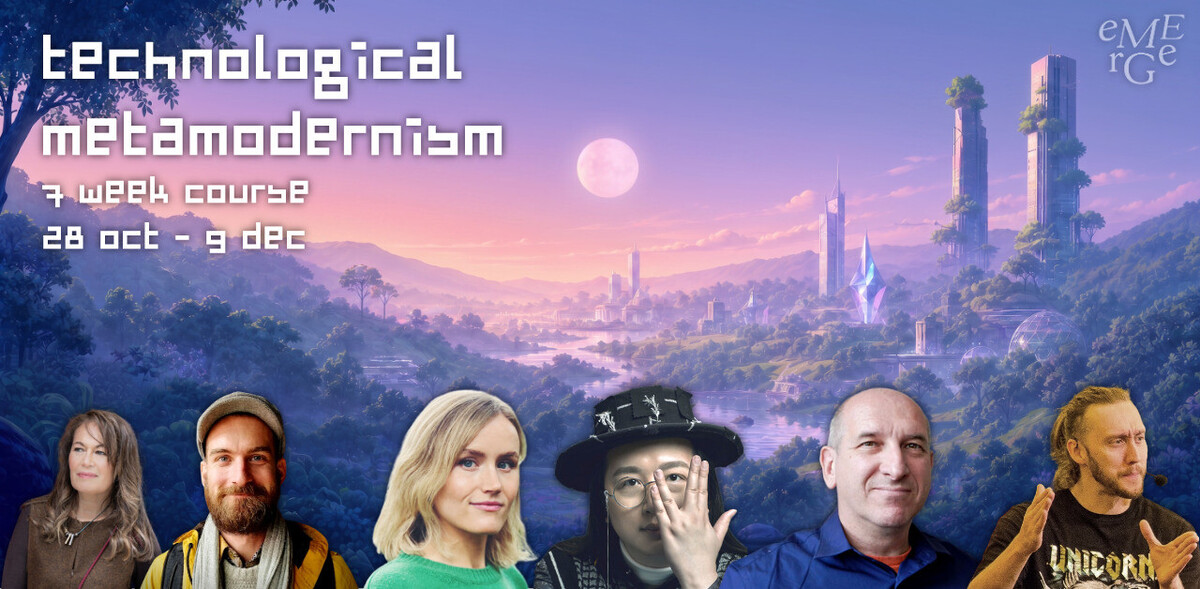
Technological Metamodernism: A seven-week course
Wed 28th Oct 2026, 1pm – Wed 9th Dec 2026, 2pm EDT (UTC -04:00)
The Nature of Technology: What It Is and How It Evolves
Leading scientific theorist W. Brian Arthur puts forth …

Ursula's list
Ursula Franklin is one of my all-time favorite thinkers about both the obvious and obscured parts of our technological world.
Pourquoi la technologie américaine domine-t-elle ?
traduction française du billet de blog "Why does U.S. technology rule?" de Paul Krugman

Technological Metamodernism | Hilma Church-Turing | Substack
Click to read Technological Metamodernism, a Substack publication with hundreds of subscribers.

Has technological innovation lost the plot? An interview with AI ethicist Dr. Shannon Vallor | Chicago Policy Review
Shannon Vallor is the Baillie Gifford Chair in the Ethics of Data and Artificial Intelligence at the Edinburgh Futures Institute (EFI) at the University of Edinburgh, where she is also appointed in Philosophy. Professor Vallor’s research explores how new technologies, especially AI, robotics, and data science, reshape human moral character, habits, and practices. She is […]

On Understanding Power and Technology
I went to a Q&A by the “godfather of AI” Geoff Hinton the other night, and was invited to a (mostly) academic dinner afterwards. In the…

The Whale and the Reactor: A Search for Limits in an Age of High Technology, Second Edition
“In an age in which the inexhaustible power of scientific technology makes all things possible, it remains to be seen where we will draw the line, where we will be able to say, here are possibilities that wisdom suggest we avoid.” First published to great acclaim in 1988, Langdon Winner’s groundbreaking exploration of the political, social, and philosophical implications of technology is timelier than ever. He demonstrates that choices about the kinds of technical systems we build and use are actually choices about who we want to be and what kind of world we want to create—technical decisions are political decisions, and they involve profound choices about power, liberty, order, and justice. A seminal text in the history and philosophy of science, this new edition includes a new chapter, preface, and postscript by the author.

Humanities in the Machine - Blain Smith
There is something quietly remarkable about the people who built the foundations of modern computing. Not their technical achievements, though those are extraordinary. What is remarkable is where they came from before they ever touched a machine.
Technocracy | The Paper Pilot
The Paper Pilot's digital garden of thoughts on philosophy, politics, and sociology
Episode 5: Metaphors for AI, with Shannon Vallor
This week, Adam talks with Shannon Vallor, a philosopher of AI, about the metaphors we use to talk about AI and ourselves. They also dunk on libertarians and San Francisco billboards, and consider what kind of hope we can have for the future of technology.Messages: • Support the show at patreon.com/DreamingAgainstTheMachine • Follow us on Bluesky and Instagram • Subscribe to the show wherever you get your podcasts! • Check out other great podcasts from Multitude like Wow if TrueAbout the show:Dreaming Against the Machine is a podcast about envisioning a realistic and hopeful future. Each week, the show’s host, journalist and astrophysicist Dr. Adam Becker, will have an earnest (and entertaining!) conversation with a guest about possible futures, seen through the lenses of history, science, and culture. In a world where tech oligarchs and their power fantasies are driving visions of the future, Dreaming Against the Machine aims to take back the terms of the public conversation about what our world can and should be.