


Come in, CQ: the body on the wire / Ellen Ullman -- The memoirs of a token: an aging Berkeley feminist examines Wired / Paulina Borsook -- How hard can it be? / Karen Coyle -- Closure was never a goal in this piece / Judy Malloy and Cathy Marshall -- Estrogen brigades and "big tits" threads: media fandom online and off / Susan Clerc -- Elites, lamers, narcs and whores: exploring the computer underground / Netta "grayarea" Gilboa -- We are geeks, and we are not guys: the systers mailing list / L. Jean Camp -- Not for the faint of heart: contemplations on Usenet / Judy Anderson "yduJ" -- The price of admission: harassment and free speech in the wild, wild West / Stephanie Brail -- Sex, fear and condescension on campus: cybercensorship at Carnegie Mellon / Donna M. Riley -- Cocktails and thumbtacks in the old West: what would Emily Post say? / Laurel A. Sutton -- "So please stop, thank you": girls online / Michele Evard -- MUDder? I hardly know 'er: adventures of a feminist MUDder / Lori Kendall -- Like magic, only real / Tari Lin Fanderclai -- Coming apart at the seams: sex, text and the virtual body / Shannon McRae; Includes bibliographical references; Ellen Ullman shares an email courtship - Paulina Borsook exposes gender attitudes at the digerati's magazine of record - Karen Coyle on overcoming macho stereotypes - Judy Malloy and Cathy Marshall reflect on their art/research collaboration - Susan Clerc and the zeal of media fandom - Netta Gilboa explores hackers' attitudes toward women - Jean Camp on the Internet's safe havens - Judy Anderson's advice on dodging Usenet flames - Stephanie Brail seeks the line between free speech and harassment - Donna Riley reveals the story of the Clitoral Hoods - Laurel Sutton and the nuances of netiquette - Michele Evard takes news-groups to the fifth grade - Lori Kendall wonders if gender is meaningless online - Tari Lin Fanderclai on MUDs as a powerful teaching tool - Shannon McRae takes a look at "virtual sex"
Glitch feminism: a manifesto
"A new manifesto for cyberfeminism. The divide between the digital and the real world no longer exists: we are connected all the time. How do we find out who we are within this digital era? Where do we create the space to explore our identity? How can we come together and create solidarity? The glitch is often dismissed as an error, a faulty overlaying, but, as Legacy Russell shows, liberation can be found within the fissures between gender, technology and the body that it creates. The glitch offers the opportunity for us to perform and transform ourselves in an infinite variety of identities. In Glitch Feminism, Russell makes a series of radical demands through memoir, art and critical theory, and the work of contemporary artists who have travelled through the glitch in their work. Timely and provocative, Glitch Feminism shows how the error can be a revolution"--Publisher's website

Data Feminism for AI
Attacks on women and trans people are not happening in a vacuum. Communications scholars W. Lance Bennett and Marianne Kneuer recently argued that we are witnessing the intensification of "illiberal public spheres" around the world (Bennett and Kneuer, 2023). These are characterized by a set of anti-democratic communications tactics that include the denigration and exclusion of minoritized people, targeted attacks on the press and political institutions, and transgression of norms of civil discourse. Such tactics are enabled and amplified by the social media platforms owned by Big Tech, whose business model elevates attention above all other metrics, such that they profit richly off extremism, threats, spectacle, and lies. The success of this corporate partnership with right-wing extremism is evident in the proliferation of book bans (Magnusson, 2024), the demonization of DEI and critical race theory (Crenshaw, 2022), and mob tactics to doxx, intimidate, misrepresent, and otherwise silence people that study misinformation, speak out against racial and gender violence, or rule against insurrectionists (Edmonds, 2024). At the same time, we have seen the continued work of feminists, including Latin American, Indigenous, and abolitionist feminists in the US and globally, doing the work of imagining alternate worlds (Cullors, 2021; Davis, 2022; Ricaurte, 2019; Simpson, 2017). This paper represents our own first attempt to imagine a more equitable, sustainable, feminist world for AI research.
Who's Afraid of Gender? (A Guide to Judith Butler)
Feminism | The Paper Pilot
The Paper Pilot's digital garden of thoughts on philosophy, politics, and sociology
Joanna Russ- SF and Technology as Mystification
Talk about technology, long familiar to science-fiction readers and writers, is getting popular in Academia too. Particularly interesting to humanists is the connection between technology and whatever their own particular subject happens to be; I've attended three such formal symposia in the last five years, six including SF conventions, and including informal discussions among students, in writing classes, SF classes, and elsewhere, somewhere between fifty and sixty.
Sharing Knowledge Openly: Author Gender, Race/Ethnicity, and Feminist Science
Open science is an increasingly important movement in contemporary social science. Many funders have begun to mandate open practices, newer journals like Socius are open access, and preprint servers have increased readership of paywalled articles. Feminist scholars have written about the values and pitfalls of open research. In this paper, we put those ideas in conversation with each other and empirical data on open-access publishing to develop a feminist framework for thinking about feminist knowledge, data, publishing, and audience. Using a survey of 19,462 social scientists, linked with their entire Web of Science publication history from 2000 to 2023 and all papers posted to SocArXiv, we replicate past work showing that articles by women are less likely to be some types of open access. We extend these findings to scholars of color and feminist scholarship, while also demonstrating a few surprising null results for all three groups.

Gender Performativity | The Paper Pilot
The Paper Pilot's digital garden of thoughts on philosophy, politics, and sociology
Social media for sex workers, IGF 2019 | Kollektiv.e
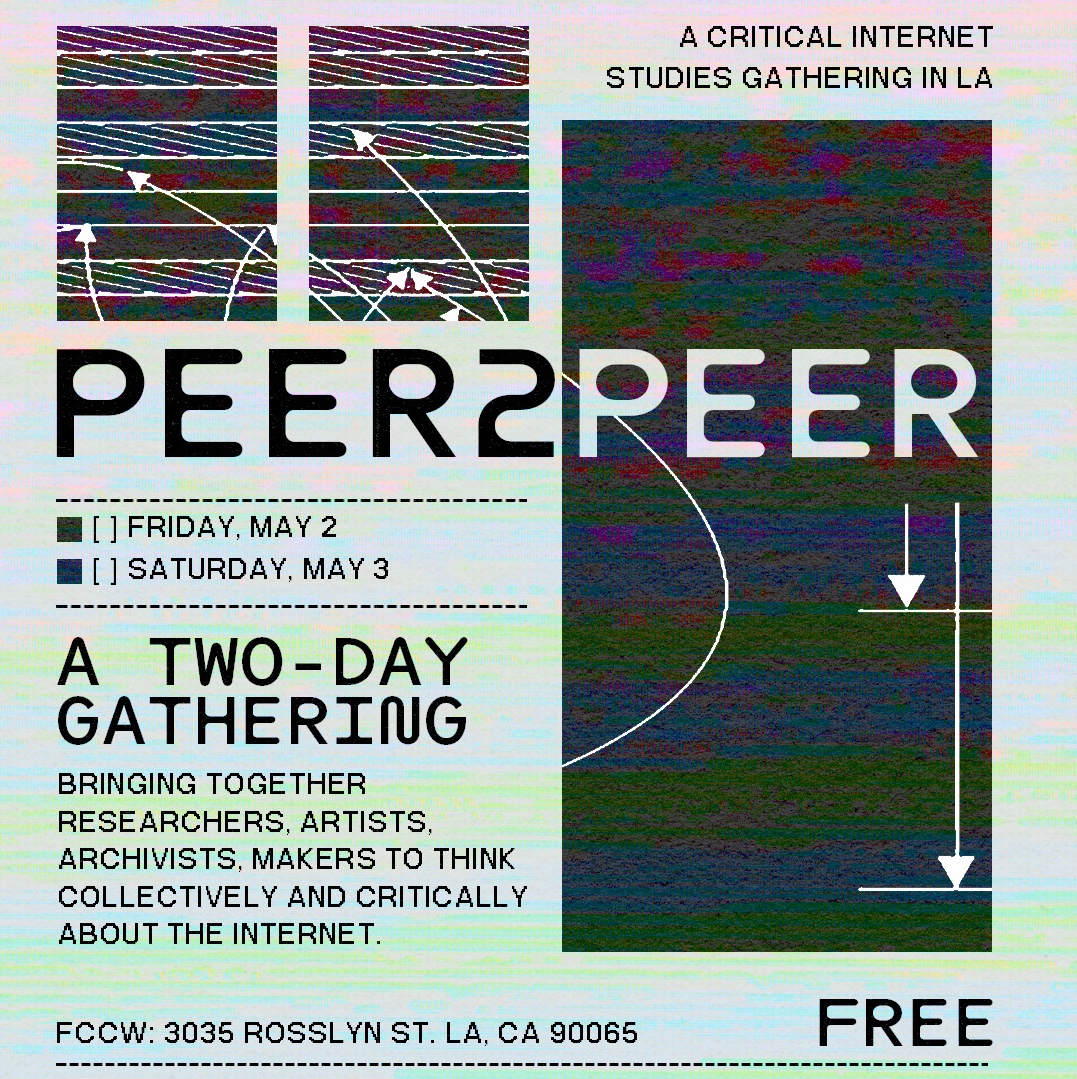
Peer2Peer: A Critical Internet Studies Gathering in LA - FCCW: Feminist Center for Creative Work
UCLA Center for Critical Internet Inquiry and FCCW Present Peer2Peer: A Critical Internet Studies Gathering in LA Friday, May 2 & Saturday, May 3 FCCW: 3035 Rosslyn St. LA, CA 90065 Info on our space Free Peer2Peer is a two-day gathering bringing together researchers, artists, archivists, and makers to think collectively and critically about the Internet. Come hear incredible new work from our research community, learn how to up your digital security, learn how to archive (or not!) the web, come laugh at jokes about the Internet! All events unless otherwise noted are open to the public. Come for an hour or stay for the whole two-days!
Governable spaces: a feminist agenda for platform policy
A proposal, informed by feminist theory, for a policy agenda of “governable spaces” across the domains of social media, gig economies, and network infrastructure.

A Queer and Feminist Defense of Being Anonymous Online
From the earliest days of digital communities, online abuse has been connected to anonymity. While concerns around the impact of anonymity, particularly for women, people of color and LGBTQ folks, is legitimate, this paper argues that a flat rejection of digital anonymity is problematic, foreclosing certain forms of queer and feminist praxis. To make this case, I turn to the platform politics of Craigslist. Using Craigslist as a case study, I discuss the persistent stigma attached to online anonymity, before addressing specific tactics of online anonymity associated with queer and feminist values of privacy and mutual aid. Drawing on accounts of Craigslist users who saw anonymity as a protective form of control over their personal information, I outline ways in which anonymity is not solely an enabler for misogyny and homophobia, and can instead (or rather, also) be a subversive tool for self-expression and intimacy.
A Queer and Feminist Defense of Being Anonymous Online
From the earliest days of digital communities, online abuse has been connected to anonymity. While concerns around the impact of anonymity, particularly for women, people of color and LGBTQ folks, is legitimate, this paper argues that a flat rejection of digital anonymity is problematic, foreclosing certain forms of queer and feminist praxis. To make this case, I turn to the platform politics of Craigslist. Using Craigslist as a case study, I discuss the persistent stigma attached to online anonymity, before addressing specific tactics of online anonymity associated with queer and feminist values of privacy and mutual aid. Drawing on accounts of Craigslist users who saw anonymity as a protective form of control over their personal information, I outline ways in which anonymity is not solely an enabler for misogyny and homophobia, and can instead (or rather, also) be a subversive tool for self-expression and intimacy.
Gender Trouble: Feminism and the Subversion of Identity
One of the most talked-about scholarly works of the past fifty years, Judith Butler’s Gender Trouble is as celebrated as it is controversial.Arguing that traditional feminism is wrong to look to a natural, 'essential' notion of the female, or indeed of sex or gender, Butler starts by questioning the category 'woman' and continues in this vein with examinations of 'the masculine' and 'the feminine'. Best known however, but also most often misinterpreted, is Butler's concept of gender as a reiterated social performance rather than the expression of a prior reality.Thrilling and provocative, few other academic works have roused passions to the same extent.

2026 IC2S2: Keynote Presentation by Kate Starbird
Feminist Technology
Feminist technology is not related to one specific community of practice, but it has been a field of research and has led to and is still leading to practices that are very valuable in the context of sustainable tech.