

Arend is a theorem prover based on Homotopy Type Theory. It natively supports higher inductive types and a version of cubical syntax. IntelliJ Arend is a plugin for IntelliJ IDEA that turns it into a full-fledged IDE for the Arend language.
Mathematics with large language models as provers and verifiers
During 2024 and 2025 the discussion about the theorem-proving capabilities of large language models started reporting interesting success stories, mostly to do with difficult exercises (such as problems from the International Mathematical Olympiad), but also with conjectures [Feldman & Karbasi, arXiv:2509.18383v1] formulated for the purpose of verifying whether the artificial intelligence could prove it. In this paper we report a theorem proving feat achieved by ChatGPT by using a protocol involving different prover and verifier instances of the gpt-5 model working collaboratively. To make sure that the produced proofs do not suffer from hallucinations, the final proof is formally verified by the lean proof assistant, and the conformance of premises and conclusion of the lean code is verified by a human. Our methodology is by no means complete or exact. It was nonetheless able to solve five out of six 2025 IMO problems, and close about a third of the sixty-six number theory conjectures in [Cohen, Journal of Integer Sequences, 2025].

Mathematics with large language models as provers and verifiers
During 2024 and 2025 the discussion about the theorem-proving capabilities of large language models started reporting interesting success stories, mostly to do with difficult exercises (such as problems from the International Mathematical Olympiad), but also with conjectures [Feldman & Karbasi, arXiv:2509.18383v1] formulated for the purpose of verifying whether the artificial intelligence could prove it. In this paper we report a theorem proving feat achieved by ChatGPT by using a protocol involving different prover and verifier instances of the gpt-5 model working collaboratively. To make sure that the produced proofs do not suffer from hallucinations, the final proof is formally verified by the lean proof assistant, and the conformance of premises and conclusion of the lean code is verified by a human. Our methodology is by no means complete or exact. It was nonetheless able to solve five out of six 2025 IMO problems, and close about a third of the sixty-six number theory conjectures in [Cohen, Journal of Integer Sequences, 2025].
Homotopy Type Theory: Univalent Foundations of Mathematics
Homotopy type theory is a new branch of mathematics, based on a recently discovered connection between homotopy theory and type theory, which brings new ideas into the very foundation of mathematics. On the one hand, Voevodsky's subtle and beautiful "univalence axiom" implies that isomorphic structures can be identified. On the other hand, "higher inductive types" provide direct, logical descriptions of some of the basic spaces and constructions of homotopy theory. Both are impossible to capture directly in classical set-theoretic foundations, but when combined in homotopy type theory, they permit an entirely new kind of "logic of homotopy types". This suggests a new conception of foundations of mathematics, with intrinsic homotopical content, an "invariant" conception of the objects of mathematics -- and convenient machine implementations, which can serve as a practical aid to the working mathematician. This book is intended as a first systematic exposition of the basics of the resulting "Univalent Foundations" program, and a collection of examples of this new style of reasoning -- but without requiring the reader to know or learn any formal logic, or to use any computer proof assistant.
iddqd, or the hardest kind of unsafe Rust | Oxide Computer Company
How our Rust collections library defends against adversarial trait implementations.
Simply Typed Reverse-Mode Automatic Differentiation with Variants: Denotational Correctness via Idempotent Completion
Reverse-mode automatic differentiation can be derived denotationally as a structure-preserving interpretation of program syntax. In the usual simply typed model, each source type has one cotangent type. Variants break this representation because the valid cotangent space depends on the branch selected at run time; established correctness results therefore use primal-indexed families of cotangent spaces, whose direct internal language is dependent.
GHC/Typed holes - HaskellWiki
Typed holes are a powerful feature in GHC inspired by Agda. But what are typed holes, and how do they help us write code?
Sequoia Backs Zed's Vision for Collaborative Coding
From the Zed Blog: This investment lets us pursue our vision for bringing a new kind of collaboration directly into the IDE.

lambek - Rust
Lambek is a library that enables type-level programming in stable Rust, supporting advanced features including higher kinded types, higher ranked types, and constraint kinds. Although Rust do not natively support these features, Lambek uses techniques including defunctionalization and CPS transformation to emulate these features in Rust.
HedgeDoc - Ideas grow better together
HedgeDoc (formerly known as CodiMD) is an open-source, web-based, self-hosted, collaborative markdown editor.

Formalizing the Real Numbers in Homotopy Type Theory with Cubical Agda
Real numbers in constructive mathematics have always seemed to require compromises of one form or another. Classical proofs of Cauchy completeness require countable choice, Bishop's setoid construction introduces persistent bookkeeping overhead on every definition and theorem, and Dedekind cuts force cumbersome universe-level tracking in predicative type theory. The Homotopy Type Theory (HoTT) book presents an alternative construction of the Cauchy real numbers as a higher inductive-inductive type family, avoiding all three compromises. We formalize the HoTT book reals in Cubical Agda, a proof assistant whose native support for higher inductive types allows the construction to be expressed directly. The code type-checks without postulates or holes, providing a foundation for further machine-assisted work in constructive analysis.
Simon on Twitter / X
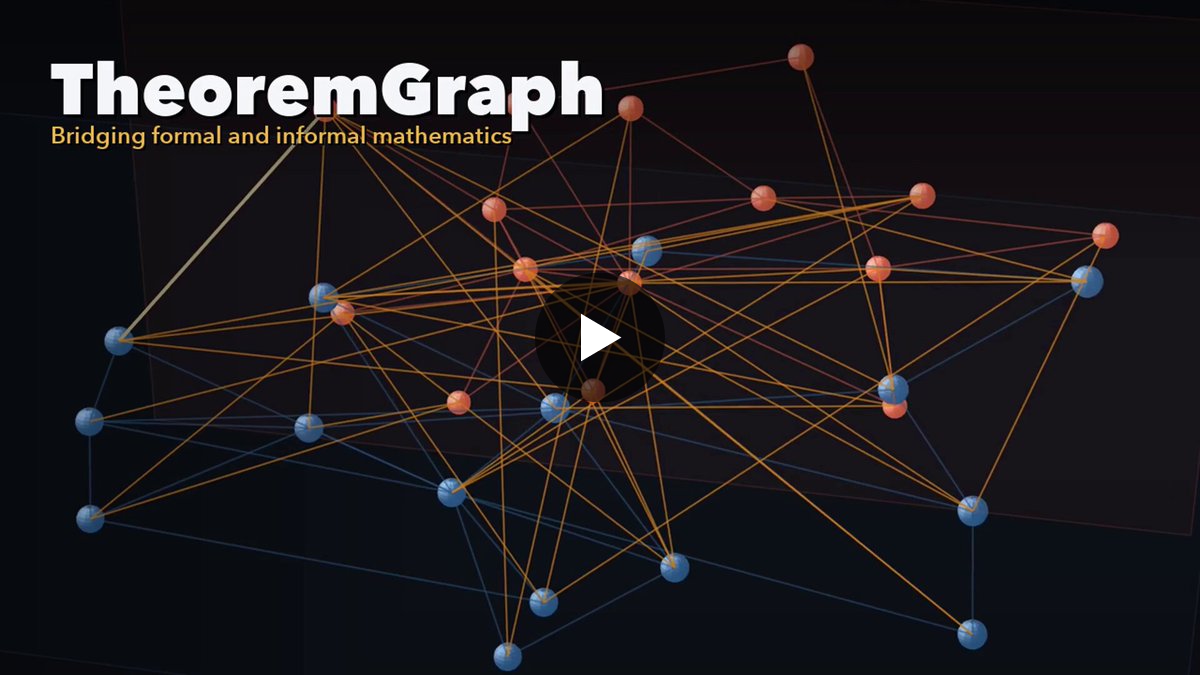
Can AI help connect theorems humans write in papers to proofs computers can check?We just released TheoremGraph (https://t.co/PQ8FcFQGat), and I made a 3Blue1Brown style video overview of the idea.This project was my first real research experience, and it meant a lot. Start… pic.twitter.com/yMUA0QziXM— Simon (@waskaja) June 29, 2026
Mutual intelligibility for schema idiolects.

GitHub - idiolect-dev/idiolect: Mutual intelligibility for schema idiolects.
github.com