


Explore Twitter's recommendation system - in-memory graph processing with Cassovary, random walks, and SALSA for user suggestions.
WTF: the who to follow service at Twitter | Request PDF
Request PDF | WTF: the who to follow service at Twitter | WTF ("Who to Follow") is Twitter's user recommendation service, which is responsible for creating millions of connections daily between users... | Find, read and cite all the research you need on ResearchGate

Twitter's For You Recommendation Algorithm
Twitter has open-sourced a majority of its recommendation algorithm. It offers an exciting opportunity for researchers, industry practitioners, and RecSys enthusiasts to take a close look at how Twitter computes the recommended feed for the For You page. This article described Twitter’s end-to-end recommender system along with relevant literature and code references.

WTF: The Who to Follow Service at Twitter
This describes the architectural overview including the technologies used behind, building and running the popular service known as “Who To…

Deep Dive: Inside X (fka Twitter)’s Recommendation Algorithm
Decoding the Machine That Powers Your “For You” Timeline ,When Elon Musk open-sourced Twitter’s recommendation algorithm in March 2023, it…

WTF: the who to follow service at Twitter
As part of the Digital Library's transition to Open Access, new features for researchers are available in the Premium Edition. Click here to learn more.

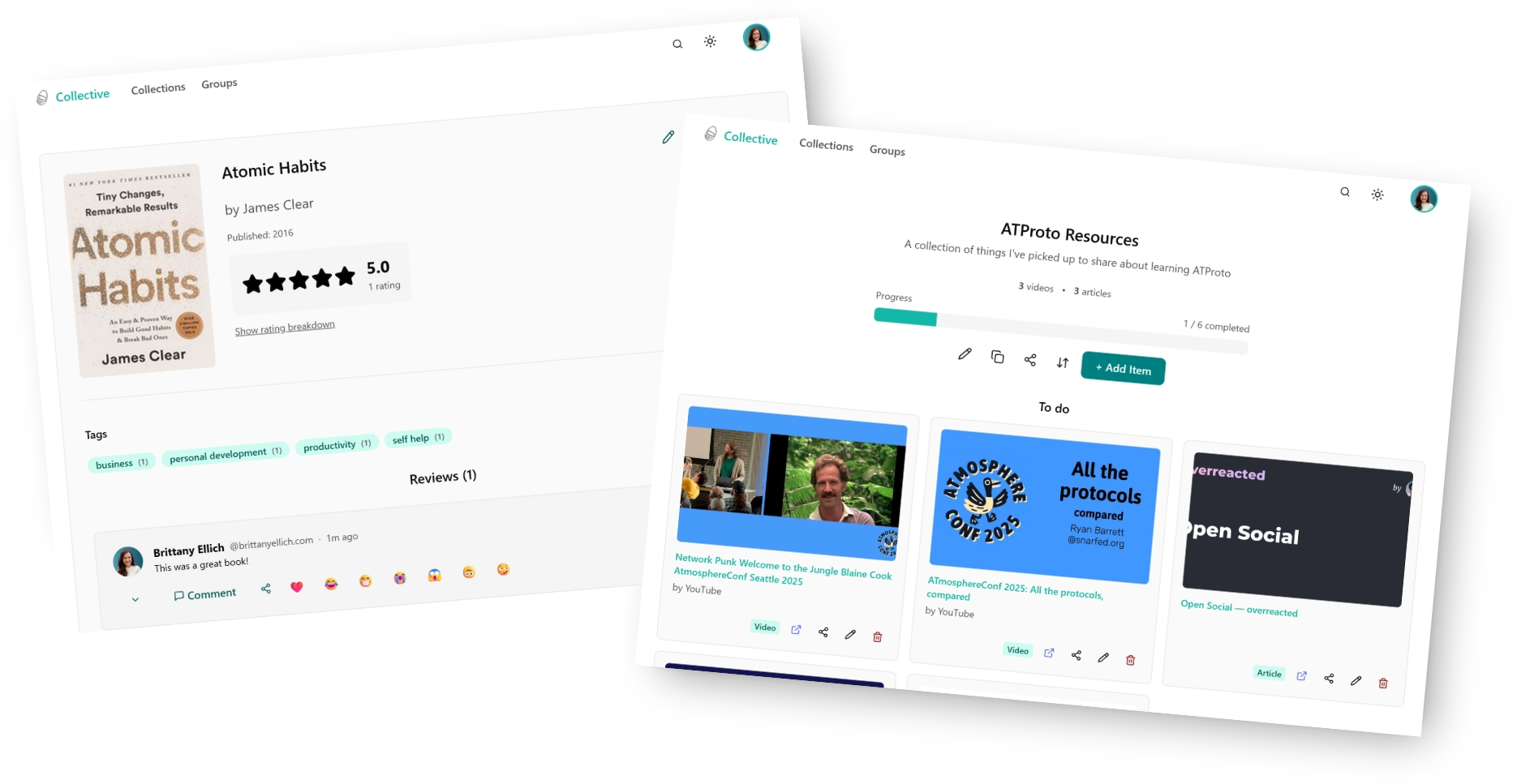
Collective Social | Track what you love. Share what matters.
Curate lists, track your progress, and share recommendations across books, movies, TV shows, and more — all on the open social web.
Paper Skygest: Personalized Academic Recommendations on Bluesky
We build, deploy, and evaluate Paper Skygest, a custom personalized social feed for scientific content posted by a user's network on Bluesky and the AT Protocol. We leverage a new capability on emerging decentralized social media platforms: the ability for anyone to build and deploy feeds for other users, to use just as they would a native platform-built feed. To our knowledge, Paper Skygest is the first and largest such continuously deployed personalized social media feed by academics, with over 50,000 weekly uses by over 1,000 daily active users, all organically acquired. First, we quantitatively and qualitatively evaluate Paper Skygest usage, showing that it has sustained usage and satisfies users; we further show adoption of Paper Skygest increases a user's interactions with posts about research, and how interaction rates change as a function of post order. Second, we share our full code and describe our system architecture, to support other academics in building and deploying such feeds sustainably. Third, we overview the potential of custom feeds such as Paper Skygest for studying algorithm designs, building for user agency, and running recommender system experiments with organic users without partnering with a centralized platform.

Understanding Social Media Recommendation Algorithms
Access the PDF version of this essay by clicking the icon to the right.

Social Media Feed Ranking Algorithms: Guide to Field Experiments
IC2S2'26 Tutorial | Social Media Feed Ranking Algorithms: Guide to Field Experiments
How the Twitter/X Algorithm Works in 2026 (Source Code)
Twitter published its ranking weights on GitHub. A reply is worth 150x a like. Free accounts get 10x less reach. Full scoring system explained.

How Platform Recommenders Work – Center for Human-Compatible Artificial Intelligence
A recommender system (or simply ‘recommender’) is an algorithm that takes a large set of items and determines which of those to display to a user—think the Facebook News Feed, the Twitter timeline, Google News, or the YouTube homepage. Recommenders are necessary tools to help navigate the sheer volume of content produced each day, but their scale and rapid development can cause unintended consequences. Facebook’s algorithms have been blamed for radicalizing users, TikTok’s for inundating teens with eating-disorder videos, and Twitter’s for political bias.
Linus on Twitter / X
Notion serves millions of very dynamic, heavily modified interactive collaborative documents to users every day. At some point the line between documents and apps blur sufficiently.— Linus (@thesephist) August 15, 2025
[Draft] Follow anyone — Open Indie
I just wanna keep track of people I care for and find interesting. The type of feed(s) available for subscription (blog, micro-blog, chat...

BridgEU: new project to study how recommendation systems can reduce polarization | SynoSys
A new collaborative project with Philipp Lorenz-Spreen, Eurosky, and SPRIND explores whether social media recommendation algorithms can strengthen public discourse instead of reinforcing divisions.
Social media algorithms don't allow us to understand or control what we see online and why... until now! Top scholars @jonathanstray.com and @noupside.bsky.social are sharing @mysky.social, a tool that allows users to adjust their feed’s priorities and explains why certain posts appear over others.

🎛️📲 Meet the algorithm you can actually control and understand
newpublic.substack.com