


New estimate: Fossil fuel companies have caused trillions of dollars in damages.
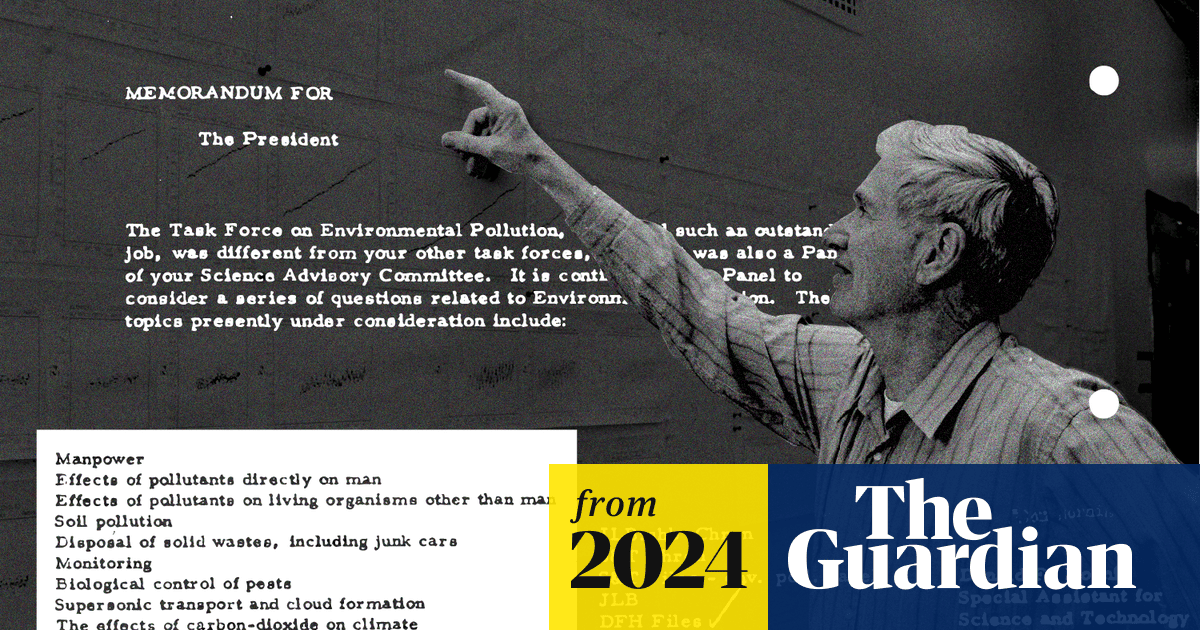
‘Smoking gun proof’: fossil fuel industry knew of climate danger as early as 1954, documents show
Documents show industry-backed Air Pollution Foundation uncovered the severe harm climate change would wreak
Assessing ExxonMobil’s global warming projections
Climate projections by the fossil fuel industry have never been assessed. On the basis of company records, we quantitatively evaluated all available global warming projections documented by—and in many cases modeled by—Exxon and ExxonMobil Corp scientists between 1977 and 2003. We find that most of their projections accurately forecast warming that is consistent with subsequent observations. Their projections were also consistent with, and at least as skillful as, those of independent academic and government models. Exxon and ExxonMobil Corp also correctly rejected the prospect of a coming ice age, accurately predicted when human-caused global warming would first be detected, and reasonably estimated the “carbon budget” for holding warming below 2°C. On each of these points, however, the company’s public statements about climate science contradicted its own scientific data. , Insider knowledge For decades, some members of the fossil fuel industry tried to convince the public that a causative link between fossil fuel use and climate warming could not be made because the models used to project warming were too uncertain. Supran et al . show that one of those fossil fuel companies, ExxonMobil, had their own internal models that projected warming trajectories consistent with those forecast by the independent academic and government models. What they understood about climate models thus contradicted what they led the public to believe. —HJS , ExxonMobil’s own climate models showed that fossil fuel use would cause climate warming. , BACKGROUND In 2015, investigative journalists discovered internal company memos indicating that Exxon oil company has known since the late 1970s that its fossil fuel products could lead to global warming with “dramatic environmental effects before the year 2050.” Additional documents then emerged showing that the US oil and gas industry’s largest trade association had likewise known since at least the 1950s, as had the coal industry since at least the 1960s, and electric utilities, Total oil company, and GM and Ford motor companies since at least the 1970s. Scholars and journalists have analyzed the texts contained in these documents, providing qualitative accounts of fossil fuel interests’ knowledge of climate science and its implications. In 2017, for instance, we demonstrated that Exxon’s internal documents, as well as peer-reviewed studies published by Exxon and ExxonMobil Corp scientists, overwhelmingly acknowledged that climate change is real and human-caused. By contrast, the majority of Mobil and ExxonMobil Corp’s public communications promoted doubt on the matter. ADVANCES Many of the uncovered fossil fuel industry documents include explicit projections of the amount of warming expected to occur over time in response to rising atmospheric greenhouse gas concentrations. Yet, these numerical and graphical data have received little attention. Indeed, no one has systematically reviewed climate modeling projections by any fossil fuel interest. What exactly did oil and gas companies know, and how accurate did their knowledge prove to be? Here, we address these questions by reporting and analyzing all known global warming projections documented by—and in many cases modeled by—Exxon and ExxonMobil Corp scientists between 1977 and 2003. Our results show that in private and academic circles since the late 1970s and early 1980s, ExxonMobil predicted global warming correctly and skillfully. Using established statistical techniques, we find that 63 to 83% of the climate projections reported by ExxonMobil scientists were accurate in predicting subsequent global warming. ExxonMobil’s average projected warming was 0.20° ± 0.04°C per decade, which is, within uncertainty, the same as that of independent academic and government projections published between 1970 and 2007. The average “skill score” and level of uncertainty of ExxonMobil’s climate models (67 to 75% and ±21%, respectively) were also similar to those of the independent models. Moreover, we show that ExxonMobil scientists correctly dismissed the possibility of a coming ice age in favor of a “carbon dioxide induced ‘super-interglacial’”; accurately predicted that human-caused global warming would first be detectable in the year 2000 ± 5; and reasonably estimated how much CO 2 would lead to dangerous warming. OUTLOOK Today, dozens of cities, counties, and states are suing oil and gas companies for their “longstanding internal scientific knowledge of the causes and consequences of climate change and public deception campaigns.” The European Parliament and the US Congress have held hearings, US President Joe Biden has committed to holding fossil fuel companies accountable, and a grassroots social movement has arisen under the moniker #ExxonKnew. Our findings demonstrate that ExxonMobil didn’t just know “something” about global warming decades ago—they knew as much as academic and government scientists knew. But whereas those scientists worked to communicate what they knew, ExxonMobil worked to deny it—including overemphasizing uncertainties, denigrating climate models, mythologizing global cooling, feigning ignorance about the discernibility of human-caused warming, and staying silent about the possibility of stranded fossil fuel assets in a carbon-constrained world. Historically observed temperature change (red) and atmospheric carbon dioxide concentration (blue) over time, compared against global warming projections reported by ExxonMobil scientists. ( A ) “Proprietary” 1982 Exxon-modeled projections. ( B ) Summary of projections in seven internal company memos and five peer-reviewed publications between 1977 and 2003 (gray lines). ( C ) A 1977 internally reported graph of the global warming “effect of CO 2 on an interglacial scale.” (A) and (B) display averaged historical temperature observations, whereas the historical temperature record in (C) is a smoothed Earth system model simulation of the last 150,000 years.

In Deep
The numbers are simply mind-blowing: up to £264 billion for a climate “solution” that will increase emissions. Has the government lost its mind?

Exxon Knew about Climate Change Almost 40 Years Ago
A new investigation shows the oil company understood the science before it became a public issue and spent millions to promote misinformation
An insider’s story of the global attack on climate science
An epic saga of secretly funded climate denial and harassment of scientists.

Former US Government Site Climate.Gov Attempts Relaunch as Non-Profit - Slashdot
The U.S. government site climate.gov offered years' worth of climate-science information — until its production team was fired earlier this summer. The site "is technically still online, but has been intentionally buried by the team of political appointees who now run the National Oceanic and...

The Climate Solution Actually Adding Millions of Tons of CO2 Into the Atmosphere — ProPublica
New research shows that California’s climate policy created up to 39 million carbon credits that aren’t achieving real carbon savings. But companies can buy these forest offsets to justify polluting more anyway.

Fossil fuel firms spent millions on US lawmakers who sponsored anti-protest bills
About 60% of oil and gas operations protected from protest due to money spent on lobbying, says Greenpeace USA report

Knowledge infrastructures for the Anthropocene
The technosphere metabolizes not only energy and materials, but information and knowledge as well. This article first examines the history of knowledge about large-scale, long-term, anthropogenic environmental change. In the 19th and 20th centuries, major systems were built for monitoring both the environment and human activity of all kinds, for modeling geophysical processes such as climate change, and for preserving and refining scientific memory, i.e. data about the planetary past. Despite many failures, these knowledge infrastructures also helped achieve notable successes such as the Limited Test Ban Treaty of 1963, the ozone depletion accords of the 1980s, and the Paris Agreement on climate change of 2015. The article’s second part proposes that knowledge infrastructures for the Anthropocene might not only monitor and model the technosphere’s metabolism of energy, materials and information, but also integrate those techniques with new accounting practices aimed at sustainability. Scientific examples include remarkable recent work on long-term socio-ecological research, and the assessment reports of the Intergovernmental Panel on Climate Change. In terms of practical knowledge, one key to effective accounting may be ‘recycling’ of the vast amounts of ‘waste’ data created by virtually all online systems today. Examples include dramatic environmental efficiency gains by Ikea and United Parcel Service, through improved logistics, self-provision of renewable energy, and feedback from close monitoring of delivery trucks. Blending social ‘data exhaust’ with physical and environmental information, an environmentally focused logistics might trim away excess energy and materials in production, find new ways to re-use or recycle waste, and generate new ideas for eliminating toxic byproducts, greenhouse gas emissions and other metabolites.
Incomputable Earth: Technology and the Anthropocene Hypothesis
This open access collection argues that climate breakdown represents an irreducibly incomputable problem that cannot be resolved through algorithmic optimization or cybernetic planetary management.

Vast fossil fuel and farming subsidies causing ‘environmental havoc’
World Bank says subsidies costing as much as $23m a minute must be repurposed to fight climate crisis
As Europe swelters, Paris judges say consumers aren’t to blame — TotalEnergies is
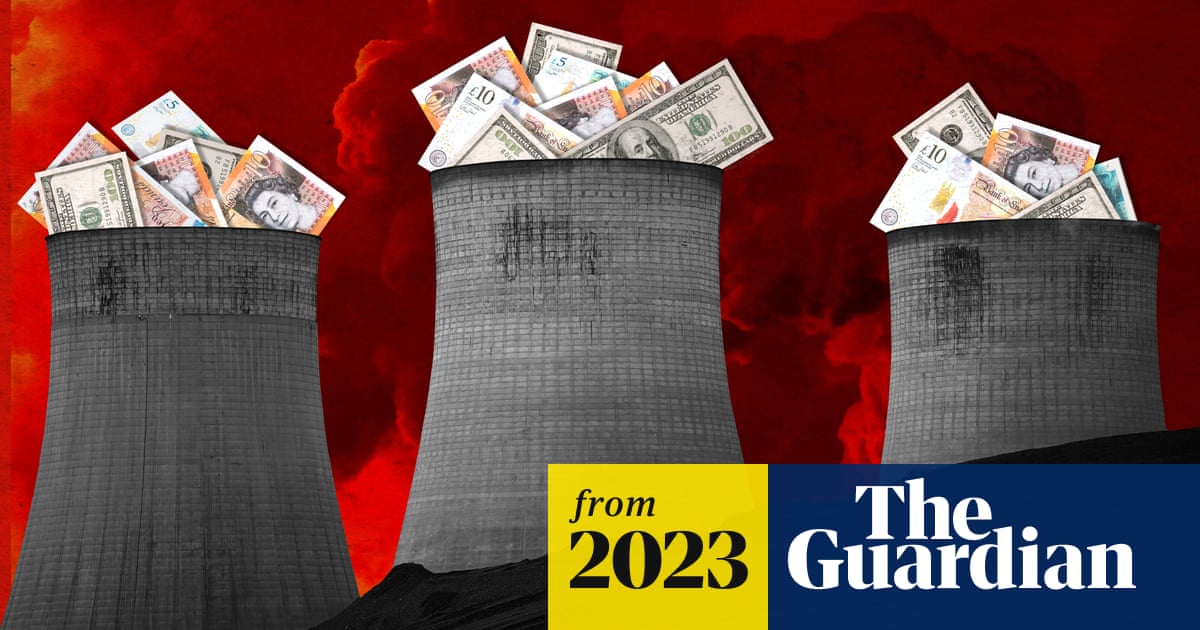
A Paris judicial tribunal has just ruled on a case brought against TotalEnergies by environmental groups and the City of Paris. The judgment does not halt the company's fossil-fuel expansion. But it does something the industry has spent half a century resisting: it holds TotalEnergies legally responsible not just for the emissions from its operations, but for the emissions produced when the oil and gas it sells are ultimately burned.

‘Hopeless and broken’: why the world’s top climate scientists are in despair
Exclusive: Survey of hundreds of experts reveals harrowing picture of future, but they warn climate fight must not be abandoned

Why Science Can't Settle Political Disputes
Attempts to scientifically “rationalize” policy, based on the belief that science is purified of politics, may be damaging democracy

The assault on US universities didn't start in 2025. Our new paper traces the decades of corporate capture that made it possible, and why climate research is a primary target. Open access: sciencedirect.com/science/article/pii/S22146296…
