

We measure real-world performance of coding agents on software engineering tasks, including cost, token usage, and execution time. We compare how performance changes across agents, models, and execution settings.
Agent Skills
AI coding agents take the shortest path to done, which usually means skipping the specs, tests, and reviews that make software reliable at scale. Agent Skill...
AI coding agents generate more code, but not more software
Study finds coding efficiency gains get "absorbed" by human review "bottleneck."

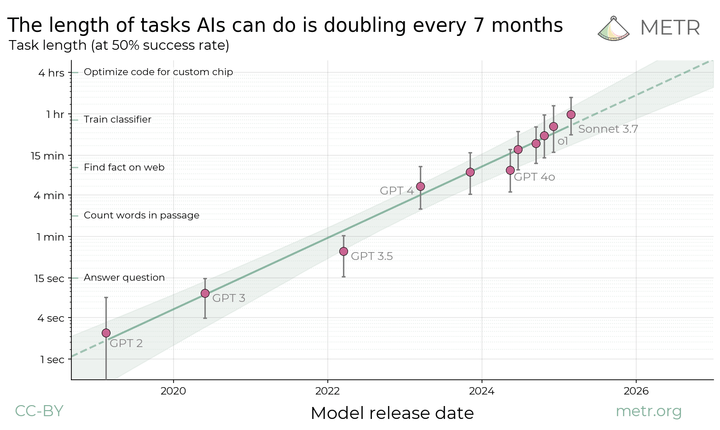
Measuring AI Ability to Complete Long Tasks
We propose measuring AI performance in terms of the *length* of tasks AI agents can complete. We show that this metric has been consistently exponentially increasing over the past 6 years, with a doubling time of around 7 months. Extrapolating this trend predicts that, in under a decade, we will see AI agents that can independently complete a large fraction of software tasks that currently take humans days or weeks.
Code execution with MCP: building more efficient AI agents
Learn how code execution with the Model Context Protocol enables agents to handle more tools while using fewer tokens, reducing context overhead by up to 98.7%.
AI Model Leaderboards & Benchmarks
Explore leaderboards with expert-driven LLM benchmarks and updated AI model rankings across coding, reasoning and more.
WebDev AI Leaderboard - Best AI Models for Web Development
View overall rankings across AI models on front-end web development tasks, including agentic coding workflows that require multi-step reasoning and tool use.
AI Coding Agents: Adoption Trends - The JetBrains Blog
How many developers use AI coding agents (Claude Code, Codex, Cursor, JetBrains Junie, and others)? Evidence from the Developer Ecosystem Survey 2026.
AI Tools Accelerates Coding, but Not Overall Software Delivery, GitLab Research Finds
GitLab's 2026 AI Accountability Report highlights an AI Paradox: although 78% of developers say they code faster, overall software delivery has not accelerated due to downstream testing and review bottlenecks and new challenges for enterprise governance and traceability.
Humans are Missing from AI Coding Agent Research
Recent progress in AI coding agent research has led to rapid improvements in agents' ability to autonomously perform complex software engineering tasks, from editing large codebases to executing long-horizon development workflows. As these systems make strides, however, the primary bottleneck to practical usefulness increasingly shifts away from pure task-solving capability, and toward challenges in how users communicate with, supervise, and trust agents. In this position paper, we argue for a reorientation from autonomous to human-centered coding agents: systems designed not only to complete tasks, but to collaborate effectively with people. We identify four core interaction-level dimensions that characterize the human-agent task-solving loop: task alignment, verifiability, steerability, and adaptability. Finally, we outline concrete research directions to advance these dimensions, including user-involved coding environments, comprehensive verification mechanisms, and principled measures of human-agent interaction quality.

Scaling long-running autonomous coding · Cursor
We've been experimenting with running coding agents autonomously for weeks at a time.
AI research speeds up. Monitoring gets harder. - Sensemaker
OpenAI says coding agents now run 3.1 days for every human research day, while its chief scientist warns the lab’s main monitoring method is weakening.
SWE-Bench Pro: Can AI Agents Solve Long-Horizon Software Engineering Tasks?
Large Language Model (LLM) agents have been widely adopted in modern software development workflows. SWE-bench [13] and related works [23, 24, 22, 25, 15] establish the task of issue resolution as a de-facto standard for assessing their capability and usefulness. In this setting, an agent is given an entire codebase, a task description (e.g., a bug report or feature request) in natural language and is instructed to produce a code patch that resolves the issue and passes the repository’s test suite. These benchmarks have been instrumental in demonstrating both the substantial potential and the persistent limitations of current models as SWE agents.
How Do AI Coding Agents Contribute to Software Development? an Empirical Study of Agentic Pull Requests
Recent advances in large language models and their rapid adoption across software engineering tasks have made Artificial Intelligence (AI) coding agents an integral component of modern software development workflows. While developers increasingly benefit from these coding agents, their impact on software quality remains insufficiently understood. In particular, how agentic contributions evolve across the software development lifecycle has not been thoroughly investigated. This study aims to characterize agentic pull requests (PR) in comparison to human generated PRs and to examine how their properties change across different stages of the development lifecycle. Using the AIDev dataset, we first analyze how differences in merge rates between agentic and human generated PRs vary over time. We then identify the types of development tasks where AI coding agents are predominantly applied and investigate how these task distributions evolve across development quarters. Finally, we compare a set of key characteristics of agentic and human generated PRs, focusing on their implications for software quality and their temporal dynamics. Overall, our findings provide an empirical and longitudinal perspective on the role of AI coding agents in software development, offering a more nuanced understanding of their benefits and limitations in real-world practices.
How Do AI Coding Agents Contribute to Software Development? an Empirical Study of Agentic Pull Requests
Recent advances in large language models and their rapid adoption across software engineering tasks have made Artificial Intelligence (AI) coding agents an integral component of modern software development workflows. While developers increasingly benefit from these coding agents, their impact on software quality remains insufficiently understood. In particular, how agentic contributions evolve across the software development lifecycle has not been thoroughly investigated. This study aims to characterize agentic pull requests (PR) in comparison to human generated PRs and to examine how their properties change across different stages of the development lifecycle. Using the AIDev dataset, we first analyze how differences in merge rates between agentic and human generated PRs vary over time. We then identify the types of development tasks where AI coding agents are predominantly applied and investigate how these task distributions evolve across development quarters. Finally, we compare a set of key characteristics of agentic and human generated PRs, focusing on their implications for software quality and their temporal dynamics. Overall, our findings provide an empirical and longitudinal perspective on the role of AI coding agents in software development, offering a more nuanced understanding of their benefits and limitations in real-world practices.
Open Coding Agents: Fast, accessible coding agents that adapt to any repo | Ai2
SERA is the first in our family of Open Coding Agents, achieving state-of-the-art performance at low cost.
SlopCodeBench: Benchmarking How Coding Agents Degrade Over Long-Horizon Iterative Tasks
Software development is iterative, yet agentic coding benchmarks hide design issues through their single-shot setup. Recent iterative benchmarks attempt to remedy this but heavily constrain an agent's design decision space, making it impossible to faithfully measure how their decisions shape future extensions. We introduce SlopCodeBench, a benchmark of 36 problems and 196 checkpoints where agents repeatedly extend their own solutions. Unlike prior iterative benchmarks, our evolving specifications demand architectural decisions but leave internal structure to the agent. We measure two forms of degradation: structural erosion (concentrated complexity) and verbosity (redundant code). Evaluating 15 coding agents across open and closed models, we find that no agent fully solves any problem end-to-end, and the best agent passes 14.8% of checkpoints. Quality degrades across checkpoints, with structural erosion rising in 77% of trajectories and verbosity in 75.5%. Compared to 473 open-source Python repositories, agent code is 2.3x more verbose and 2.0x more eroded, and the human repositories degrade less often and by smaller margins across their git histories. Explicit quality guidance reduces initial verbosity and erosion by up to a third, without affecting degradation rates. SlopCodeBench provides the first measurement of code degradation under iterative extension, revealing that agents pass checkpoints while producing code that erodes and bloats with each turn.