


Mechanistic physiological modeling is a scientific method that combines available data with scientific knowledge and engineering approaches to facilitate better understanding of biological systems, improve decision‐making, reduce risk, and increase efficiency in drug discovery and development. It is a type of quantitative systems pharmacology (QSP) approach that places drug‐specific properties in the context of disease biology. This tutorial provides a broadly applicable model qualification method (MQM) to ensure that mechanistic physiological models are fit for their intended purposes.
Evaluation framework for systems models
Abstract As decisions in drug development increasingly rely on predictions from mechanistic systems models, assessing the predictive capability of such models is becoming more important. Several frameworks for the development of quantitative systems pharmacology (QSP) models have been proposed. In this paper, we add to this body of work with a framework that focuses on the appropriate use of qualitative and quantitative model evaluation methods. We provide details and references for those wishing to apply these methods, which include sensitivity and identifiability analyses, as well as concepts such as validation and uncertainty quantification. Many of these methods have been used successfully in other fields, but are not as common in QSP modeling. We illustrate how to apply these methods to evaluate QSP models, and propose methods to use in two case studies. We also share examples of misleading results when inappropriate analyses are used.

Pharmacometrics and systems pharmacology for metabolic bone diseases
Mathematical modelling and simulation (M&S) of drug concentrations, pharmacologic effects and the (patho)physiologic systems within which they interact can be powerful tools for the preclinical, translational and clinical development of drugs. Indeed, the Prescription Drug User Fee Act (PDUFA VI), incorporated as part of the FDA Reauthorization Act of 2017 (FDARA), highlights the goal of advancing model‐informed drug development (MIDD). MIDD can benefit development across many drug classes, including for metabolic bone diseases such as osteoporosis, cancer‐related and numerous rare metabolic bone diseases; conditions characterized by significant morbidity and mortality. A drought looms in terms of the availability of new drugs to better treat these devastating diseases. This review provides an overview of several M&S approaches ranging from simple pharmacokinetic to integrated pharmacometric and systems pharmacology modelling. Examples are included to illustrate the use of these approaches during the development of several drugs for metabolic bone diseases such as bisphosphonates, denosumab, teriparatide and sclerostin inhibitors (romosozumab and blosozumab).

Automated Scale Reduction of Nonlinear <span style="font-variant:small-caps;">QSP</span> Models With an Illustrative Application to a Bone Biology System
Integrating quantitative systems pharmacology ( QSP ) into pharmacokinetics/pharmacodynamics ( PKPD ) has resulted in models that are highly complex and often not amenable to further exploration via estimation or design. Because QSP models are usually depicted using nonlinear differential equations it is not straightforward to apply some model reduction techniques, such as proper lumping. In this study, we explore the combined use of linearization and proper lumping as a general method to simplification of a nonlinear QSP model. We illustrate this with a bone biology model and the reduced model was then applied to describe bone mineral density ( BMD ) changes due to denosumab dosing. The methodologies used in this study can be applied to other multiscale models for developing a mechanism‐based structural model for future analyses.

Toward a Mathematical Modeling of Diseases’ Impact on Bone Remodeling: Technical Review
A wide variety of bone diseases have hitherto been discovered, such as osteoporosis, Patget’s disease, osteopetrosis, and metastatic bone disease, which is not well defined. Some of these diseases are secondary to other pathologies, including cancer, or to some clinical treatments. To better understand bone behavior and prevent its deterioration, bone biomechanics have been the subject of mathematical modeling that exponentially increased over the last years. These models are more and more involving the impact of bone diseases on its quality. The current paper provides a meaningful and critical analysis of previously developed bone remodeling mathematical models, particularly those addressing bone diseases. Besides, mechanistic pharmacokinetic/pharmacodynamic (PK/PD) models, which englobe either bone disease and its treatments’ effect on bone health. Therefore, the review starts by presenting bone remodeling cycle and mathematical models describing this process, followed by introducing some bone diseases and discussing models of pathological mechanisms affecting bone, and ends by exhibiting the available bone treatment procedures and the PK/PD models considering these lasts.

How AI Can Advance Mathematical Biology: Opportunities, Challenges, and Future Directions
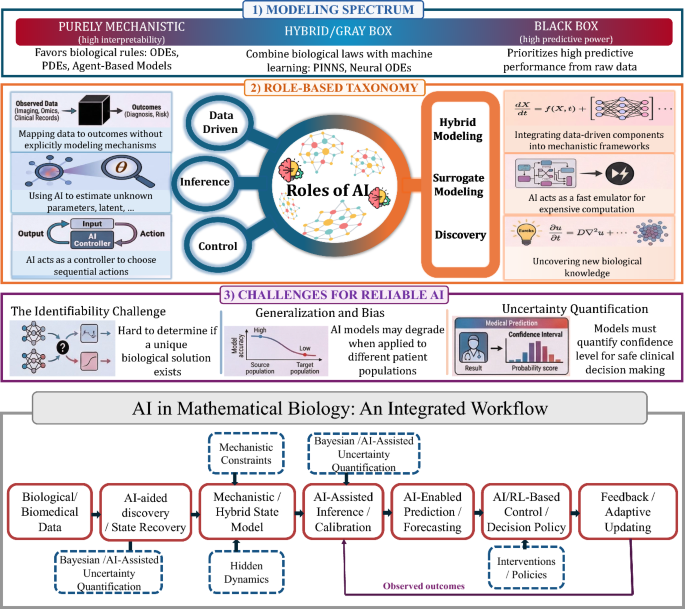
Mathematical biology has long relied on mechanistic models, including ordinary and partial differential equations, stochastic systems, and agent-based models, to study biological processes across scales. These approaches remain central because they provide structure, interpretability, and biological insight. However, modern biological and biomedical data, including longitudinal clinical records, medical imaging, and multi-omics measurements, are often high-dimensional, noisy, heterogeneous, and incomplete. These features make model calibration, simulation, and uncertainty quantification increasingly difficult. As a result, artificial intelligence (AI) and machine learning (ML) are playing a growing role in mathematical biology, not as replacements for mechanistic modeling, but as complementary tools that can support prediction, hybrid modeling, inference, and control. In this review, we organize these uses of AI from a mathematical biology perspective and examine how data-driven and mechanistic approaches interact across different modeling tasks. The selected examples span biomedical, epidemiological, ecological, evolutionary, biochemical, and population-level systems, while the review is intended to be representative rather than exhaustive. We emphasize recurring challenges that strongly affect biological credibility and practical usefulness, including interpretability, identifiability, generalization, and uncertainty quantification. Our goal is to clarify the roles AI can play in mathematical biology and to highlight the opportunities and limitations that arise when flexible learning methods are integrated with biologically grounded modeling.
A Nonparametric Approach to Practical Identifiability of Nonlinear Mixed Effects Models
Mathematical modelling is a widely used approach to understand and interpret clinical trial data. This modelling typically involves fitting mechanistic mathematical models to data from individual trial participants. Despite the widespread adoption of this individual-based fitting, it is becoming increasingly common to take a hierarchical approach to parameter estimation, where modellers characterize the population parameter distributions, rather than considering each individual independently. This hierarchical parameter estimation is standard in pharmacometric modelling. However, many of the existing techniques for parameter identifiability do not immediately translate from the individual-based fitting to the hierarchical setting. In this work, we propose a nonparametric approach to study practical identifiability within a hierarchical parameter estimation framework. We focus on the commonly used nonlinear mixed effects framework and investigate two well-studied examples from the pharmacometrics and viral dynamics literature to illustrate the potential utility of our approach.

Mathematical modeling of postmenopausal osteoporosis and its treatment by the anti‐catabolic drug denosumab
SUMMARY Denosumab, a fully human monoclonal antibody, has been approved for the treatment of postmenopausal osteoporosis. The therapeutic effect of denosumab rests on its ability to inhibit osteoclast differentiation. Here, we present a computational approach on the basis of coupling a pharmacokinetics model of denosumab with a pharmacodynamics model for quantifying the effect of denosumab on bone remodeling. The pharmacodynamics model comprises an integrated systems biology‐continuum micromechanics approach, including a bone cell population model, considering the governing biochemical factors of bone remodeling (including the action of denosumab), and a multiscale micromechanics‐based bone mechanics model, for implementing the mechanobiology of bone remodeling in our model. Numerical studies of postmenopausal osteoporosis show that denosumab suppresses osteoclast differentiation, thus strongly curtailing bone resorption. Simulation results also suggest that denosumab may trigger a short‐term bone volume gain, which is, however, followed by constant or decreasing bone volume. This evolution is accompanied by a dramatic decrease of the bone turnover rate by more than one order of magnitude. The latter proposes dominant occurrence of secondary mineralization (which is not anymore impeded through cellular activity), leading to higher mineral concentration per bone volume. This explains the overall higher bone mineral density observed in denosumab‐related clinical studies. Copyright © 2013 John Wiley & Sons, Ltd.

Coping with time scales in disease systems analysis: application to bone remodeling
In this study we demonstrate the added value of mathematical model reduction for characterizing complex dynamic systems using bone remodeling as an example. We show that for the given parameter values, the mechanistic RANK-RANKL-OPG pathway model proposed by Lemaire et al. (J Theor Biol 229:293–309, 2004) can be reduced to a simpler model, which can describe the dynamics of the full Lemaire model to very good approximation. The response of both models to changes in the underlying physiology and therapeutic interventions was evaluated in four physiologically meaningful scenarios: (i) estrogen deficiency/estrogen replacement therapy, (ii) Vitamin D deficiency, (iii) ageing, and (iv) chronic glucocorticoid treatment and its cessation. It was found that on the time scale of disease progression and therapeutic intervention, the models showed negligible differences in their dynamic properties and were both suitable for characterizing the impact of estrogen deficiency and estrogen replacement therapy, Vitamin D deficiency, ageing, and chronic glucocorticoid treatment and its cessation on bone forming (osteoblasts) and bone resorbing (osteoclasts) cells. It was also demonstrated how the simpler model could help in elucidating qualitative properties of the observed dynamics, such as the absence of overshoot and rebound, and the different dynamics of onset and washout.

Biohub releases a world model of protein biology
Open AI models used for a wide range of scientific applications, including accelerating the design of therapeutic molecules.

Modeling osteoporosis to design and optimize pharmacological therapies comprising multiple drug types
For the treatment of postmenopausal osteoporosis, several drug classes with different mechanisms of action are available. Since only a limited set of dosing regimens and drug combinations can be tested in clinical trials, it is currently unclear whether common medication strategies achieve optimal bone mineral density gains or are outperformed by alternative dosing schemes and combination therapies that have not been explored so far. Here, we develop a mathematical framework of drug interventions for postmenopausal osteoporosis that unifies fundamental mechanisms of bone remodeling and the mechanisms of action of four drug classes: bisphosphonates, parathyroid hormone analogs, sclerostin inhibitors, and receptor activator of NF-κB ligand inhibitors. Using data from several clinical trials, we calibrate and validate the model, demonstrating its predictive capacity for complex medication scenarios, including sequential and parallel drug combinations. Via simulations, we reveal that there is a large potential to improve gains in bone mineral density by exploiting synergistic interactions between different drug classes, without increasing the total amount of drug administered.

GEMOT: Towards Mechanistic World Models for Biology
Scientific discovery seeks mechanisms that explain observations and predict beyond the measurements that produced them. Whereas large language models (LLMs) encode knowledge implicitly, mechanistic world models organise it as a parsimonious set of explicit, modular, reusable mechanisms whose predictions can be scored against data.
Dynamics of Bone Cell Interactions and Differential Responses to PTH and Antibody-Based Therapies
We propose a mathematical model describing the dynamics of osteoblasts and osteoclasts in bone remodeling. The goal of this work is to develop an integrated modeling framework for bone remodeling and bone cell signaling dynamics that could be used to explore qualitatively combination treatments for osteoporosis in humans. The model has been calibrated using 57 checks from the literature. Specific global optimization methods based on qualitative objectives have been developed to perform the model calibration. We also added pharmacokinetics representations of three drugs to the model, which are teriparatide (PTH(1–34)), denosumab (a RANKL antibody) and romosozumab (a sclerostin antibody), achieving excellent goodness-of-fit of human clinical data. The model reproduces the paradoxical effects of PTH on the bone mass, where continuous administration of PTH results in bone loss but intermittent administration of PTH leads to bone gain, thus proposing an explanation of this phenomenon. We used the model to simulate different categories of osteoporosis. The main attributes of each disease are qualitatively well captured by the model, for example changes in bone turnover in the disease states. We explored dosing regimens for each disease based on the combination of denosumab and romosozumab, identifying adequate ratios and doses of both drugs for subpopulations of patients in function of categories of osteoporosis and the degree of severity of the disease.

Mechanobiological osteocyte feedback drives mechanostat regulation of bone in a multiscale computational model
Significant progress has been made to identify the cells and signaling molecules involved in the mechanobiological regulation of bone remodeling. It is now well accepted that osteocytes act as mechanosensory cells in bone expressing several signaling molecules such as nitric oxide (NO) and sclerostin (Scl) which are able to control bone remodeling responses. In this paper, we present a comprehensive multiscale computational model of bone remodeling which incorporates biochemical osteocyte feedback. The mechanostat theory is quantitatively incorporated into the model using mechanical feedback to control expression levels of NO and Scl. The catabolic signaling pathway RANK–RANKL–OPG is co-regulated via (continuous) PTH and NO, while the anabolic Wnt signaling pathway is described via competitive binding reactions between Wnt, Scl and the Wnt receptors LRP5/6. Using this novel model of bone remodeling, we investigate the effects of changes in the mechanical loading and hormonal environment on bone balance. Our numerical simulations show that we can calibrate the mechanostat anabolic and catabolic regulatory mechanisms so that they are mutually exclusive. This is consistent with previous models that use a Wolff-type law to regulate bone resorption and formation separately. Furthermore, mechanical feedback provides an effective mechanism to obtain physiological bone loss responses due to mechanical disuse and/or osteoporosis.

Selecting synthetic data for successful simulation-based transfer learning in dynamical biological systems
Accurate prediction of the temporal dynamics of biological systems is crucial for informing timely and effective interventions, e.g., in ecological or epidemiological contexts, or for treatment adjustments in therapy. While machine learning has proven its capabilities in generalizing the underlying non-linear dynamics of such systems, unlocking its predictive power is often restrained by the limited availability of large, curated datasets. To supplement real-world data, informing machine learning by transfer learning with synthetic data derived from simulations using ordinary differential equations has emerged as a promising solution. However, the success of this approach highly depends on the designed characteristics of the synthetic data.

Clinical Data for Parametrization of In Silico Bone Models Incorporating Cell-Cytokine Dynamics: A Systematic Review of Literature
In silico simulations aim to provide fast, inexpensive, and ethical alternatives to years of costly experimentation on animals and humans for studying bone remodeling, its deregulation during osteoporosis and the effect of therapeutics. Within the varied spectrum of in silico modeling techniques, bone cell population dynamics and agent-based multiphysics simulations have recently emerged as useful tools to simulate the effect of specific signaling pathways. In these models, parameters for cell and cytokine behavior are set based on experimental values found in literature; however, their use is currently limited by the lack of clinical in vivo data on cell numbers and their behavior as well as cytokine concentrations, diffusion, decay and reaction rates. Further, the settings used for these parameters vary across research groups, prohibiting effective cross-comparisons. This review summarizes and evaluates the clinical trial literature that can serve as input or validation for in silico models of bone remodeling incorporating cells and cytokine dynamics in post-menopausal women in treatment, and control scenarios. The GRADE system was used to determine the level of confidence in the reported data, and areas lacking in reported measures such as binding site occupancy, reaction rates and cell proliferation, differentiation and apoptosis rates were highlighted as targets for further research. We propose a consensus for the range of values that can be used for the cell and cytokine settings related to the RANKL-RANK-OPG, TGF-β and sclerostin pathways and a Levels of Evidence-based method to estimate parameters missing from clinical trial literature.

AI for Drug Discovery Needs Trustworthy Biological Data
To unleash the potential of AI in life sciences and drug discovery, biological datasets must be authenticated, validated, and supported by standardized metadata.