


The automated detection of plagiarism is an information retrieval task of increasing importance as the volume of readily accessible information on the web expands. A major shortcoming of current automated plagiarism detection approaches is their dependence on high character‐based similarity. As a result, heavily disguised plagiarism forms, such as paraphrases, translated plagiarism, or structural and idea plagiarism, remain undetected. A recently proposed language‐independent approach to plagiarism detection, C itation‐based P lagiarism D etection ( CbPD ), allows the detection of semantic similarity even in the absence of text overlap by analyzing the citation placement in a document's full text to determine similarity. This article evaluates the performance of CbPD in detecting plagiarism with various degrees of disguise in a collection of 185,000 biomedical articles. We benchmark CbPD against two character‐based detection approaches using a ground truth approximated in a user study. Our evaluation shows that the citation‐based approach achieves superior ranking performance for heavily disguised plagiarism forms. Additionally, we demonstrate CbPD to be computationally more efficient than character‐based approaches. Finally, upon combining the citation‐based with the traditional character‐based document similarity visualization methods in a hybrid detection prototype, we observe a reduction in the required user effort for document verification.
Using structural information and citation evidence to detect significant plagiarism cases in scientific publications
Abstract In plagiarism detection (PD) systems, two important problems should be considered: the problem of retrieving candidate documents that are globally similar to a document q under investigation, and the problem of side‐by‐side comparison of q and its candidates to pinpoint plagiarized fragments in detail. In this article, the authors investigate the usage of structural information of scientific publications in both problems, and the consideration of citation evidence in the second problem. Three statistical measures namely Inverse Generic Class Frequency, Spread, and Depth are introduced to assign a degree of importance (i.e., weight) to structural components in scientific articles. A term‐weighting scheme is adjusted to incorporate component‐weight factors, which is used to improve the retrieval of potential sources of plagiarism. A plagiarism screening process is applied based on a measure of resemblance, in which component‐weight factors are exploited to ignore less or nonsignificant plagiarism cases. Using the notion of citation evidence, parts with proper citation evidence are excluded, and remaining cases are suspected and used to calculate the similarity index. The authors compare their approach to two flat‐based baselines, TF‐IDF weighting with a Cosine coefficient, and shingling with a Jaccard coefficient. In both baselines, they use different comparison units with overlapping measures for plagiarism screening. They conducted extensive experiments using a dataset of 15,412 documents divided into 8,657 source publications and 6,755 suspicious queries, which included 18,147 plagiarism cases inserted automatically. Component‐weight factors are assessed using precision, recall, and F ‐measure averaged over a 10‐fold cross‐validation and compared using the ANOVA statistical test. Results from structural‐based candidate retrieval and plagiarism detection are evaluated statistically against the flat baselines using paired‐ t tests on 10‐fold cross‐validation runs, which demonstrate the efficacy achieved by the proposed framework. An empirical study on the system's response shows that structural information, unlike existing plagiarism detectors, helps to flag significant plagiarism cases, improve the similarity index, and provide human‐like plagiarism screening results.

Improving Academic Plagiarism Detection for STEM Documents by Analyzing Mathematical Content and Citations
Identifying academic plagiarism is a pressing task for educational and research institutions, publishers, and funding agencies. Current plagiarism detection systems reliably find instances of copied and moderately reworded text. However, reliably detecting concealed plagiarism, such as strong paraphrases, translations, and the reuse of nontextual content and ideas is an open research problem. In this paper, we extend our prior research on analyzing mathematical content and academic citations. Both are promising approaches for improving the detection of concealed academic plagiarism primarily in Science, Technology, Engineering and Mathematics (STEM). We make the following contributions: i) We present a two-stage detection process that combines similarity assessments of mathematical content, academic citations, and text. ii) We introduce new similarity measures that consider the order of mathematical features and outperform the measures in our prior research. iii) We compare the effectiveness of the math-based, citation-based, and text-based detection approaches using confirmed cases of academic plagiarism. iv) We demonstrate that the combined analysis of math-based and citation-based content features allows identifying potentially suspicious cases in a collection of 102K STEM documents. Overall, we show that analyzing the similarity of mathematical content and academic citations is a striking supplement for conventional text-based detection approaches for academic literature in the STEM disciplines.

Towards an Understanding and Explanation for Mixed-Initiative Artificial Scientific Text Detection
Large language models (LLMs) have gained popularity in various fields for their exceptional capability of generating human-like text. Their potential misuse has raised social concerns about plagiarism in academic contexts. However, effective artificial scientific text detection is a non-trivial task due to several challenges, including 1) the lack of a clear understanding of the differences between machine-generated and human-written scientific text, 2) the poor generalization performance of existing methods caused by out-of-distribution issues, and 3) the limited support for human-machine collaboration with sufficient interpretability during the detection process. In this paper, we first identify the critical distinctions between machine-generated and human-written scientific text through a quantitative experiment. Then, we propose a mixed-initiative workflow that combines human experts' prior knowledge with machine intelligence, along with a visual analytics prototype to facilitate efficient and trustworthy scientific text detection. Finally, we demonstrate the effectiveness of our approach through two case studies and a controlled user study with proficient researchers. We also provide design implications for interactive artificial text detection tools in high-stakes decision-making scenarios.
Comparative evaluation of text- and citation-based plagiarism detection approaches using guttenplag
As part of the Digital Library's transition to Open Access, new features for researchers are available in the Premium Edition. Click here to learn more.

Testing of detection tools for AI-generated text
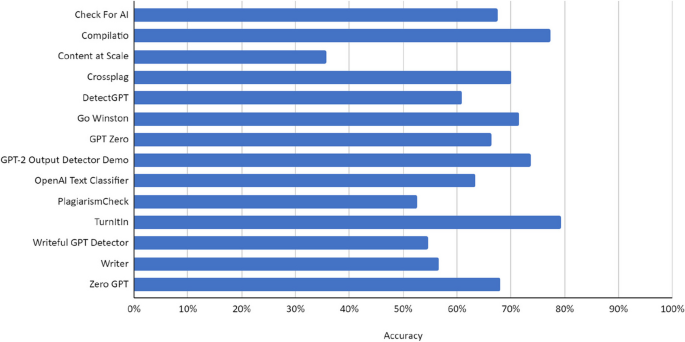
Recent advances in generative pre-trained transformer large language models have emphasised the potential risks of unfair use of artificial intelligence (AI) generated content in an academic environment and intensified efforts in searching for solutions to detect such content. The paper examines the general functionality of detection tools for AI-generated text and evaluates them based on accuracy and error type analysis. Specifically, the study seeks to answer research questions about whether existing detection tools can reliably differentiate between human-written text and ChatGPT-generated text, and whether machine translation and content obfuscation techniques affect the detection of AI-generated text. The research covers 12 publicly available tools and two commercial systems (Turnitin and PlagiarismCheck) that are widely used in the academic setting. The researchers conclude that the available detection tools are neither accurate nor reliable and have a main bias towards classifying the output as human-written rather than detecting AI-generated text. Furthermore, content obfuscation techniques significantly worsen the performance of tools. The study makes several significant contributions. First, it summarises up-to-date similar scientific and non-scientific efforts in the field. Second, it presents the result of one of the most comprehensive tests conducted so far, based on a rigorous research methodology, an original document set, and a broad coverage of tools. Third, it discusses the implications and drawbacks of using detection tools for AI-generated text in academic settings.
Testing of detection tools for AI-generated text
Recent advances in generative pre-trained transformer large language models have emphasised the potential risks of unfair use of artificial intelligence (AI) generated content in an academic environment and intensified efforts in searching for solutions to detect such content. The paper examines the general functionality of detection tools for AI-generated text and evaluates them based on accuracy and error type analysis. Specifically, the study seeks to answer research questions about whether existing detection tools can reliably differentiate between human-written text and ChatGPT-generated text, and whether machine translation and content obfuscation techniques affect the detection of AI-generated text. The research covers 12 publicly available tools and two commercial systems (Turnitin and PlagiarismCheck) that are widely used in the academic setting. The researchers conclude that the available detection tools are neither accurate nor reliable and have a main bias towards classifying the output as human-written rather than detecting AI-generated text. Furthermore, content obfuscation techniques significantly worsen the performance of tools. The study makes several significant contributions. First, it summarises up-to-date similar scientific and non-scientific efforts in the field. Second, it presents the result of one of the most comprehensive tests conducted so far, based on a rigorous research methodology, an original document set, and a broad coverage of tools. Third, it discusses the implications and drawbacks of using detection tools for AI-generated text in academic settings.
Documenting Large Webtext Corpora: A Case Study on the Colossal Clean Crawled Corpus
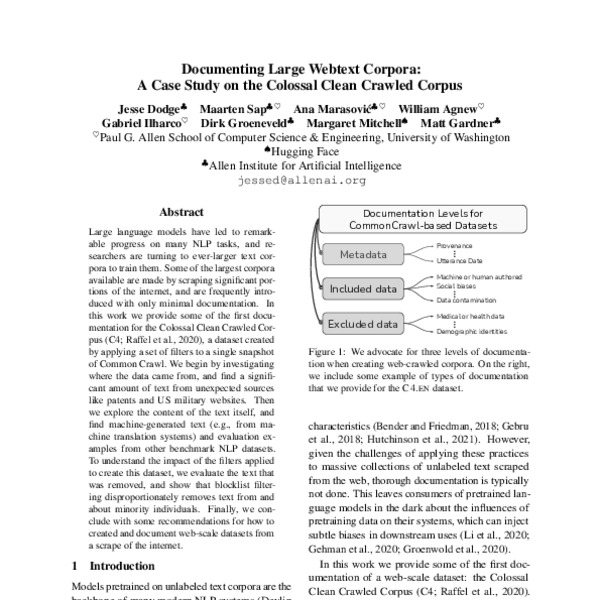
Large language models have led to remarkable progress on many NLP tasks, and researchers are turning to ever-larger text corpora to train them. Some of the largest corpora available are made by scraping significant portions of the internet, and are frequently introduced with only minimal documentation. In this work we provide some of the first documentation for the Colossal Clean Crawled Corpus (C4; Raffel et al., 2020), a dataset created by applying a set of filters to a single snapshot of Common Crawl. We begin by investigating where the data came from, and find a significant amount of text from unexpected sources like patents and US military websites. Then we explore the content of the text itself, and find machine-generated text (e.g., from machine translation systems) and evaluation examples from other benchmark NLP datasets. To understand the impact of the filters applied to create this dataset, we evaluate the text that was removed, and show that blocklist filtering disproportionately removes text from and about minority individuals. Finally, we conclude with some recommendations for how to created and document web-scale datasets from a scrape of the internet.
Analyzing Semantic Concept Patterns to Detect Academic Plagiarism
As part of the Digital Library's transition to Open Access, new features for researchers are available in the Premium Edition. Click here to learn more.

Comparing scientific abstracts generated by ChatGPT to real abstracts with detectors and blinded human reviewers
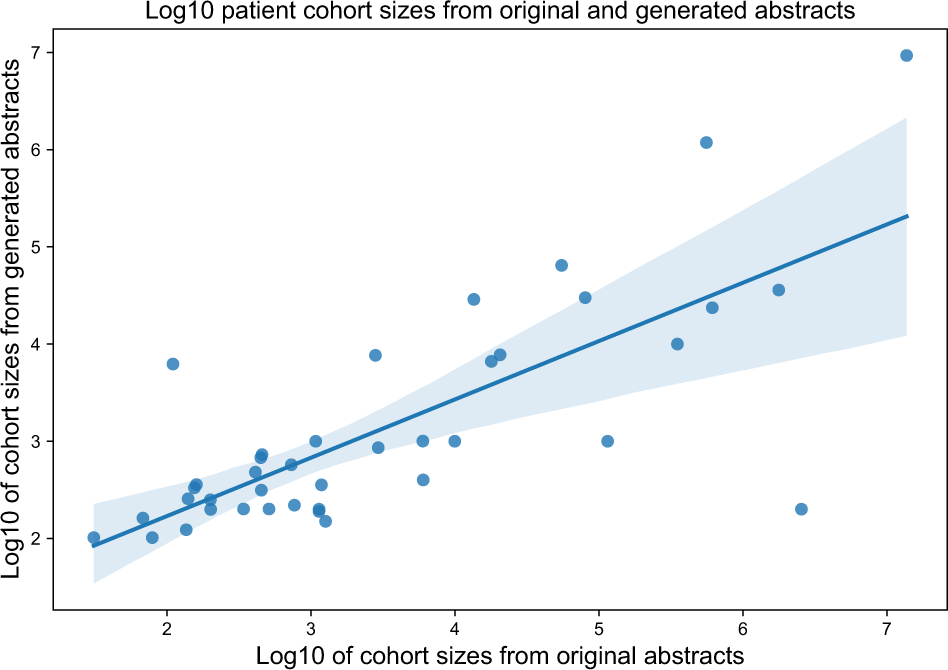
Large language models such as ChatGPT can produce increasingly realistic text, with unknown information on the accuracy and integrity of using these models in scientific writing. We gathered fifth research abstracts from five high-impact factor medical journals and asked ChatGPT to generate research abstracts based on their titles and journals. Most generated abstracts were detected using an AI output detector, ‘GPT-2 Output Detector’, with % ‘fake’ scores (higher meaning more likely to be generated) of median [interquartile range] of 99.98% ‘fake’ [12.73%, 99.98%] compared with median 0.02% [IQR 0.02%, 0.09%] for the original abstracts. The AUROC of the AI output detector was 0.94. Generated abstracts scored lower than original abstracts when run through a plagiarism detector website and iThenticate (higher scores meaning more matching text found). When given a mixture of original and general abstracts, blinded human reviewers correctly identified 68% of generated abstracts as being generated by ChatGPT, but incorrectly identified 14% of original abstracts as being generated. Reviewers indicated that it was surprisingly difficult to differentiate between the two, though abstracts they suspected were generated were vaguer and more formulaic. ChatGPT writes believable scientific abstracts, though with completely generated data. Depending on publisher-specific guidelines, AI output detectors may serve as an editorial tool to help maintain scientific standards. The boundaries of ethical and acceptable use of large language models to help scientific writing are still being discussed, and different journals and conferences are adopting varying policies.
Citing Less Critically: LLMs Reshape the Rhetoric and Reach of Scientific Citation
Scientific citations carry rhetorical intent. Scholars may cite prior work positively (supporting), negatively (contrasting), or neutrally (mentioning). As large language models (LLMs) increasingly assist scientific writing, whether they reproduce citations with the same rhetorical intent as humans remains unclear. We introduce a masked-citation task to compare human and LLM-generated citation behavior. For each citation context, an LLM generates a replacement citation sentence, producing a counterfactual corpus directly comparable to human citation. We analyze what, whom, and how models cite, using an LLM-as-a-judge to classify citation intent and a 20-million-edge coauthorship network to measure social distance between cited authors. Across six popular LLMs and 1,746 top NLP conference papers (63k+ contexts, 132k+ citations), three patterns emerge: (1) Compared with human citation, LLMs cite significantly less critically; (2) LLMs over-cite popular and older papers, a tendency amplified for contrasting citations where human writing more often draws on recent, niche work; (3) Whereas humans often cite within their close social network, especially for supporting citations, LLMs tend to draw on more socially distant authors. Together, these differences are double-edged: LLM citation reaches beyond a scholar's close collaborators while being less critical and amplifying visibility bias, reshaping the rhetoric and reach of scientific citation.
Duplicate and fake publications in the scientific literature: how many SCIgen papers in computer science?
Two kinds of bibliographic tools are used to retrieve scientific publications and make them available online. For one kind, access is free as they store information made publicly available online. For the other kind, access fees are required as they are compiled on information provided by the major publishers of scientific literature. The former can easily be interfered with, but it is generally assumed that the latter guarantee the integrity of the data they sell. Unfortunately, duplicate and fake publications are appearing in scientific conferences and, as a result, in the bibliographic services. We demonstrate a software method of detecting these duplicate and fake publications. Both the free services (such as Google Scholar and DBLP) and the charged-for services (such as IEEE Xplore) accept and index these publications.

SciFact-Open: Towards open-domain scientific claim verification
While research on scientific claim verification has led to the development of powerful systems that appear to approach human performance, these approaches have yet to be tested in a realistic setting against large corpora of scientific literature. Moving to this open-domain evaluation setting, however, poses unique challenges; in particular, it is infeasible to exhaustively annotate all evidence documents. In this work, we present SciFact-Open, a new test collection designed to evaluate the performance of scientific claim verification systems on a corpus of 500K research abstracts. Drawing upon pooling techniques from information retrieval, we collect evidence for scientific claims by pooling and annotating the top predictions of four state-of-the-art scientific claim verification models. We find that systems developed on smaller corpora struggle to generalize to SciFact-Open, exhibiting performance drops of at least 15 F1. In addition, analysis of the evidence in SciFact-Open reveals interesting phenomena likely to appear when claim verification systems are deployed in practice, e.g., cases where the evidence supports only a special case of the claim. Our dataset is available at https://github.com/dwadden/scifact-open.
Language agents achieve superhuman synthesis of scientific knowledge
Language models are known to hallucinate incorrect information, and it is unclear if they are sufficiently accurate and reliable for use in scientific research. We developed a rigorous human-AI comparison methodology to evaluate language model agents on real-world literature search tasks covering information retrieval, summarization, and contradiction detection tasks. We show that PaperQA2, a frontier language model agent optimized for improved factuality, matches or exceeds subject matter expert performance on three realistic literature research tasks without any restrictions on humans (i.e., full access to internet, search tools, and time). PaperQA2 writes cited, Wikipedia-style summaries of scientific topics that are significantly more accurate than existing, human-written Wikipedia articles. We also introduce a hard benchmark for scientific literature research called LitQA2 that guided design of PaperQA2, leading to it exceeding human performance. Finally, we apply PaperQA2 to identify contradictions within the scientific literature, an important scientific task that is challenging for humans. PaperQA2 identifies 2.34 +/- 1.99 contradictions per paper in a random subset of biology papers, of which 70% are validated by human experts. These results demonstrate that language model agents are now capable of exceeding domain experts across meaningful tasks on scientific literature.
Evaluating Multilingual Metadata Quality in Crossref
Introduction: Scholarly research spans multiple languages, making multilingual metadata crucial for organizing and accessing knowledge across linguistic boundaries. These multilingual metadata already exist and are propagated throughout scholarly publishing infrastructure, but the extent to which they are correctly recorded, or how they affect metadata quality more broadly is little understood. Methods: Our study quantifies the prevalence of multilingual records across a sample of publisher metadata and offers an understanding of their completeness, quality, and alignment with metadata standards. Utilizing the Crossref API to generate a random sample of 519,665 journal article records, we categorize each record into four distinct language types: English monolingual, non-English monolingual, multilingual, and uncategorized. We then investigate the prevalence of programmatically-detectable errors and the prevalence of multilingual records within the sample to determine whether multilingualism influences the quality of article metadata. Results: We find that English-only records are still in the vast majority among metadata found in Crossref, but that, while non-English and multilingual records present unique challenges, they are not a source of significant metadata quality issues and, in few instances, are more complete or correct than English monolingual records. Discussion & Conclusion: Our findings contribute to discussions surrounding multilingualism in scholarly communication, serving as a resource for researchers, publishers, and information professionals seeking to enhance the global dissemination of knowledge and foster inclusivity in the academic landscape.
Comparing the writing style of real and artificial papers
Recent years have witnessed the increase of competition in science. While promoting the quality of research in many cases, an intense competition among scientists can also trigger unethical scientific behaviors. To increase the total number of published papers, some authors even resort to software tools that are able to produce grammatical, but meaningless scientific manuscripts. Because automatically generated papers can be misunderstood as real papers, it becomes of paramount importance to develop means to identify these scientific frauds. In this paper, I devise a methodology to distinguish real manuscripts from those generated with SCIGen, an automatic paper generator. Upon modeling texts as complex networks (CN), it was possible to discriminate real from fake papers with at least 89\% of accuracy. A systematic analysis of features relevance revealed that the accessibility and betweenness were useful in particular cases, even though the relevance depended upon the dataset. The successful application of the methods described here show, as a proof of principle, that network features can be used to identify scientific gibberish papers. In addition, the CN-based approach can be combined in a straightforward fashion with traditional statistical language processing methods to improve the performance in identifying artificially generated papers.
Fact or Fiction: Verifying Scientific Claims
We introduce scientific claim verification, a new task to select abstracts from the research literature containing evidence that SUPPORTS or REFUTES a given scientific claim, and to identify rationales justifying each decision. To study this task, we construct SciFact, a dataset of 1.4K expert-written scientific claims paired with evidence-containing abstracts annotated with labels and rationales. We develop baseline models for SciFact, and demonstrate that simple domain adaptation techniques substantially improve performance compared to models trained on Wikipedia or political news. We show that our system is able to verify claims related to COVID-19 by identifying evidence from the CORD-19 corpus. Our experiments indicate that SciFact will provide a challenging testbed for the development of new systems designed to retrieve and reason over corpora containing specialized domain knowledge. Data and code for this new task are publicly available at https://github.com/allenai/scifact. A leaderboard and COVID-19 fact-checking demo are available at https://scifact.apps.allenai.org.