


A search on the term “metadata” in the International Organization for Standardization's Online Browsing Platform (ISO OBP) reveals that there are 96 separate ISO standards that provide definitions of the term. Between them, these standards supply 46 different definitions—a lack of standardization that we might not have expected, given the context. In fact, if we make creative use of Simpson's index of concentration (originally devised as a measure of ecological diversity) to measure the degree of standardization of definition in this case, we arrive at a value of 0.05, on a scale of zero to one. It is suggested, however, that the situation is not as problematic as it might seem: that low cross‐domain levels of standardization of definition should not be cause for concern.
(PDF) Understanding the Nature of Metadata: Systematic Review
PDF | Background Metadata are created to describe the corresponding data in a detailed and unambiguous way and is used for various applications in... | Find, read and cite all the research you need on ResearchGate

DSWB | Metadata Standards: Selecting and Applying Standards in Research | Webinar Recording
Metadata Integration: A Systematic Review on Methods, Challenges and Applications Across Multiple Domains
Metadata contributes to ensuring semantic interoperability, data reuse, and efficient information retrieval across heterogeneous systems. However, existing studies present fragmented approaches and lack a consolidated view of the strategies adopted in different domains. This fragmentation creates a gap in understanding the current state of the art and identifying cross-domain trends and challenges. This systematic review aims to address this gap by analyzing metadata integration practices across multiple domains, including Health and Medicine, Smart Cities and IoT, Data Science, Geosciences, Cultural Heritage, Library and Information Science. This review follows the Kitchenham structure, encompassing the planning, execution, and reporting phases. A total of 81 peer-reviewed articles published between 2014 and 2025 were selected from five major databases, based on the defined inclusion and exclusion criteria and a structured quality assessment process. The results reveal a predominance of the use of ontology, followed by metadata-driven language, standards, processes, and common metadata schema with an emerging trend towards automation through the adoption of AI-based approaches. The identified challenges include semantic heterogeneity, lack of standardization, limited automation, and usability issues in the current tools and platforms. We provide a comprehensive synthesis of existing approaches, highlighting domain-specific and cross-domain trends, and identifying research opportunities to advance metadata integration through automation, semantic enrichment, and standardized practices.
How are library cataloging metadata used differently over time: a large-scale quantitative analysis of the Library of Congress catalog
Purpose. The library catalog is not only a useful tool for patrons to find and access library collections but also a valuable dataset for various types of quantitative analysis on our cultural assets. This research aims to develop the latter potential of library metadata by conducting a large-scale analysis of how the metadata fields encoded in the Machine-Readable Cataloging (MARC) standards.Design/methodology/approach. We examined more than 6 million book records from 1980 to 2018 in the catalog of the Library of Congress. We particularly focused on how bibliographic records have changed over time and whether these changes correlate with the introduction of new cataloging policies.Findings. Our results show that more than 200 unique fields and 1,300 unique subfields have been used in the MARC format, though the majority of them are used in fewer than 1% of all records. At the same time, bibliographic records have become increasingly complex, with more fields and subfields per record over the past 40 years. Additionally, there are clear, although sometimes asynchronous, parallel developments between MARC tags and cataloging standards.Originality/value. This study represents the first large-scale quantitative analysis of the history of library metadata, revealing significant and interesting changes over time and highlighting challenges for the meaningful use of library metadata in the current data environment.

Proposal: standard.site.declaration
Proposal: standard.site.declaration Draft for Discussion Abstract AT Protocol provides portable identity, portable content, and portable social graphs. What it currently lacks is a standard mechanism for discovering machine-readable declarations associated with digital content. Today, creators and organisations publish declarations about digital assets through websites, registries, the C2PA provenance framework, and other systems. These declarations may describe provenance, copyright ownership...

Evaluating Multilingual Metadata Quality in Crossref
Introduction: Scholarly research spans multiple languages, making multilingual metadata crucial for organizing and accessing knowledge across linguistic boundaries. These multilingual metadata already exist and are propagated throughout scholarly publishing infrastructure, but the extent to which they are correctly recorded, or how they affect metadata quality more broadly is little understood. Methods: Our study quantifies the prevalence of multilingual records across a sample of publisher metadata and offers an understanding of their completeness, quality, and alignment with metadata standards. Utilizing the Crossref API to generate a random sample of 519,665 journal article records, we categorize each record into four distinct language types: English monolingual, non-English monolingual, multilingual, and uncategorized. We then investigate the prevalence of programmatically-detectable errors and the prevalence of multilingual records within the sample to determine whether multilingualism influences the quality of article metadata. Results: We find that English-only records are still in the vast majority among metadata found in Crossref, but that, while non-English and multilingual records present unique challenges, they are not a source of significant metadata quality issues and, in few instances, are more complete or correct than English monolingual records. Discussion & Conclusion: Our findings contribute to discussions surrounding multilingualism in scholarly communication, serving as a resource for researchers, publishers, and information professionals seeking to enhance the global dissemination of knowledge and foster inclusivity in the academic landscape.

Canada’s Metadata Retention Plan Would Make It an Outlier | Robert Diab
A comparison of metadata retention law in five eye nations
Licensing terms for data in the Atmosphere
I’d like to raise a fun and interesting topic, and that’s intellectual property and content licensing. The data that flies around the Atmosphere is all visible and public. We’re at a stage within the Atmosphere where services are beginning to grow, and we’re beginning to see lexicons and data that express creative works that extend in length beyond microblogging. I think that the Standard.site lexicons are a great example. But these creations lead to further questions. Who has permission to...

The Problem With Promoting ‘Gold Standard Science’
Opinion | Branding scientific research with a simplified label risks misleading the public and harming scientific literacy.

News/Media Alliance Statement on Changes to Meta Commercial Terms of Use | News/Media Alliance
"Meta's new commercial terms of use are outrageous and probably illegal."

Introduction - Standard.site
A brief introduction to Standard.site lexicons, what they are, and how they're used.
Position paper: persistent identifiers in research infrastructure policy - Crossref
PIDs have become central to national and international open research strategies, but identifiers alone cannot deliver the connected, open record that researchers, institutions, funders, publishers, and policymakers depend on. Effective research infrastructure rests on three interdependent elements: open, persistent identifiers; rich, open, and linked metadata; and the sustainable governance and resilient operation of the organisations involved. Crossref urges policymakers to evaluate all three together.

Metrics for biodiversity and health policy integration
Despite over a decade of progressive commitments from parties to the Convention on Biological Diversity (CBD), integrated biodiversity and health indicators and monitoring mechanisms remain limited, hampering achievement of the sustainable development goals and improvements in health and well-being. Adoption of the Kunming-Montreal Global Biodiversity Framework (2022) and the Global Action Plan on Biodiversity and Health (2024) provide a renewed entry point to shape the way governments approach health and wellbeing and address the environmental burden of disease. This is a critical opportunity that scholars at the health-environment nexus should not miss. This Perspective outlines building blocks to mobilize the field, starting with essential terminology and a scope of metrics needed by governments. We then evaluate elements to be considered in the construction of integrated metrics, including concepts, overarching challenges, a review of scientific hypotheses from an ecological perspective, as well as a set of principles and characteristics for indicators. To raise awareness across parallel communities of practice working at the health-environment nexus, we then briefly examine four approaches to integrated metrics developed by: conservationists, Indigenous scholars, One Health experts, and planetary health experts. We conclude with actionable steps to enhance governance, mobilize funding, and apply integrated indicators in national and global strategies. A broad science community is needed to support national governments to meet global commitments to address biodiversity loss and the environmental burden of disease concurrently. The overall aim of this paper is to contribute to addressing biodiversity loss by effectively linking policy and transdisciplinary practice at the health-environment nexus.

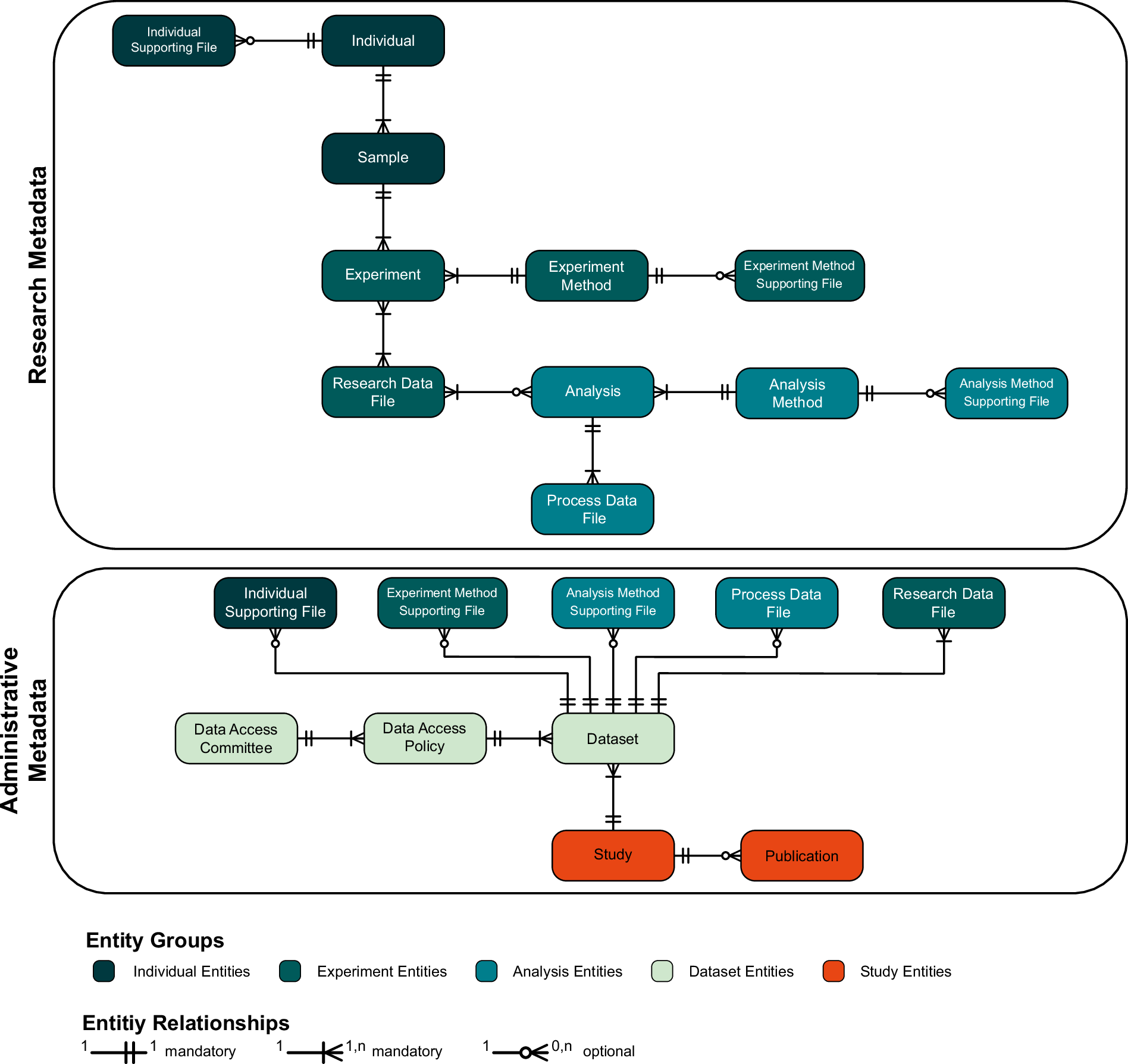
Semantic alignment of the German Human Genome-Phenome Archive metadata model in Europe’s genomics field
Legal and technical developments drive data sharing via federated infrastructures, especially in the field of human omics. This requires interoperability across technical, syntactic, organizational, and semantic layers. The German Human Genome-Phenome Archive (GHGA) has been building a national, federated infrastructure for secure sharing of human omics data. As part of its mission to enhance interoperability and to promote reliable data sharing, a detailed crosswalk analysis was conducted comparing the GHGA metadata model with four other domain-relevant standards and metadata models: EGA (Submission API and model draft), FAIR Genomes and ISA-tab. The analysis aimed at identifying semantic consensus fields to define datasets in the context of human omics by forward mapping (GHGA model to external models). Backward mapping (external models to GHGA) focused on spotting gaps in GHGA’s semantic metadata representation. Forward mapping showed overall similar property coverage across models, aligning with MINSEQE. Backward mapping showed greater model heterogeneity. None of the identified information gaps spanned across all models. These findings highlight the detail and adaptability of the GHGA metadata model.
Data‐ and code‐archiving in the British Ecological Society journals: Present status and recommendations for future improvements
Abstract Data‐ and code‐archiving are important components of open science, as both make research more transparent, reproducible, accountable and credible, allowing future researchers to build on previous work. Despite progress in implementing data‐ and code‐archiving policies in journals publishing ecology and evolution research, issues remain. To be more useful to future researchers, archived data and code must not only be archived but also meet good practice standards. We collected data from 1861 papers published between 2017 and 2024 in the seven British Ecological Society (BES) journals, during a hackathon event. We systematically checked associated data and/or code, metadata, help files and annotations to assess archiving practices. We determined if and where data and code files were archived, whether they could be located, downloaded and opened, and whether they had associated READMEs, digital object identifiers (DOI) and licences. We also recorded the file extensions used to save data/code files, and which programming languages code was written in. 93% of the 1861 papers we examined used data and ~90% used code. While 97% of the 1735 papers that used data also archived it, only 35% of the 1670 papers that used code also archived code. Over 85% of archived data and code could be located, downloaded and opened. Reusability, however, was more limited; around a third of papers did not have a README or similar to explain their data/code files, and the quality of READMEs varied substantially. We recommend that researchers archive their code and that archived code be explicitly mentioned in the Data (or Code) Availability statement. We also encourage researchers to provide more accessible and informative READMEs for data and code. To help achieve these recommendations, we advocate that journals employ Data/Code editors to review data and code quality, research institutions deliver more training in open science practices, and funding bodies set clear expectations on open data and code practices.

New Build Notes article discussing ATProto and how we as developers can go about forming standard lexicons for common datatypes without being overly prescriptive on implementation details that would limit creativity and competition blog.stygiantech.dev/a/3msmoumcr4d23-atproto-stand…

ATProto Standards Bodies—Guiding the Future of the Network
blog.stygiantech.dev