

mem-agent: Equipping LLM Agents with Memory Using RL
The insights and the technical report behind Mem-Agent, our 4B model for persistent memory in LLMs
The rebel alliance
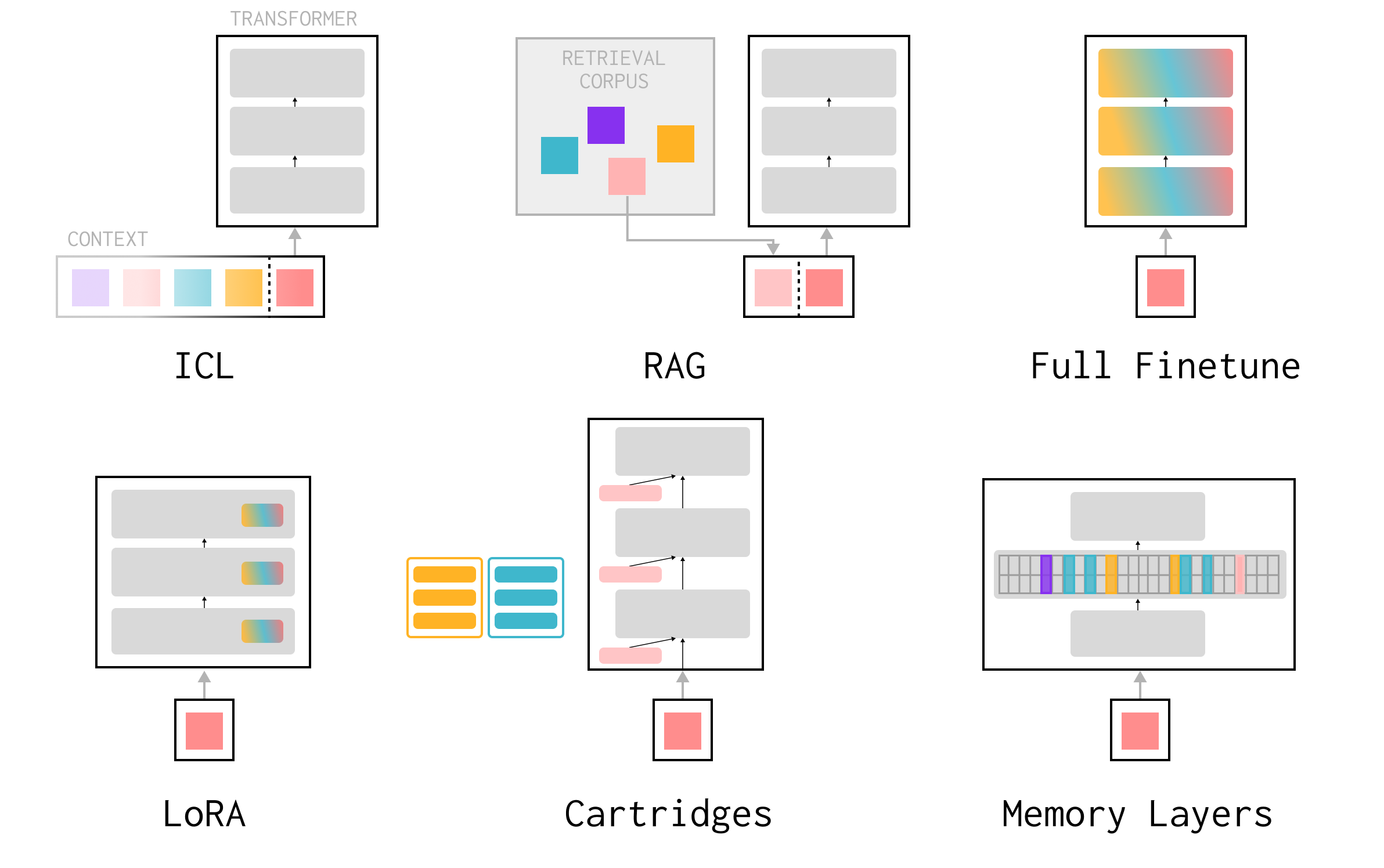
This blog is co-authored with Zoe Weinberg and Matt Hawes at ex/ante, and is a follow-up to our first blog post on the topic, 'You don't own your memory.' We need an open architecture that puts us in control of our memories while making their exploitation technically impossible. But how will this shift happen? In order to discover possible implementations, we must understand how our data informs LLMs. The three predominant context engineering techniques are prompt design, retrieval-augmented ...

The Continual Learning Problem
A perspective on continual learning, motivating our paper on sparse memory finetuning
The Implementation Remembers · The Phoenix Architecture
Every mature system is carrying around lessons that were never written down. They’re encoded as validations, retries, timeouts, workflows, and exceptions. The implementation remembers. The organization forgets
Memory Models: Towards Agents That Learn
Agents that truly learn from experience will be powered by memory models: models that create and curate token-space memory across model generations, trained with memory-native RL.
Layers of Memory, Layers of Compression
AI superpower = strategic amnesia. Letta caches memory like a CPU, Anthropic spreads it across agent swarms, Cognition warns of chaos. Curious how forgetting makes machines smarter? Dive in.

Memory system - Please Leave here your opinions (if you have any) · Issue #74 · code-yeongyu/oh-my-openagent
I heard many people wants that memory system- but it's really easy to be redundant from my experiences. Projects like claude-mem or many others have memory system. Want to hear your opinions re...
A Comprehensive Survey of Continual Learning: Theory, Method and Application
To cope with real-world dynamics, an intelligent system needs to incrementally acquire, update, accumulate, and exploit knowledge throughout its lifetime. This ability, known as continual learning, provides a foundation for AI systems to develop themselves adaptively. In a general sense, continual learning is explicitly limited by catastrophic forgetting, where learning a new task usually results in a dramatic performance degradation of the old tasks. Beyond this, increasingly numerous advances have emerged in recent years that largely extend the understanding and application of continual learning. The growing and widespread interest in this direction demonstrates its realistic significance as well as complexity. In this work, we present a comprehensive survey of continual learning, seeking to bridge the basic settings, theoretical foundations, representative methods, and practical applications. Based on existing theoretical and empirical results, we summarize the general objectives of continual learning as ensuring a proper stability-plasticity trade-off and an adequate intra/inter-task generalizability in the context of resource efficiency. Then we provide a state-of-the-art and elaborated taxonomy, extensively analyzing how representative methods address continual learning, and how they are adapted to particular challenges in realistic applications. Through an in-depth discussion of promising directions, we believe that such a holistic perspective can greatly facilitate subsequent exploration in this field and beyond.

Letta
Making machines that learn. Create stateful agents that remember everything, learn continuously, and improve themselves over time.

To Remember, the Brain Must Actively Forget | Quanta Magazine
Researchers find evidence that neural systems actively remove memories, suggesting that forgetting may be the default mode of the brain.

DREAM — Dynamic Retention Episodic Architecture for Memory
Modern AI systems lack persistent, user-specific episodic memory. Existing approaches rely on short-term context windows, shallow preference storage, or static conversation logs that do not scale and cannot preserve meaningful long-term continuity. This paper introduces DREAM (Dynamic Retention Episodic Architecture for Memory), a scalable, opt-in, episodic memory framework designed to work with current LLM and agent architectures. DREAM integrates episodic summarization, user-controlled opt-in memory, semantic retrieval via per-user vector indexes, an adaptive retention mechanism that expands TTL based on user engagement, and horizontal sharding of orchestrators and storage for large-scale deployments. The paper details the architecture, components, data flows, and implementation examples, and argues that DREAM provides a practical path toward AI systems capable of consistent, privacy-aligned long-term reasoning. This project has been extended with a conceptual analysis and simulation of a "DREAM-as-a-Support" (DaaS) hybrid layer. This extension demonstrates DREAM's architectural extensibility, reframing it from a standalone framework into a foundational platform component. The DaaS model provides core memory governance such as adaptive retention (ARM) and user-centric opt-in as an on-demand service to complementary cognitive systems, validating the original four-pillar design through a scalable, internal API. Reference Implementation A reference implementation of the DREAM architecture is available as an open-source Python framework:Official Reference Implementation This implementation is intended for experimentation and architectural validation and does not represent a production-ready system DREAM Architecture — Official GitHub Repository
How to forget
Most agent frameworks optimize for recall. Open-strix optimizes for forgetting — and that turns out to be the whole trick.
I Benchmarked OpenAI Memory vs LangMem vs Letta (MemGPT) vs Mem0 for Long-Term Memory: Here’s How They Stacked Up
145 votes, 53 comments. Lately, I’ve been testing memory systems to handle long conversations in agent setups, optimizing for: Factual consistency…
New blog post: Ambient associative agent memory Largely, I think deep research styled agents are extremely useful for new content we haven't seen before, but fail hard for memory that's already supposed to be "known" Here are 2 patterns, mine and @3fz.org's timkellogg.me/blog/2026/05/17/ambient-memor…

Ambient Associative Memory
timkellogg.mePost-Archive-Everything

For me personally there is a journey here - I was a firm believer in archive everything. This peaked in a period where I was very interested in IPFS, CIDs, CAS, etc. Now, the next step. Post-Archive(-Everything). Through a series of conversations I came to the conclusion that forgetting is probably more powerful than remembering. The links in this collections play a similar note, or are related to my understanding of this.

FOSDEM 2026 - Willow - Protocols for an uncertain future
Willow - Home
I Deleted My Second Brain

