How do Internet atheism and Internet feminism help us understand the current cultural moment?
All Internet Roads Lead Back to 2014
Ten years ago, developments in commerce, activism, and influencer culture coalesced, and our contemporary concept of “being online” was born

Cybercultural: Internet History and Its Impact on Our Culture
Cybercultural is a website covering internet history and the evolution of digital culture.
Feminist Principles of the Internet - Version 2.0
A feminist internet works towards empowering more women and queer persons – in all our diversities – to fully enjoy our rights, engage in pleasure and play, and dismantle patriarchy. The following key principles are critical towards realising a feminist internet.

White paper on feminist internet research
APC has been working towards imagining and making a feminist internet by building and strengthening networks of researchers, activists and others. This paper aims to assess feminist internet research on internet governance and policy, with a particular focus on scholarship in the global South.

A Future for Intersectional Black Feminist Technology Studies
Neoliberal narratives of digital technologies and the internet have flourished in information and internet studies and suggest that the web is a panacea of social liberation and empowerment.

Historical pragmatism and the internet
This article argues that the literature describing the internet revolution in the 1990s was characterized by the rhetoric of the technological sublime. This rhetoric suffered from three fatal flaws: (1) it was not sufficiently grounded in the historical development of technology; (2) it viewed the internet in isolation, failing to consider the wider technological context; and (3) it failed to examine the internet in view of the social, economic, religious and political circumstances of its users. Several examples from history are cited, demonstrating that changes in various systems for the production, dissemination and preservation of cultural information both border and deborder the world. The article suggests that if internet researchers take a pragmatic, historically grounded approach, they will discover that the introduction of internet technology can be seen to have similar consequences. While the technology overcomes many boundaries (of space and time, politics and economics), other social borders may be created at the same time. It is easier to see old boundaries coming down than to see new ones being erected. Rather than being swept by utopian or dystopian enthusiasms, the article insists that the really interesting discoveries are to be made in locating the subtle social shifts taking place, relatively unnoticed, as a consequence of technological change.

Art or tool?
The Internet spaces I tend to inhabit have more polarisation than at many other recent times, and little explication of the worldviews that lead to different premises for discussion, that in turn...

The Malaise Of Peak Wokeism Within Online Culture
How have certain forms of education and new technology formed the template to woke culture today? This piece examines the link between social media and new technology to the outwoking of the wokest through a veritable closing of the mind.

Whose Global Village — Ramesh Srinivasan
In the digital age, technology has shrunk the physical world into a “global village,” where we all seem to be connected as an online community as information travels to the farthest reaches of the planet with the click of a mouse. Yet from the US election, to the growth of the alt-right movement, to the Dakota pipeline to the question of ISIS, we also have begun to recognize how incredibly disconnected we are at the same time, occupying various bubbles and self-selected communities.While we think of platforms such as Twitter and Facebook as open and accessible to all, in reality, these are commercial entities developed primarily by and for the Western world. Considering how new technologies increasingly shape labor, economics, and politics, these tools often reinforce the inequalities of globalization, rarely reflecting the perspectives of those at the bottom of the digital divide.
Why Open-Source Needs More Feminism | Built In
In open source, as in life, hidden labor goes unrewarded.

No Sense of Place: The Impact of Electronic Media on Social Behavior
Electronic media present us with a collage of experiences from everyplace. We eat dinner at home while watching starving children thousands of miles away reach out to us for food. From our easy chairs, we stare at blindfolded hostages, and coolly

Digital hopes, real power: From connection to collective action
If the Arab Spring was defined by optimism about what the internet could do, the years since have been marked by a more sober understanding of what it takes to defend it

The Melancholy of Subculture Society
Internet links small groups, helping dissolve big groups; good, bad? But a bit sad.

Feminism | The Paper Pilot
The Paper Pilot's digital garden of thoughts on philosophy, politics, and sociology
Opinion | Meet the Renegades of the Intellectual Dark Web (Published 2018)
An alliance of heretics is making an end run around the mainstream conversation. Should we be listening?

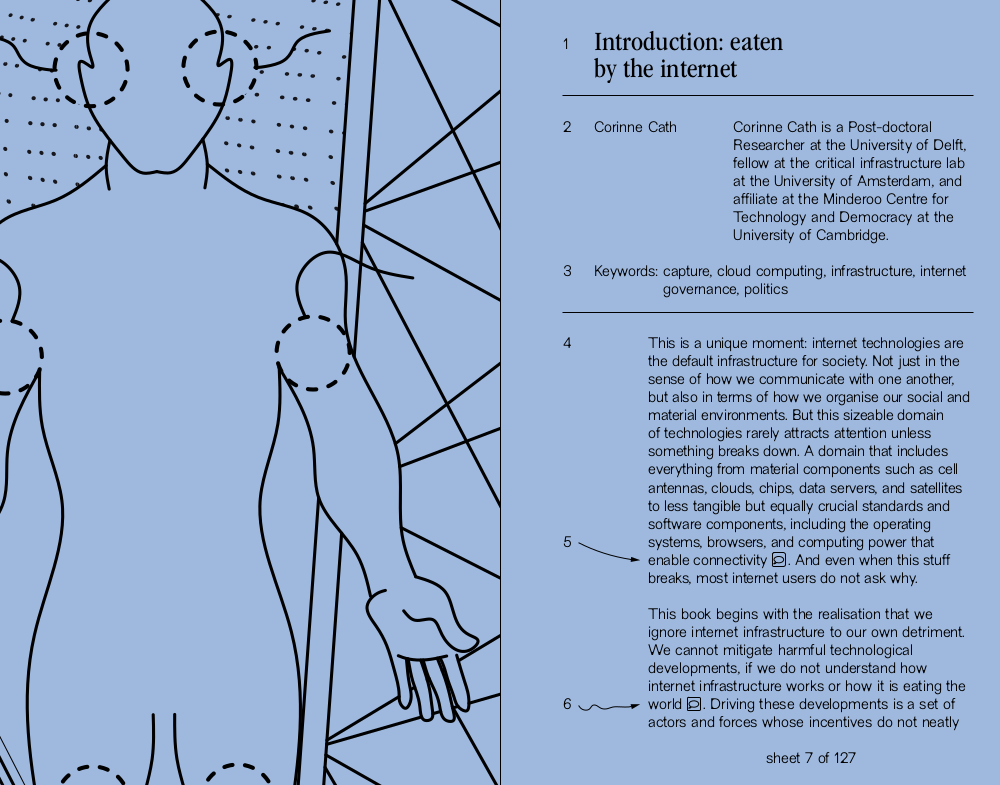
Eaten by the Internet
This book makes internet infrastructure visible as a force of political power, which is transforming the social world, from the bottom up—through fifteen chapters contributed by a global set of researchers, activists, and techies. We are living a unique moment: internet technologies are the default infrastructure for society, not just how we communicate but also how we organise our social life, politics, and economy, all the way down to our material environments, like cities. Our world is eaten by the internet. This means that those who control the internet control the bounds of public speech, economic production, social cohesion, and politics, making its infrastructure a core political terrain in the networked age. The book’s chapters cover a wide set of topics, spanning from the global politics of content moderation by internet infrastructure to the colonialism inherent in the race to plug the moon, from the harms wrought by blockchain companies in rural America to the particularities of online censorship across Asia. The chapters take on thorny topics, discussing power consolidation in the advertisement and cloud industry, the role of internet infrastructure in the war in Ukraine, and tech’s environmental impact—amongst others. In doing so, this book roots contemporary technology debates in the politics of internet infrastructure and urges us to ask how can we ensure our infrastructures sustain us, rather than consume us?