Entity-level semantic merge driver for Git. Two agents edit different functions in the same file? Clean merge. Every time.
mergiraf
A syntax-aware git merge driver for a growing collection of programming languages and file formats.
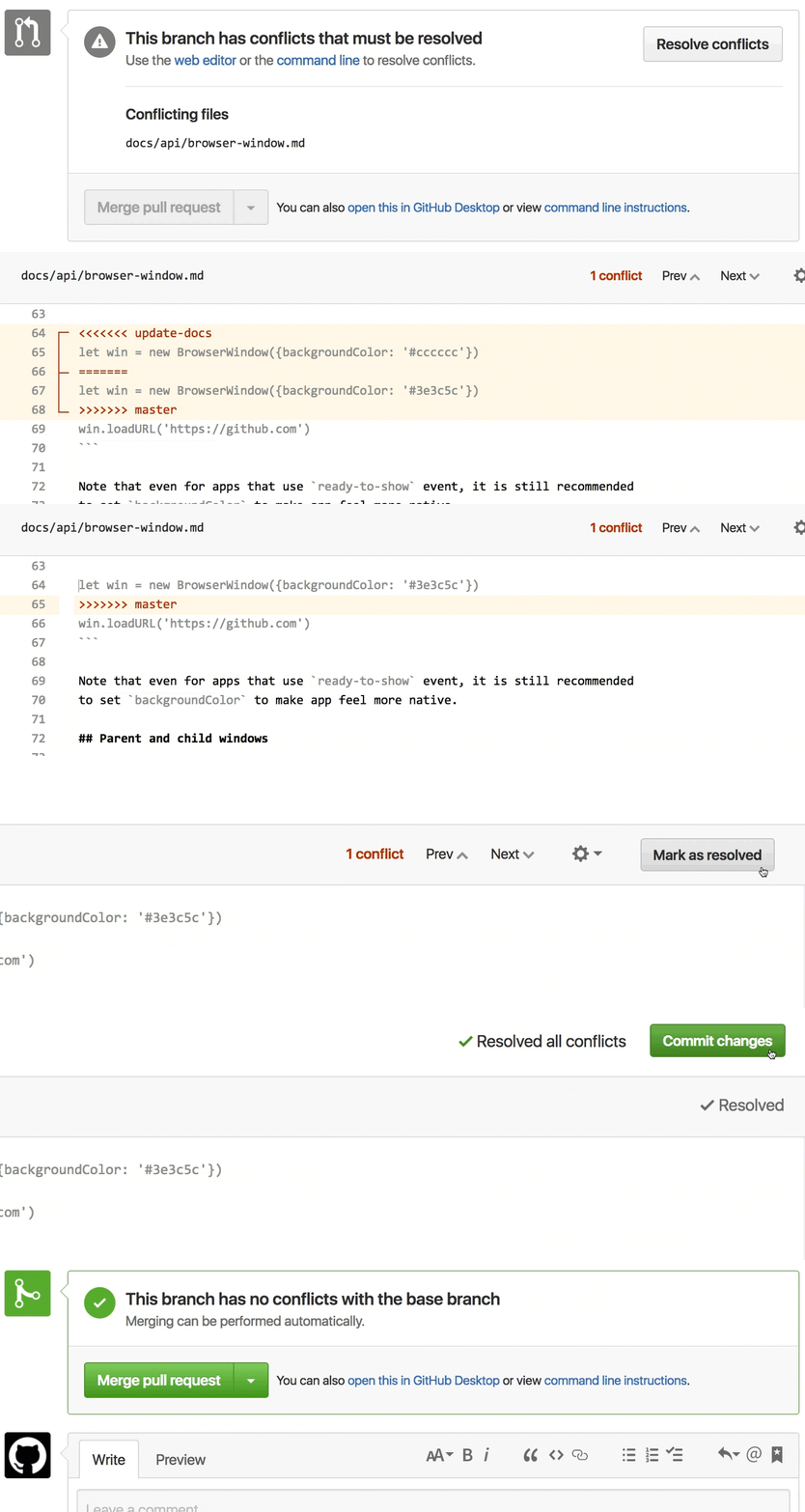
Resolve simple merge conflicts on GitHub
You can now resolve simple merge conflicts on GitHub right from your pull requests, saving you a trip to the command line and helping your team merge pull requests faster.…
A Better Merge Workflow with Jujutsu | ofcrse by Benjamin Tan
A merge workflow for activating multiple branches simultaneously using Jujutsu, an alternative VCS to Git.

Trusting AI with Your Data: Safe Automation from Branch to Production
Structured merge with auto-tuning: balancing precision and performance
Software-merging techniques face the challenge of finding a balance between precision and performance. In practice, developers use unstructured-merge (i.e., line-based) tools, which are fast but imprecise. In academia, many approaches incorporate information on the structure of the artifacts being merged. While this increases precision in conflict detection and resolution, it can induce severe performance penalties. Striving for a proper balance between precision and performance, we propose a structured-merge approach with auto-tuning. In a nutshell, we tune the merge process on-line by switching between unstructured and structured merge, depending on the presence of conflicts. We implemented a corresponding merge tool for Java, called JDime. Our experiments with 8 real-world Java projects, involving 72 merge scenarios with over 17 million lines of code, demonstrate that our approach indeed hits a sweet spot: While largely maintaining a precision that is superior to the one of unstructured merge, structured merge with auto-tuning is up to 12 times faster than purely structured merge, 5 times on average.

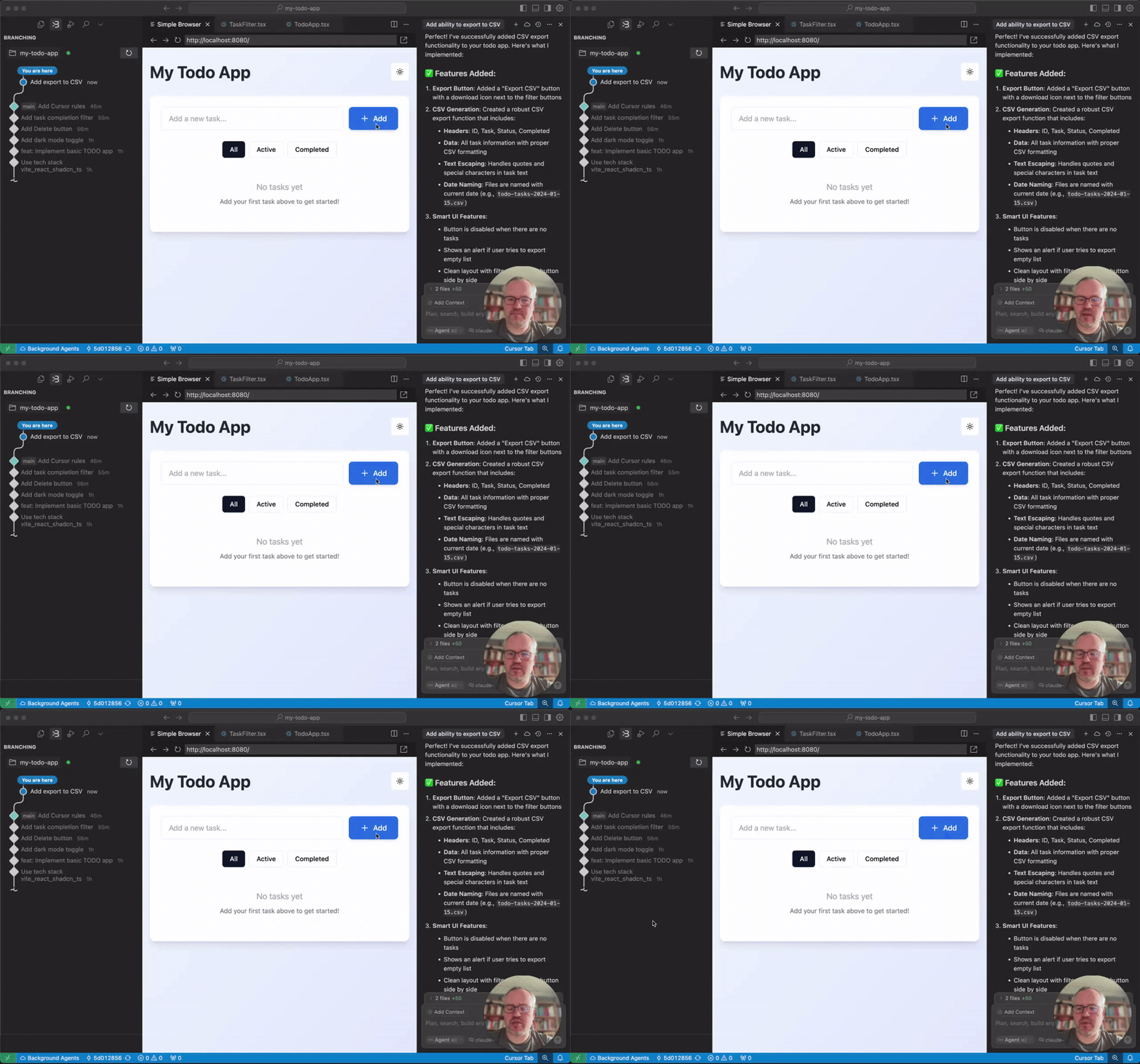
Managing Changes from Multiple AI Agents
In this video, I walk you through managing changes from multiple AI agents in our to-do app, specifically focusing on the Expert to CSV button. We explore design options using ground agents, where one agent proposes a green design and the other a blue one. After some time, both agents complete their tasks, and their changes are synchronized to GitHub and our local machine. I demonstrate the final designs and decide to ship the green version as the main one. I encourage you to apply this approach in your own projects and consider using rebase in GitHub for similar tasks.
Agent Driven Project Management and Issue Refinement with gh-issue-sync
A Categorical Theory of Patches
When working with distant collaborators on the same documents, one often uses a version control system, which is a program tracking the history of files and helping importing modifications brought by others as patches. The implementation of such a system requires to handle lots of situations depending on the operations performed by users on files, and it is thus difficult to ensure that all the corner cases have been correctly addressed. Here, instead of verifying the implementation of such a system, we adopt a complementary approach: we introduce a theoretical model, which is defined abstractly by the universal property that it should satisfy, and work out a concrete description of it. We begin by defining a category of files and patches, where the operation of merging the effect of two coinitial patches is defined by pushout. Since two patches can be incompatible, such a pushout does not necessarily exist in the category, which raises the question of which is the correct category to represent and manipulate files in conflicting state. We provide an answer by investigating the free completion of the category of files under finite colimits, and give an explicit description of this category: its objects are finite sets labeled by lines equipped with a transitive relation and morphisms are partial functions respecting labeling and relations.
How Notion handles concurrent editing with CRDTs
Building a CRDT-based rich-text system that merges concurrent edits across Notion blocks—without losing anyone’s work

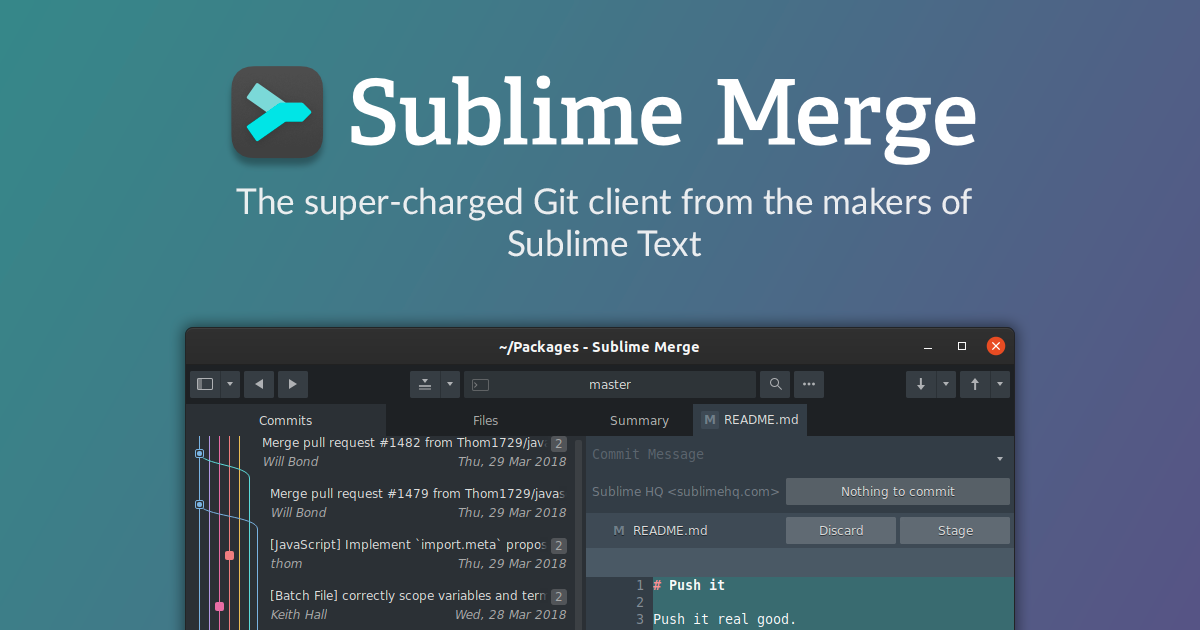
Sublime Merge - Git client from the makers of Sublime Text
Blaze through your commits with Sublime Merge - available on Mac, Windows and Linux
Humans approve intent, machines prove conformance
The pull request assumes a human wrote the diff. gittifacts is my attempt at a git platform for when agents write most of it.

Arcee AI | Arcee AI and mergekit unite
Several months ago, I stumbled upon an innovative technique in the world of language model training known as Model Merging. This SOTA approach involves the fusion of two or more LLMs into a singular, cohesive model, presenting a novel and experimental method for creating sophisticated models at a fraction of
Unison | A friendly, statically-typed, functional programming language from the future · Unison programming language
A friendly programming language from the future.