


Manage your tasks on the AT Protocol with complete data ownership. A simple, decentralized todo app powered by Bluesky.
Beyond Bluesky: These are the apps building social experiences on the AT Protocol | TechCrunch
A list of AT Protocol-based, consumer-facing apps that are either built on top of Bluesky or its underlying protocol, allowing users to take back control over their social networking experiences and personal data.

AT Protocol - AT Protocol
The AT Protocol is an open, decentralized, and high-performance network for building social applications.
AT Protocol
The AT Protocol is a protocol and set of open standards for decentralized publishing and distribution of self-authenticating data within the social web. It serves as the technical foundation of the Bluesky social network, originally developed as a reference implementation for the protocol, as well as an ecosystem of interoperable social applications and services collectively referred to as the ATmosphere.

Bluesky and the AT Protocol: Usable Decentralized Social Media
Bluesky is a new social network built upon the AT Protocol, a decentralized foundation for public social media. It was launched in private beta in February 2023, and has grown to over 10 million registered users by October 2024. In this paper we introduce the architecture of Bluesky and the AT Protocol, and explain how the technical design of Bluesky is informed by our goals: to enable decentralization by having multiple interoperable providers for every part of the system; to make it easy for users to switch providers; to give users agency over the content they see; and to provide a simple user experience that does not burden users with complexity arising from the system's decentralized nature. The system's openness allows anybody to contribute to content moderation and community management, and we invite the research community to use Bluesky as a dataset and testing ground for new approaches in social media moderation.

research.latha.org
A permissioned appview for research documents on AT Protocol. True data ownership with optional monetization.
Decentralization Trade Offs in AT Protocol and ActivityPub DWeb Camp 2026
Christine Lemmer Webber is lead author and co-editor of the W3C ActivityPub specification. Daniel Holmgren is Head of Protocol at Bluesky, working on the AT Protocol specification at the IETF. Join us for a discussion on decentralization trade-offs and other design decisions in the two protocols, and what that means for different architectures, structures, and even future points of convergence. Moderated by Boris Mann
Bluesky Is an App. The AT Protocol Is the Internet Beneath It. - Ewan’s Blog
There is a confusion that keeps recurring, and it is understandable enough that it is worth addressing directly.
Bluesky Is an App. The AT Protocol Is the Internet Beneath It. - Ewan’s Blog
There is a confusion that keeps recurring, and it is understandable enough that it is worth addressing directly.
The AT Protocol | Bluesky
The AT Protocol (Authenticated Transfer Protocol, or atproto) is a standard for public conversation and an open-source framework for building social apps.

AT Protocol, OAuth, and well, decentralization
I've been very happy with how Bluesky and AT Protocol as a whole is going, except for one thing: OAuth.
A peer to peer community platform built on the AT Protocol
Exploring Identities in the AT Protocol via Bluesky
The AT Protocol is an open, decentralized network for building social applications. Bluesky, a relatively new social network, is built on top of the AT Protocol. It recently piqued my interest as I came across this fascinating research paper Bluesky and the AT Protocol: Usable Decentralized Social Media. In this post, we’ll dive into one of the key elements of the AT Protocol: identities. We will start with Bluesky user handles, explore additional information about them, and see what else we can discover. DID Resolution A handle in Bluesky is associated with a DID, which can be resolved using DNS or HTTPS. decentralized identifier (DID) A globally unique persistent identifier that does not require a centralized registration authority and is often generated and/or registered cryptographically. […] Many—but not all—DID methods make use of distributed ledger technology (DLT) or some other form of decentralized network. From Decentralized Identifiers (DIDs) v1.0 The DID for @jay.bsky.team can be resolved via a DNS record. Example with dig: > dig _atproto.jay.bsky.team TXT [...] _atproto.jay.bsky.team. 14400 IN TXT "did=did:plc:oky5czdrnfjpqslsw2a5iclo" If you don’t have dig installed, try an online tool like nslookup.io. If no DNS TXT entry exists, the handle may resolve to a DID through a well-known HTTPS endpoint. Let’s take the example of @jamesgunn.bsky.social: > curl https://jamesgunn.bsky.social/.well-known/atproto-did did:plc:lotavzt36yanhfy3j3gpysyj If you don’t have curl installed, you can just open the link in your browser https://jamesgunn.bsky.social/.well-known/atproto-did. PLC Once you have a DID, examine the part after the first colon. This is known as the method. The above two examples use plc, which stands for Public Ledger of Credentials. These PLC DIDs can be looked up in the PLC directory at plc.directory. The AT Protocol also supports the web method, though we focus on plc here. We can use curl again to get more information about a DID. Let’s take @jay.bsky.team’s DID as example. > curl https://plc.directory/did:plc:oky5czdrnfjpqslsw2a5iclo/log | jq [ { "sig": "KuN3A61golVNSDU71wZKLP9lVuXk6YekJAz1lwDzrPsNTEWHBBW_8zSyV6pDxV4KiYXuAXlS1Ik47XkjQZ94mA", "prev": null, "type": "create", "handle": "jay.bsky.social", "service": "https://bsky.social", "signingKey": "did:key:zQ3shP5TBe1sQfSttXty15FAEHV1DZgcxRZNxvEWnPfLFwLxJ", "recoveryKey": "did:key:zQ3shhCGUqDKjStzuDxPkTxN6ujddP4RkEKJJouJGRRkaLGbg" }, { "sig": "TY3ot8yFF-0LL8ceoRwSGaNQj0F1aj-IApYXRGT21G1fnznKHUHT1QE7c1aTrYd9PQLVvXUGag6CZ9EEeIKqgA", "prev": "bafyreidswhiwi4ljkl4es4vwqhkas3spmmktortqbp6lkrb5v7qqdfr3mm", "type": "plc_operation", "services": { "atproto_pds": { "type": "AtprotoPersonalDataServer", "endpoint": "https://bsky.social" } }, "alsoKnownAs": [ "at://jay.bsky.social" ], "rotationKeys": [ "did:key:zQ3shhCGUqDKjStzuDxPkTxN6ujddP4RkEKJJouJGRRkaLGbg", "did:key:zQ3shpKnbdPx3g3CmPf5cRVTPe1HtSwVn5ish3wSnDPQCbLJK" ], "verificationMethods": { "atproto": "did:key:zQ3shXjHeiBuRCKmM36cuYnm7YEMzhGnCmCyW92sRJ9pribSF" } }, { "sig": "WmQmobHA6abtu8xIkBSrDkkoMNjOxP1Tl_1zl1DbIZlA9kjOyxjX-J1rzwWVy3stdzMowpBeBnedkAug84n_RQ", "prev": "bafyreicgb25yf5fro22oyhtkbgerzr4nume4sx757r525skxdzpeoeseha", "type": "plc_operation", "services": { "atproto_pds": { "type": "AtprotoPersonalDataServer", "endpoint": "https://bsky.social" } }, "alsoKnownAs": [ "at://jay.bsky.team" ], "rotationKeys": [ "did:key:zQ3shhCGUqDKjStzuDxPkTxN6ujddP4RkEKJJouJGRRkaLGbg", "did:key:zQ3shpKnbdPx3g3CmPf5cRVTPe1HtSwVn5ish3wSnDPQCbLJK" ], "verificationMethods": { "atproto": "did:key:zQ3shXjHeiBuRCKmM36cuYnm7YEMzhGnCmCyW92sRJ9pribSF" } }, { "sig": "dhstt4uPua8OVs8TVzHTqtCnNMsBDN7kjxIBmTIYBDRkknrtprBJ_AISXFoBZyqfoxq2altp-vlRAPEKSh5zeg", "prev": "bafyreihmf7dapx27fexc7jwj4cdpbxcmhnnwo3x5vrpvbr6lclzj7gpsmi", "type": "plc_operation", "services": { "atproto_pds": { "type": "AtprotoPersonalDataServer", "endpoint": "https://morel.us-east.host.bsky.network" } }, "alsoKnownAs": [ "at://jay.bsky.team" ], "rotationKeys": [ "did:key:zQ3shhCGUqDKjStzuDxPkTxN6ujddP4RkEKJJouJGRRkaLGbg", "did:key:zQ3shpKnbdPx3g3CmPf5cRVTPe1HtSwVn5ish3wSnDPQCbLJK" ], "verificationMethods": { "atproto": "did:key:zQ3shtJpFGgEG3tv3ERKvjo7VHbjDPVyvjYvW7gpie49rtNtc" } } ] Again, feel free to click on it instead, https://plc.directory/did:plc:oky5czdrnfjpqslsw2a5iclo/log. This returns a list of all operations that were performed on this DID. The first entry is the genesis operation — the one that created the DID. It is the only one where prev (previous entry) is null, because it is the first one. Note that the first entry of this DID’s log has a different format. This entry uses the legacy format. Currently, newly created DIDs use the new format (subsequent records), but @jay.bsky.team has been around for a while (the account belongs to Bluesky’s CEO). If you look through the logs you will notice a couple of changes that were made to her identity over time: the handle was changed from jay.bsky.social to jay.bsky.team (note that the legacy format used handle whereas the new format uses alsoKnownAs) the handle now includes at:// the personal data server changed from https://bsky.social to https://morel.us-east.host.bsky.network Signatures Each entry in the log includes a sig field, which contains the signature. This cryptographic signature is derived from the other fields in the entry. For the genesis operation, the rotationKeys (or signingKey for legacy) field contains the public key(s) of the key pair(s) with which the entry was signed. Subsequent operations need to be signed with the key from the previous entry. Additionally, the prev field references the previous entry. Creating a DID The identifier in the DID, which is the last part of the colon-separated string, is constructed from the genesis operation. For @jay.bsky.team: the identifier is oky5czdrnfjpqslsw2a5iclo the genesis operation is this JSON document: { "sig": "KuN3A61golVNSDU71wZKLP9lVuXk6YekJAz1lwDzrPsNTEWHBBW_8zSyV6pDxV4KiYXuAXlS1Ik47XkjQZ94mA", "prev": null, "type": "create", "handle": "jay.bsky.social", "service": "https://bsky.social", "signingKey": "did:key:zQ3shP5TBe1sQfSttXty15FAEHV1DZgcxRZNxvEWnPfLFwLxJ", "recoveryKey": "did:key:zQ3shhCGUqDKjStzuDxPkTxN6ujddP4RkEKJJouJGRRkaLGbg" } Steps: encode the genesis operation in DAG-CBOR (this is a concise binary format and looks a bit like JSON) create a SHA256 hash of the encoded document encode the hash with base 32 and make its letters lowercase. take the first 24 characters add did:plc: as a prefix to create the 32-character DID Verification Based on what we’ve learned so far we can verify a handle from Bluesky. For example, if we want to check @jay.bsky.team: resolve DID via DNS: did:plc:oky5czdrnfjpqslsw2a5iclo look up DID in PLC directory the handle in the alsoKnownAs (or handle for legacy) field must match jay.bsky.team verify all operations using the public keys and signatures reconstruct the DID from the genesis operation and ensure it is the same as the one we found in the DNS TXT record Can we trust the PLC directory though? Say a malicious actor has taken over control and modified all entries in the log. The hacker even constructed the entries in the log so that all the signatures appear valid. How would we still know the PLC directory is compromised? Remember that the DID can be reconstructed from the genesis operation. If that were modified, we’d end up with a different DID from the one we found in the DNS TXT record. Summary This blog explores the AT Protocol, the decentralized foundation of social applications like Bluesky, with a focus on user identities and their technical underpinnings. It explains how Bluesky user handles are associated with Decentralized Identifiers (DIDs), which can be resolved using DNS records or HTTPS endpoints. Detailed examples demonstrate how tools like dig and curl retrieve DID data, revealing the method (plc) and structure used to catalog them in the Public Ledger of Credentials (PLC). The post also examines the DID lifecycle, showcasing how historical operations and changes—such as updates to handles or servers—are logged and accessible for transparency. There are several aspects that we did not investigate, such as: the web method for DIDs tombstone operations in the log recovery how exactly to construct the prev entry in the DID document what the other fields in the DID document mean If you are curious, the links in the next section will help you answer these questions. Links & Further Reading Bluesky Application AT Protocol AT Protocol Identity AT Protocol DID AT Protocol Handle Decentralized Identifiers (DIDs) v1.0 did:plc Method Specification Specification: DAG-CBOR
AT Protocol apps

Apps and services on ATProto (aside from Bluesky). See “AT Protocol” collection for links related to the protocol itself, as well as “Bluesky” for Bluesky clients etc.
Bluesky
Bookmarks related to Bluesky, including clients and utilities. See also “AT Protocol” and “AT Protocol apps” collections

linxtape

Skydit — communities, on your own terms
CalendAT
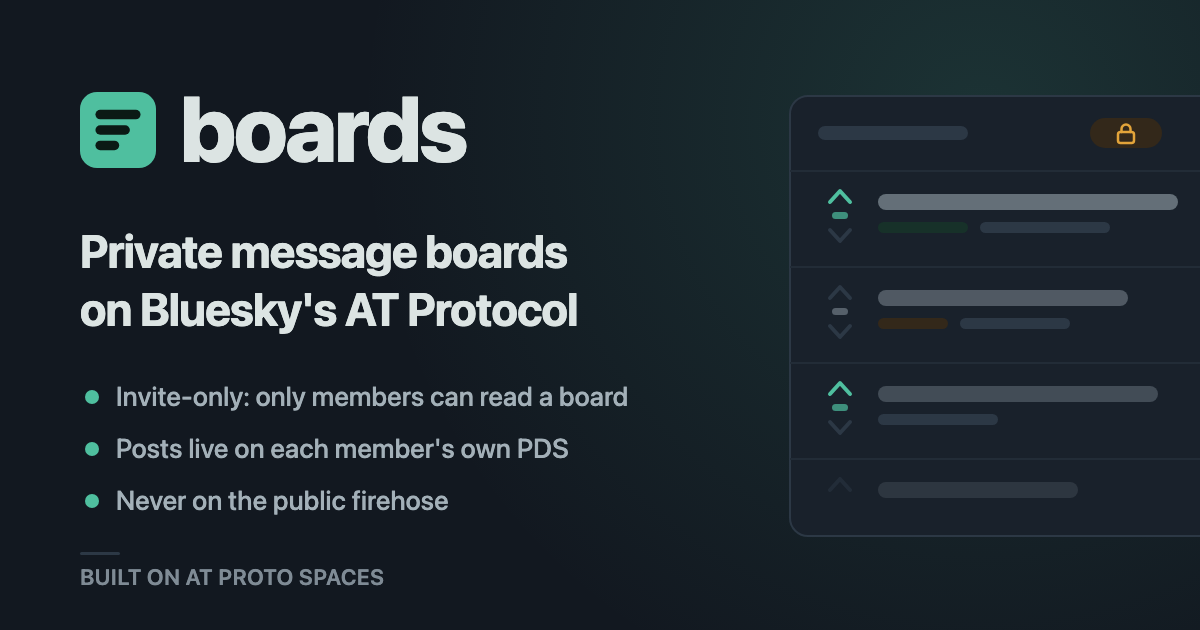
boards · private message boards on AT Proto
Link Jar: Your links. Your jar. Forever.
ATSMS — end-to-end encrypted group messaging

Skylens: who blocked you on Bluesky?
Buddy List — who's online on Bluesky
blusco

Postcard · Paste a post, get a clean image
ZonePane - マルチSNSクライアント

ByeSky — Clean up who you follow on Bluesky