

The section covers the naming and content of Internet-Drafts (I-Ds) including the required and recommended sections. There are lots of rules governing the content, developed over many years in order, which aim to ensure the readability and consistency of I-Ds. Please follow this section closely. The pages in this section are:
afterword
Writing this handbook has been a process of not over-thinking it. In deciding to do it post-by-post, day-by-day, I practiced sharing as I went, posting to a ...

Web Interface Guidelines
Guidelines for building great interfaces on the web. Covers interactions, animations, layout, content, forms, performance & design.
Proposal: standard.site.declaration
Proposal: standard.site.declaration Draft for Discussion Abstract AT Protocol provides portable identity, portable content, and portable social graphs. What it currently lacks is a standard mechanism for discovering machine-readable declarations associated with digital content. Today, creators and organisations publish declarations about digital assets through websites, registries, the C2PA provenance framework, and other systems. These declarations may describe provenance, copyright ownership...

W3C Manual of Style
This manual is a guide containing best current practice, written for editors and authors of W3C technical reports. No requirements for W3C publications are in this document. All requirements for W3C publications are in W3C [[[PUBRULES]]].
Publishing · Standard Reader
Wire a personal site's own site.standard.* records by hand.
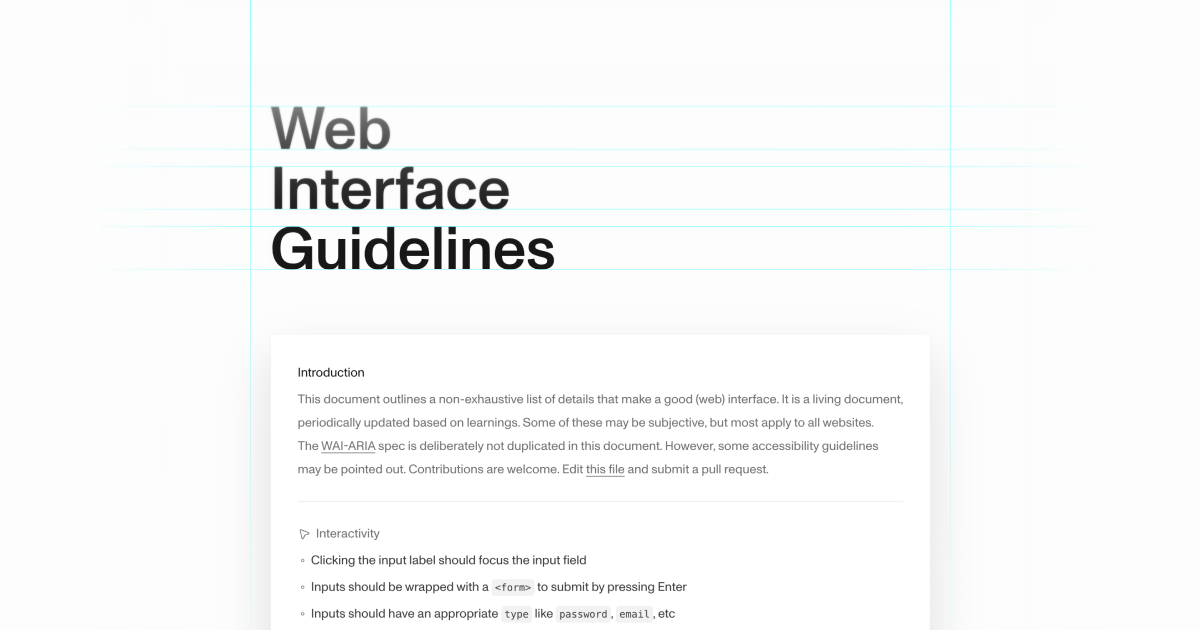
Web Interface Guidelines
A non-exhaustive list of details that make a good web interface.
Netiquette Guidelines
This document provides a minimum set of guidelines for Network Etiquette (Netiquette) which organizations may take and adapt for their own use. This memo provides information for the Internet community. This memo does not specify an Internet standard of any kind.
Design system doc spec 0.15.2
A machine-readable format for design system documentation. DSDS structures components, tokens, themes, foundations, patterns, and guides as a single source of truth for humans, parsers, and agents.

Who Shapes Web Standards? Uncovering the Main Topics of Interest in the W3C
Introduction - Standard.site
A brief introduction to Standard.site lexicons, what they are, and how they're used.
Standard Reader · blog index
Standard Search
A search engine for standard.site posts, indexing documents published on AT Protocol.
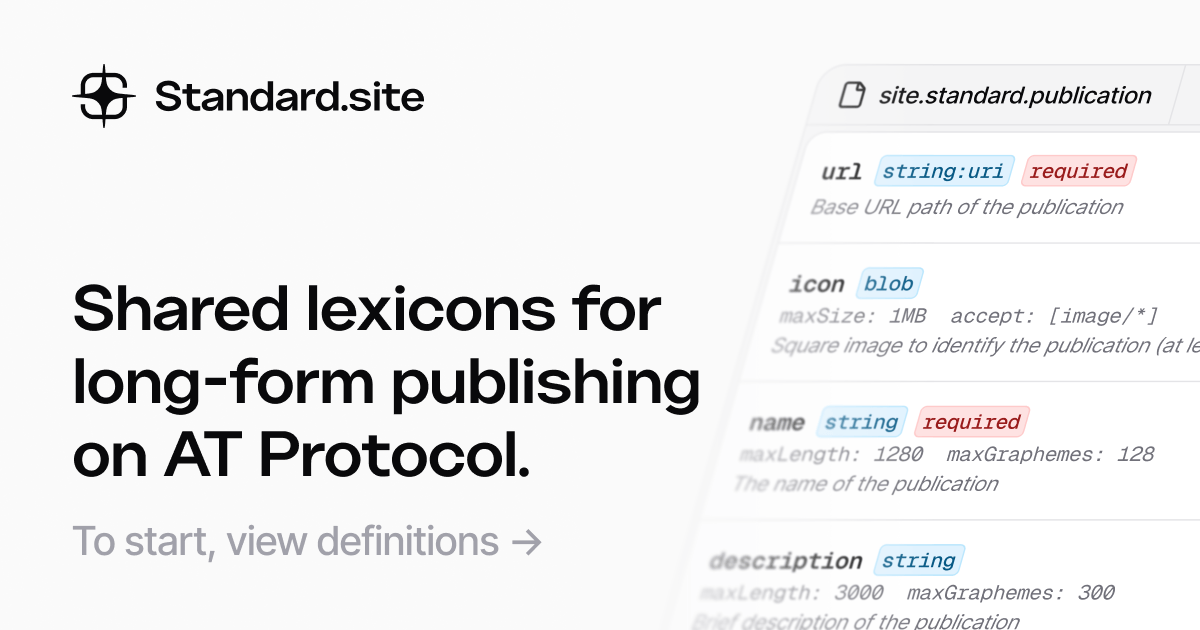
Standard.site - One schema. Every platform.
Standard.site provides shared lexicons for long-form publishing on AT Protocol. Making content easier to discover, index, and move across the ATmosphere.
We wrote a @standard.site explainer — what it is & why it's useful 📝✨ ~shared standards for longform publishing? ~a way to see what friends read & write? ~the atmosphere's hottest collab? yes yes & yes! Seeing lots of q's after Bluesky's new standard.site link card integration. Here's a TL;DR!

What is Standard Site, and why is it useful?
lab.leaflet.pubNew project! I recently needed feedback on a doc I was writing and didn't have a good place to post it. So I built requested.fyi. Post docs, get comments, all on the Atmosphere. disnetdev.com/blog/rfcs-on-the-atmosphere

RFCs on the Atmosphere
www.disnetdev.com⁂ Standarding yo site

Blog posts and guides from folks who have integrated standard.site into their website
I Moved My Website to Leaflet - Norbert Woehnl Photography
Hello, Leaflet 👋🏼🍃 - augment

New: special subscribe route for *any* @standard.site publication…useful as an embeddable form! leaflet-hosted: `pub_domain/subscribe` e.g…
How to publish multiple Standard Site publications on one domain

Putting my Neocities blog on ATProto

Understanding Standard.Site

