

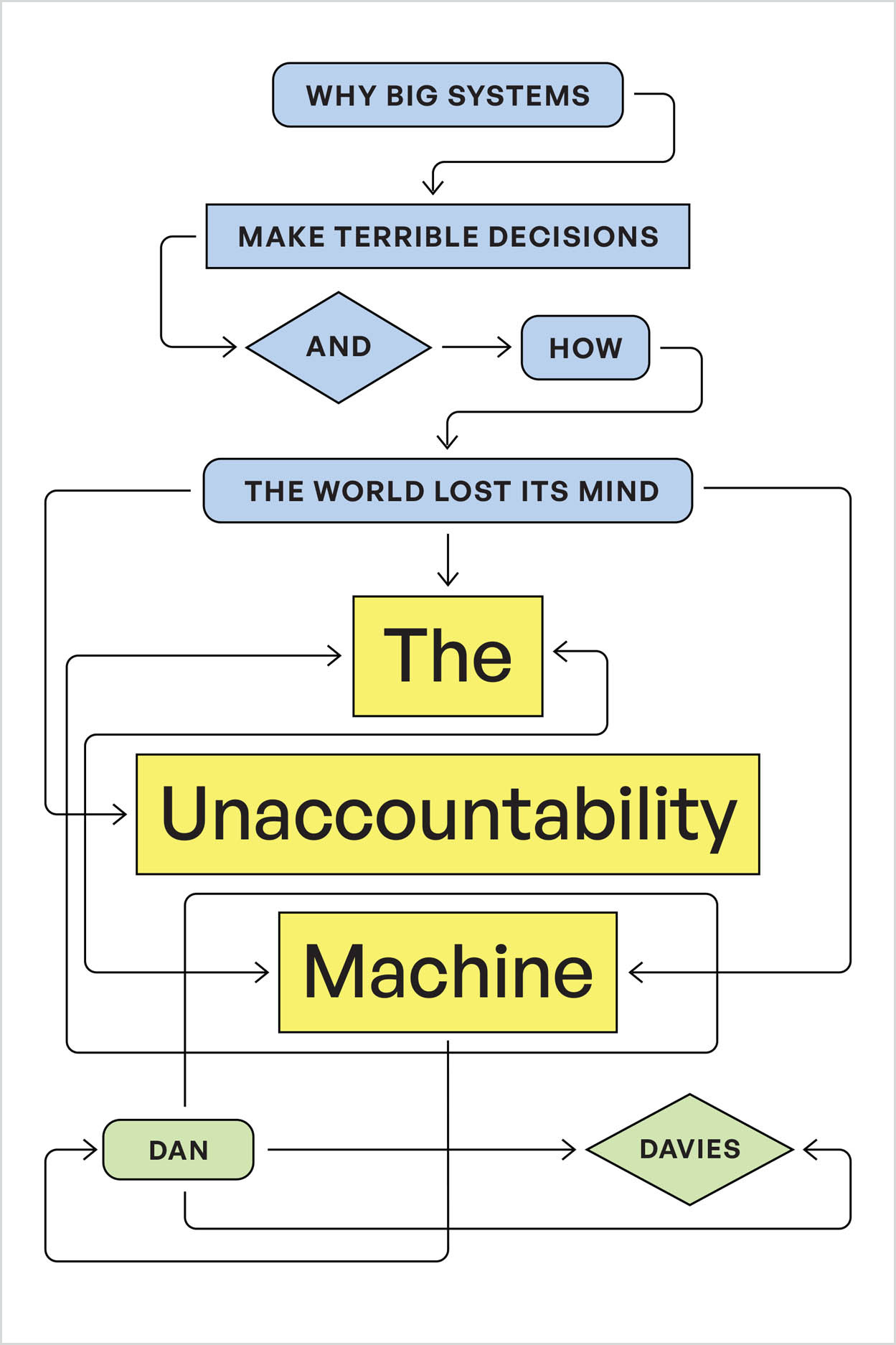
In The Unaccountability Machine, Dan Davies argues that organizations form “accountability sinks,” structures that absorb or obscure the consequences of a decision such that no one can be held dire...
The Unaccountability Machine, by Dan Davies
I read an online excerpt of this book and was immediately intrigued by the idea of an “accountability sink”, which is a mechanism by which “The communication between the decision-maker and the decided-upon has been broken – they have created a handy sink into which negative feedback can be poured without any danger of it affecting anything.” This lack of accountability where people shrug their shoulders and ask “What else could we do?” really frustrates me, as I believe that we should take responsibility for our actions and their consequences. So I bought the book and inhaled it in a few days.
The Unaccountability Machine: Why Big Systems Make Terrible Decisions—and How the World Lost Its Mind
Longlisted for the 2024 Financial Times Book of the Year. How life and the economy became a black box—a collection of systems no one understands, producing outcomes no one likes. Passengers get bumped from flights. Phone menus disconnect. Automated financial trades produce market collapse. Of all the challenges in modern life, some of the most vexing come from our relationships with automation: a large system does us wrong, and there’s nothing we can do about it. The problem, economist Dan Davies shows, is accountability sinks: systems in which decisions are delegated to a complex rule book or set of standard procedures, making it impossible to identify the source of mistakes when they happen. In our increasingly unhuman world—lives dominated by algorithms, artificial intelligence, and large organizations—these accountability sinks produce more than just aggravation. They make life and economy unknowable—a black box for no reason. In The Unaccountability Machine, Davies lays bare how markets, institutions, and even governments systematically generate outcomes that no one—not even those involved in making them—seems to want. Since the earliest days of the computer age, theorists have foreseen the dangers of complex systems without personal accountability. In response, British business scholar Stafford Beer developed an accountability-first approach to management called “cybernetics,” which might have taken off had his biggest client (the Chilean government) not fallen to a bloody coup in 1973. With his signature blend of economic and journalistic rigor, Davies examines what’s gone wrong since Beer, including what might have been had the world embraced cybernetics when it had the chance. The Unaccountability Machine is a revelatory and resonant account of how modern life became predisposed to dysfunction.
#NoAccountability | Allen Holub
The notion of accountability—and its lesser cousin, responsibility—often pop up in the context of business, as if both of those ideas are good things. A culture of accountability, we’re told, is essential to running a business. The word “accountable” appears all over the 2020 Scrum Guide. I don’t buy any of it. A culture of…
Why accountability is an increasingly elusive endeavour
In the age of algorithmic decision-making, allocating blame is a fraught process — but this doesn’t have to be a bad thing

Davies on The Unaccountability Machine
Dan Davies' The Unaccountability Machine is a book that leaves me a bit confused about how I feel about it. On the one hand, it covers topics I enjoy reading about and for which I have strong opinions—the industrialization of decision-making—and does so with references to cybernetics (where the author has clearly dug deeper than I have). On the other hand, it does the "airport book" kind of thing where the last chapters propose solutions to the identified problems that are plainly inadequate.
Dreaming Accountability
What if accountability wasn’t scary? Take a breath and let that sink in for a second. What if accountability wasn’t scary? It will never be easy or comfortable, but what if it wasn’t scary? What if…

The Anti-Corruption Tracker: Mapping the Erosion of Oversight and Accountability
This Anti-Corruption Tracker focuses on the erosion or dismantling of oversight and accountability systems within the United States Executive Branch

Information accountability
With access control and encryption no longer capable of protecting privacy, laws and systems are needed that hold people accountable for the misuse of personal information, whether public or secret.
The System From Nowhere
When Accountability Goes Rogue 💡I recently spoke with Dr. Zena Assaad for her podcast, Responsible Bytes. Video is above, below is an essay adapted from the conversation. "The system from nowhere" is a way of talking about AI systems that excludes its origin as a consciously, human-designed product. It


Obeying Nobody: Public Service and the Ordinary Evil of Administration - Roy L. Heidelberg, 2026
This essay explores administrative evil by reconsidering it through Weber’s ideal-type of bureaucracy and Arendt’s concerns over the bureaucratization of social...

A Return of "Management Cybernetics" as a Way Forward Out of Economics-Based Neoliberalism?
I signed up to write an 800-word review of Dan Davies’s brand-new "The Unaccountability Machine". The problem is that what I now have is more than 5000 words. And the publication it was for has...

The Public Accountability Initiative –LittleSis –
is a nonprofit public interest research organization focused on corporate and government accountability.

Alphonse Bertillon and the Troubling Pursuit of Human Metrics
To measure was to apprehend and be made accountable, and nowhere was this more resonant than in the identification and classification of criminals.

In Pursuit of Ideal Data: Epistemic Enchantment and the Unintended Consequences of Datafying for Artificial Intelligence
The increasing datafication of work has become a pervasive theme within organizations, particularly with the rise of artificial intelligence (AI) technologies that rely on data and machine learning to generate insights and decisions. Prior research has shown that datafication practices aimed at administrative control and accountability can transform organizations in profound and often unintended ways. Our research moves beyond investigating datafication for administrative purposes to explore how it unfolds when actors intend to extract knowledge through AI predictive modeling. Drawing on a three-year ethnography of a human resources (HR) department introducing AI for candidate screening, we find that datafication expanded far beyond the technology’s initially envisioned scope. We explain this scope expansion by introducing the concept of epistemic enchantment : a collective process through which organizational members become captivated and mobilized by AI’s promise to generate predictive, objective, and continuously improving insights from data, while overlooking the costs and risks involved. Our study reveals how datafication practices can expand endlessly as organizational members, enchanted by AI’s epistemic promises, pursue the notion of ideal data as an ever-desired but never reachable goal.
