


Putrid vibes reigned at SF billionaire-funded Hamilton Society debate.
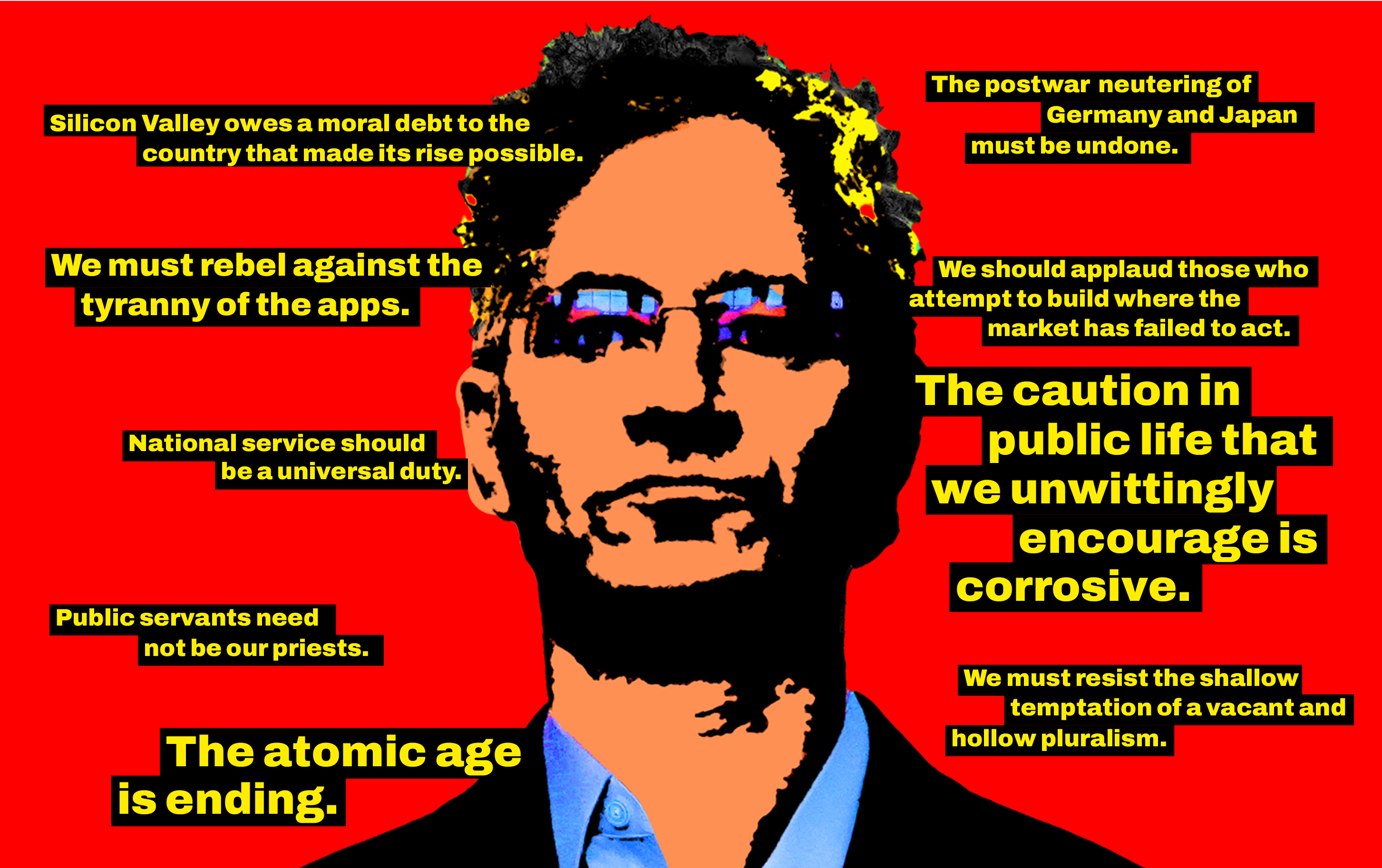
Palantir's social media manifesto is a blueprint for technofascism
The surveillance firm’s viral X post calls for hard power, conscription and the end of pluralism. AI expert and academic Mark Coeckelbergh on what happens when technology becomes the gateway to authoritarianism
‘If we don’t fight back, we don’t have a future’: the journalist taking on the ‘tech fascists’ of Silicon Valley
As Elon Musk, Peter Thiel and their peers have grown richer and more influential, Gil Durán argues they have all but abandoned democracy – and found the perfect government to enable them
Technocracy | The Paper Pilot
The Paper Pilot's digital garden of thoughts on philosophy, politics, and sociology
‘Headed for technofascism’: the rightwing roots of Silicon Valley
The industry’s liberal reputation is misleading. Its reactionary tendencies – celebrating wealth, power and traditional masculinity – have been clear since the dotcom mania of the 1990s

Major Tech Investor Calls Architect of Fascism a 'Saint' in Unhinged Manifesto
Silicon Valley's 'techno-optimism' cult believes we should let rich tech guys do whatever they want.


An Abundance of Influence
A group of YIMBY Big Tech donors took over San Francisco politics. Now they’re setting their sights on the rest of the country.

Thirty Years On, the Californian Ideology is Alive and Well
In the seminal essay, Barbrook and Cameron insisted that there are other ways to build technology, and to do it democratically, writes Nathan Schneider.

When Silicon Valley’s AI warriors came to Washington
Effective altruism is increasingly described as a cult. But as the movement’s billionaire adherents pour money into D.C., its obsession with the AI apocalypse is remaking the capital’s tech policy landscape.

Technocracy References
References and Revisions “Should Scientists and Engineers Run Society?” References [1] Wikipedia: “Technocracy.” [2] Academic Paper: Gunnell, John G. "The technocratic image and the theory of technocracy." Technology and culture 23.3 (1982): 392-416. [3] Academic Paper: Oh, Kyunghwan. "A non-co...

You Can’t Post Your Way Out of Fascism
Authoritarians and tech CEOs now share the same goal: to keep us locked in an eternal doomscroll instead of organizing against them, Janus Rose writes.

Afterlives of the California Ideology| “Polemic Becomes Canon”: An Interview With Richard Barbrook on the Californian Ideology
In this interview, Richard Barbrook shares his perspective on the essay “The Californian Ideology,” which he published in 1995 and 1996 with Andy Cameron, who died in 2012. Richard Barbrook lays out the essay’s genesis, explores the inspiration offered by Marx and Engels’ The German Ideology, discusses his ambivalent but not simply dismissive relationship to California and the United States, and provides insight into the thinking around the masters program in hypermedia at the University of Westminster, United Kingdom, that he and Cameron were setting up at the time of the essay’s publication. In the essay they wanted to impart a different approach to digital technologies than was prevalent in the Californian computer industry at the time. Overall, the interview makes it apparent how “The Californian Ideology” should be seen in its temporal context—as well as how the basic questions the essay raises continue to shape the discussion about digital media and infrastructures today.
The Philosophy Behind Palantir: Moira Weigel and Anthony Burton w/ Alexis Papazoglou
Palantir posted a manifesto that reads like the ramblings of a comic book villain
Palantir shared 22 points excerpted from CEO Alex Karp and Nicholas W. Zamiska's 2025 book, The Technological Republic, and they're troubling.

Anarchist Cybernetics
The Paper Pilot's digital garden of thoughts on philosophy, politics, and sociology. Reading time: ~14 minute read | Published: Aug 12, 2026 | Updated: Sep 6, 2026

During the 1980s and 1990s, networks of evangelists and venture capitalists fused technological boosterism with reactionary social ideals. Our video of the week examines the deep roots of Silicon Valley's shift toward the right. Featuring @beccalew.bsky.social at @westernu.ca buff.ly/ydgntnc
