


We can all tell this story: The rails of human advancement stretching from the Enlightenment to a Bitcoin start-up; innovation measured by increased reach, increased uniformity, increased predictability and size and quickness. The telegraph to the landline to the mobile phone to the Bluetooth wearable; the abacus to Pascal’s mechanical calculator to the room-sized computer to the palm-sized device a million times more powerful than equipment a thousand times its size from only ten years ago; the stone tablet to the book to the internet offering everything, no excuses. We are all connected. We’re at the bright tip of a comet hurtling forward. We can place ourselves, with mild satisfaction. Thank god it’s not then. What kind of person uses a BlackBerry? (Old people!)
Berlin Biennale | All Problems Can Be Illuminated; Not All Problems Can Be Solved
We can all tell this story: The rails of human advancement stretching from the Enlightenment to a Bitcoin start-up; innovation measured by increased reach, increased uniformity, increased predictability and size and quickness. The telegraph to the landline to the mobile phone to the Bluetooth wearable; the abacus to Pascal’s mechanical calculator to the room-sized computer to the palm-sized device a million times more powerful than equipment a thousand times its size from only ten years ago; the stone tablet to the book to the internet offering everything, no excuses. We are all connected. We’re at the bright tip of a comet hurtling forward. We can place ourselves, with mild satisfaction. Thank god it’s not then. What kind of person uses a BlackBerry? (Old people!)
under the hood
This week I’ve been thinking about what it’s like for a new generation to make things with computers. When we were talking in Berlin, Luce made a point that...

Building resilient social media
Next week I’ll be in Berlin, speaking at a Franco-German “Summit on European Digital Sovereignty” satellite event to help launch…

Mobile Phone Museum
We are a not-for-profit entity created to safeguard the rich history and design diversity of mobile devices which have been launched over the last four decades.

Technopoly: The Surrender of Culture to Technology
A witty, often terrifying that chronicles our transform…

Topics — Real Life
ABOUT TOPICS: Since we began Real Life in the summer of 2016, we’ve run many essays across a range of topics, with a particular focus on the personal and cultural implications of living with technology. Our aim is not to track the news cycle so much as the longstanding social issues that inform and transcend it. We wanted to make it easier to read and explore Real Life beyond our chronological archive, so we’ve created these Topics to gather in one place the work we’ve published on some key themes. More Topics will be added to this page over time.

Fast Capitalism | Mavs Open Press Open Access Journals | University of Texas at Arlington
Fast Capitalism is an academic journal aimed at describing the current moment of capitalism. We publish peer reviewed scholarship and essays about the impact of rapid information and communication technologies on self, society and culture in the 21st century. Our authors examine how heretofore distinct social institutions, such as work and family, education and entertainment, have blurred to the point of near identity in an accelerated, post-Fordist stage of capitalism. This makes it difficult for people to shield themselves from subordination and surveillance. The working day has expanded; there is little down time anymore. People can 'office' anywhere, using laptops and cells to stay in touch. But these invasive technologies that tether us to capital and control can also help us resist these tendencies. People use the Internet as a public sphere in which they express and enlighten themselves and organize others; information technologies afford connection, mitigate isolation, and even make way for social movements. We are convinced that the best way to study an accelerated media culture and its various political economies and existential meanings is dialectically, with nuance, avoiding sheer condemnation and ebullient celebration. We seek to shape these new technologies and social structures in democratic ways. We look at technology, Artificial Intelligence (AI), global flows, political economy, culture and cultural studies, social theory, political theory, intersectionality, and the envionrment.
Historical pragmatism and the internet
This article argues that the literature describing the internet revolution in the 1990s was characterized by the rhetoric of the technological sublime. This rhetoric suffered from three fatal flaws: (1) it was not sufficiently grounded in the historical development of technology; (2) it viewed the internet in isolation, failing to consider the wider technological context; and (3) it failed to examine the internet in view of the social, economic, religious and political circumstances of its users. Several examples from history are cited, demonstrating that changes in various systems for the production, dissemination and preservation of cultural information both border and deborder the world. The article suggests that if internet researchers take a pragmatic, historically grounded approach, they will discover that the introduction of internet technology can be seen to have similar consequences. While the technology overcomes many boundaries (of space and time, politics and economics), other social borders may be created at the same time. It is easier to see old boundaries coming down than to see new ones being erected. Rather than being swept by utopian or dystopian enthusiasms, the article insists that the really interesting discoveries are to be made in locating the subtle social shifts taking place, relatively unnoticed, as a consequence of technological change.

Institute of Network Cultures | Ben Grosser: Planning the Exodus from Platform Realism
Thinking about the current state of platforms, I’m reminded of Mark Fisher’s articulation of capitalist realism, the idea that we don’t imagine or build alternatives to capitalism because we can no longer envision a world without it. Big tech, in a few short years, has managed to instill within the public a similar state of platform realism. So many are unable to imagine how global communication, media, search, etc. could ever function without the platforms. Despite a growing malaise, it’s become difficult for many to consider a world without big tech platforms as a viable conception of the future.

About — Every Object an Archive
We interview people about their experiences with technological objects that were once everywhere, but are now being replaced or redesigned. We are interested in the physical experience of living with these objects, their handfeel and relationships to our bodies. We are also interested in how they shaped our habits, relationships, and ways of being. Technologies are more than physical objects: whole worlds of infrastructure, process, policy and culture are built around them.

New Design Congress (@newdesigncongress@mastodon.world)
4 Posts, 7 Following, 128 Followers · An independent research group confronting the gap between what is said to be happening and what is actually happening in digitised societies.

Appropriating Technology | Public Sphere Project — Liberating Voices Pattern Language
Dematerialization, Participatory Design, Techno-Criticism, Intermediate Technologies, Users' IT Quality Network, Wholesome Design for Wicked Problems, Labor Visions, Community Inquiry, Tactical Media
Weizenbaum examines computers and society - The Tech
An article from the Tuesday, April 9, 1985 issue of The Tech - MIT's oldest and largest newspaper and the first newspaper published on the Internet.
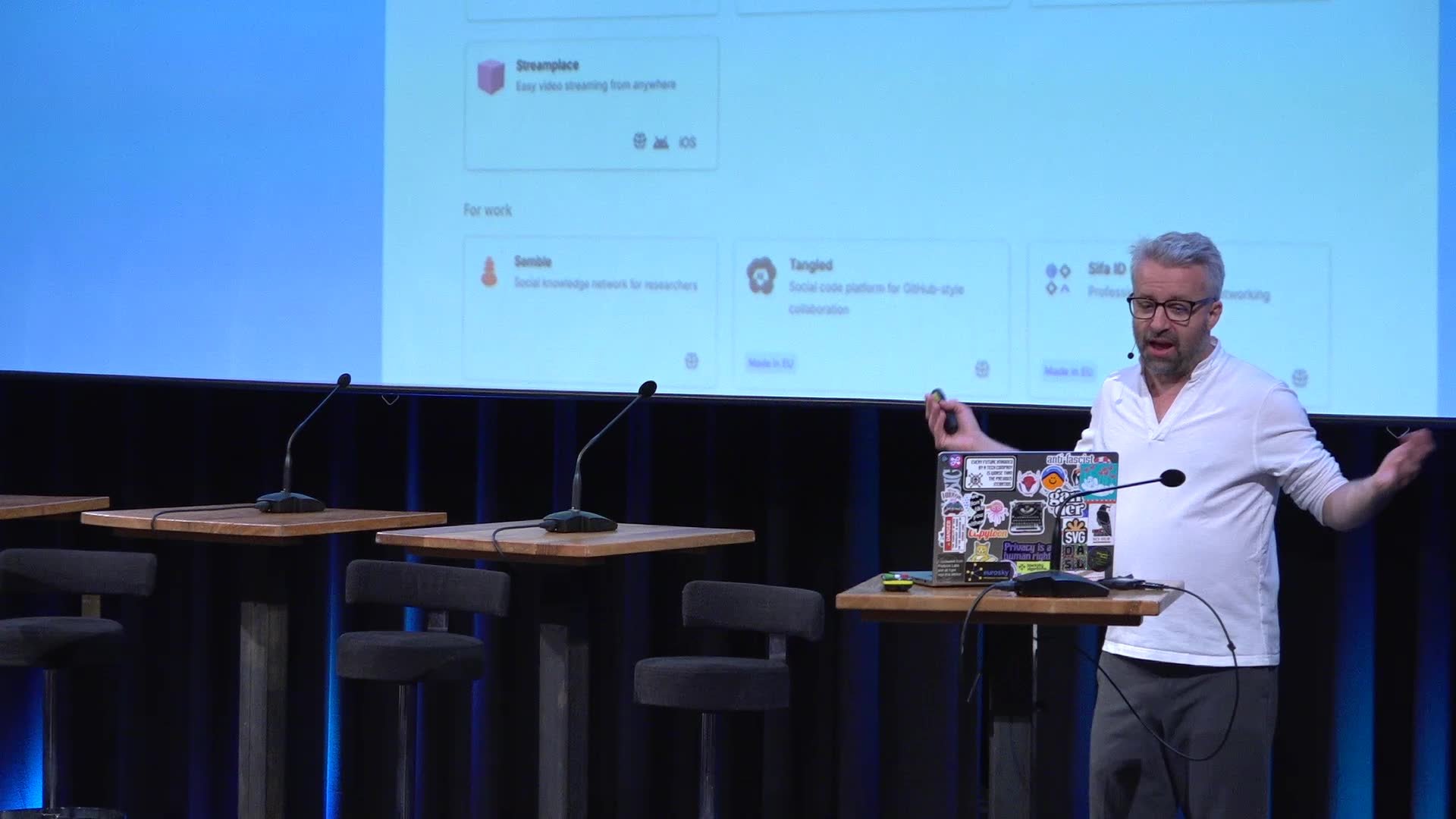
We Build On Hope @ PublicSpaces Conference 2026
Keynote by Robin Berjon The current state of tech can feel disheartening. Years of critical analysis and reform efforts have left us with a digital sphere that seems worse than ever. In Europe, our...
Libra Season: iPhone Modernism by Travis Diehl
The shock-of-the-new is back in literature, rebooted for screen time – and with it, the question: To what end should writing reflect our networked selves?