

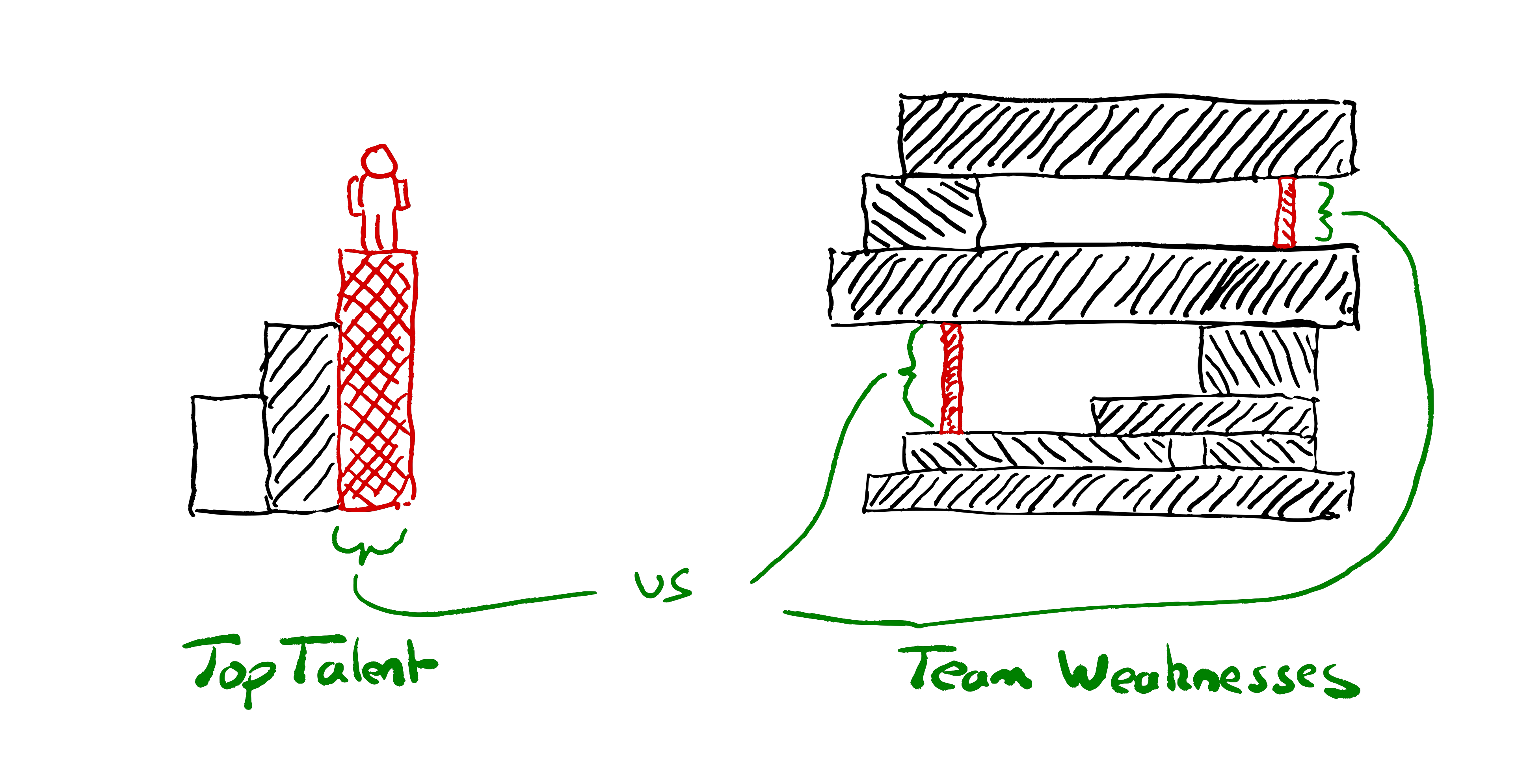
Design your hiring process to find the right people to strengthen your teams' weaknesses, rather than trying to find the best people. Instead of "how can we find the smartest people?" think about "how can we find the people who will make our team stronger?"
Don't hire top talent; hire for weaknesses. - Benji's Blog
Design your hiring process to find the right people to strengthen your teams' weaknesses, rather than trying to find the best people. Instead of "how can we find the smartest people?" think about "how can we find the people who will make our team stronger?"
Why Hiring the 'Best' People Produces the Least Creative Results - Slashdot
An anonymous reader shares an excerpt from a report written by Scott E. Page, who explains why hiring the "best" people produces the least creative results: The burgeoning of teams -- most academic research is now done in teams, as is most investing and even most songwriting (at least for the good s...

How to Hire
Most companies approach hiring with faulty assumptions and poor practices. They believe talent is fixed rather than contextual. They fail to create real partnerships between internal recruiters and hiring managers. And they rely too much on salary surveys and rigid compensation formulas. The author shares what she learned about making and keeping great hires during her 14 years as the chief talent officer at Netflix. The process requires probing beneath the surface of people and their résumés; engaging managers in every aspect of hiring; ensuring that recruiters deeply understand the business and are not viewed as support staff; adopting a mindset in which you’re always recruiting; and coming up with compensation that suits the performance you need and the future you aspire to. These lessons may be especially relevant to fast-growing tech-based firms, whose rapid innovation means a continual need for new talent. But organizations of all types can benefit from taking a fresh look at their hiring and compensation practices.

Upwork | Hire Top Freelance Talent with Confidence
Upwork is the world’s largest human and AI-powered freelance marketplace to hire top talent—trusted by businesses and professionals worldwide.

In Praise of “Normal” Engineers
Software engineer Charity Majors challenges the "10x engineer" myth, arguing that true productivity lies in team performance, not individual brilliance. She encourages building workplaces where "normal" engineers can thrive. Are we focusing too much on hiring "the best" instead of the right people?

Manufacturing the Talent Shortage
How our assumptions about the skill and capability of our technical workforce keeps us from building more diverse -- and more successful -- organizations.

“We only hire the best”
How many times have you heard a company claim that they only hire the best? The top of the top. The crème de la crème. Most of them, by sheer necessity of math, are delusional. There just aren’t th…
Superteams
FEATURED ON THE COVER OF HARVARD BUSINESS REVIEW SHORTLISTED FOR THE SABEW 2026 BEST IN BUSINESS BOOK AWARDS “An outstanding book.” —NPR “A valuable guide for teams and managers seeking to improve performance.” —The Wall Street Journal “A rare read that introduces fresh ideas about how to make groups more than the sum of their parts.” —Adam Grant, bestselling author of Think Again “The ultimate playbook for how to build exceptional teams.” —Fast Company What do the best teams do differently? To find out, award-winning social psychologist Ron Friedman surveyed thousands of teams and pinpointed the precise habits that separate the best from the rest. The results upend everything we think we know about teamwork. It turns out that the most successful teams aren’t the ones that collaborate most, get along best, or put in the longest hours. What really sets them apart is the way they manage their energy and attention, bring out the best in one another, and keep improving over time. Blending eye-opening discoveries with unforgettable stories, Superteams takes you inside the writers’ room of Succession and Bridgerton, the recording studio of ABBA and Fleetwood Mac, the kitchens of Michelin-starred restaurants, the laboratories of Nobel Prize-winning scientists, the locker rooms of NBA and NFL teams, and the boardrooms of the world's most innovative companies. You will learn: - A simple rule that instantly cuts meeting time in half - Why the secret to better teamwork is less teamwork - The one question that makes team decisions up to 30% smarter - The only office perk that improves performance (spoiler: it’s not coffee) - How personal productivity hacks make teamwork harder - Why feeling like the smartest person in the room is a red flag - Why top performers care more about disappointing their peers than their boss - How the best teams avoid burnout without working fewer hours - The science of truly restorative breaks, evenings, and vacations - How to build a team that keeps getting better (even when you’re not in charge) Smart, insightful, and relentlessly practical, this is your science-backed guide to turning your team into a Superteam.

We Hire the Best, Just Like Everyone Else
One of the most common pieces of advice you’ll get as a startup is this: Only hire the best. The quality of the people that work at your company will be one of the biggest factors in your success – or failure. I’ve heard this advice over and over
Reasons to hire inexperienced engineers
There are many reasons to consider hiring inexperienced software engineers into your team, beyond the commonly discussed factors of cost and social responsibility. Hire to maximise team effectiveness; not to maximise team size. Adding more people increases the communication and synchronisation overhead in the team. Growing a team has rapidly diminishing returns. However, adding the... Read more »
A Comprehensive Guide to Hire Ideal Developers for your projects
Not Getting Right Developers for your Business? Check this Guide for Top 6 Significant Factors to Consider For Hiring the Right Developers

Opinion | Why Some Teams Are Smarter Than Others (Published 2015)
It’s about listening, empathy and having more women.

AI makes weak engineers less harmful
Like other kinds of puzzle-solving, software engineering ability is strongly heavy-tailed. The strongest engineers produce way more useful output than the average, and the weakest engineers often are actively net-negative: instead of moving projects along, they create problems that their colleagues have to spend time solving. That’s why many tech companies try to build a small, ludicrously well-paid team instead of a large team of more average engineers, and why so far this seems to be a winning strategy.

Home
Research, expert perspectives, and product announcements from Atlassian on how teams can work smarter with AI. Subscribe for monthly insights on the future of teamwork.
The Strength of the Strongest Ties in Collaborative Problem Solving
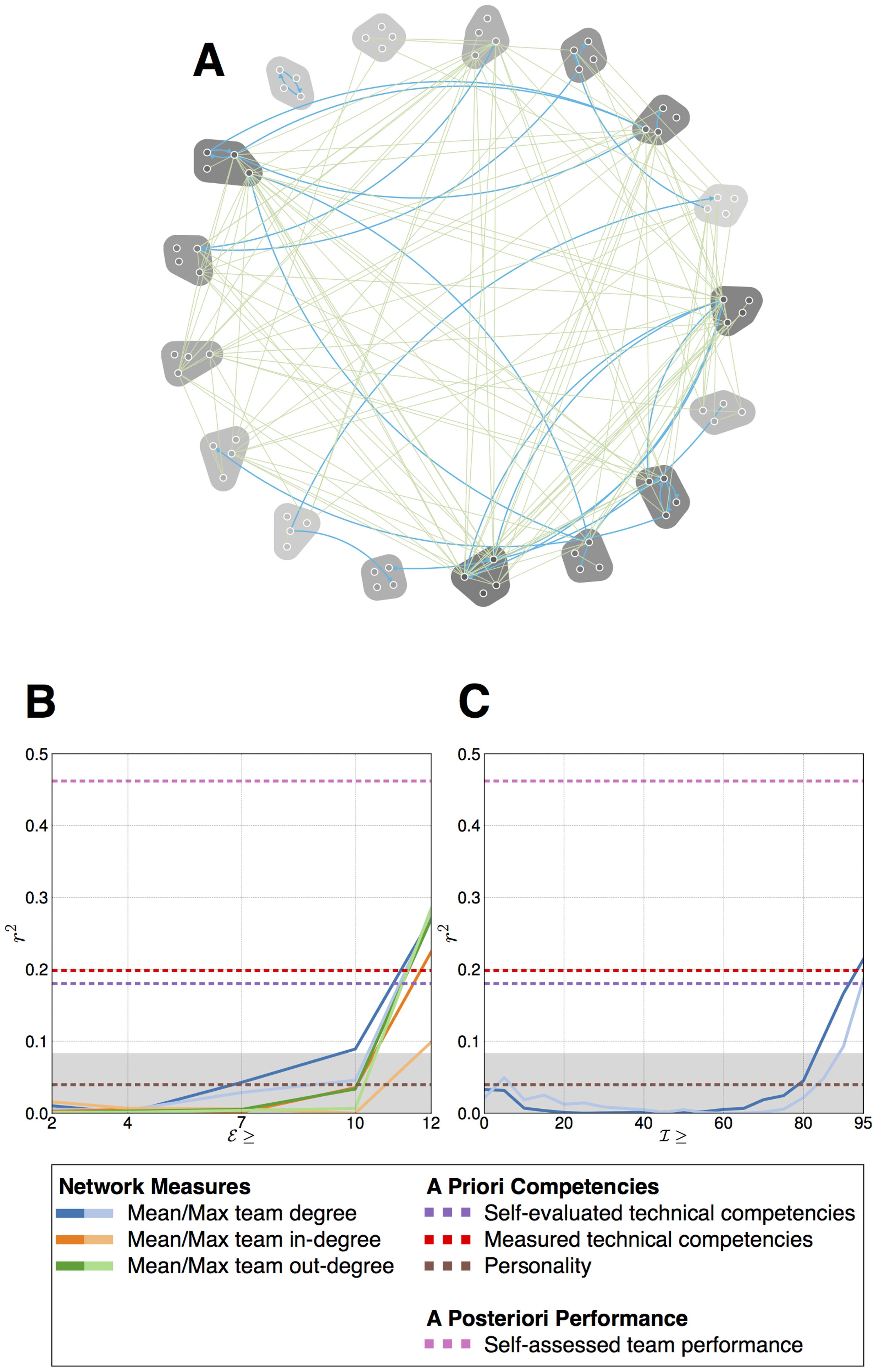
Complex problem solving in science, engineering and business has become a highly collaborative endeavor. Teams of scientists or engineers collaborate on projects using their social networks to gather new ideas and feedback. Here we bridge the literature on team performance and information networks by studying teams' problem solving abilities as a function of both their within-team networks and their members' extended networks. We show that, while an assigned team's performance is strongly correlated with its networks of expressive and instrumental ties, only the strongest ties in both networks have an effect on performance. Both networks of strong ties explain more of the variance than other factors, such as measured or self-evaluated technical competencies, or the personalities of the team members. In fact, the inclusion of the network of strong ties renders these factors non-significant in the statistical analysis. Our results have consequences for the organization of teams of scientists, engineers and other knowledge workers tackling today's most complex problems.
The Strength of the Strongest Ties in Collaborative Problem Solving
Complex problem solving in science, engineering and business has become a highly collaborative endeavor. Teams of scientists or engineers collaborate on projects using their social networks to gather new ideas and feedback. Here we bridge the literature on team performance and information networks by studying teams' problem solving abilities as a function of both their within-team networks and their members' extended networks. We show that, while an assigned team's performance is strongly correlated with its networks of expressive and instrumental ties, only the strongest ties in both networks have an effect on performance. Both networks of strong ties explain more of the variance than other factors, such as measured or self-evaluated technical competencies, or the personalities of the team members. In fact, the inclusion of the network of strong ties renders these factors non-significant in the statistical analysis. Our results have consequences for the organization of teams of scientists, engineers and other knowledge workers tackling today's most complex problems.