


This is the kick-off post in a series in which I'm going to explore things that we could change about the Web. The odds are pretty good that I will be wrong, possibly even very wrong. You're going to dislike some, or perhaps all of it! My point isn't to jump straight into building these ideas — even though I do believe they point in a better direction and are feasible — but rather to break out of the incrementalist rut and stagnant vision that the Web finds itself mired in. It's not in a good place and I feel the need for more vision work and much more thinking about architectural interventions that can bring about radical change.
Toward Wayfinding Infrastructure for the Living Web · Atlas Research Group
Our world is getting crazier by the day. Our old maps and compasses weren’t made for this complexity. While new tools may open up amazing possibilities, they also make it easier to lose ourselves – especially when they don’t belong to us, and make us vulnerable to other people’s hidden choices and unsavory intentions about what is worth attending to.

The Internet Transition
The Internet is allowing us to build a richer, more complex society but the way in which we Internet today is failing to support the governance systems that a more complex world requires. I take a look at why these issues are related, try to develop an intuition for a way forward, and point at the emerging field that is coming together to build that future.

The Missing Building Blocks of the Web
At a time when millions are losing trust in the the web’s biggest sites, it’s worth revisiting the idea that the web was supposed to be…

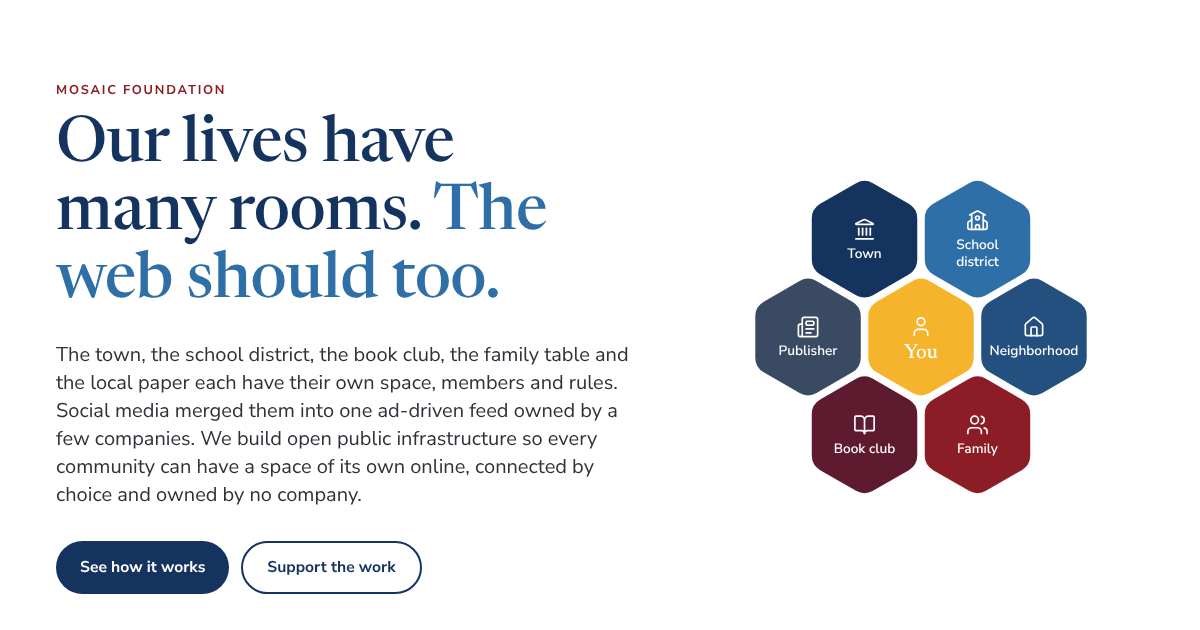
Mosaic Foundation: our lives have many rooms, the web should too
Open public infrastructure so every community can have its own space online, connected by choice in an open ecosystem that no company controls.
Architecture and the Internet: Designing places in cyberspace
Cyberspace, as the information space is called, has become accessible in the past decade through the World Wide Web. And although it can only be experienced through the mediation of computers, it is quickly becoming an alternative stage for everyday economic, cultural, and other human activities. As such, there is a potential and a need to design it according to place–like principles. Making places for human inhabitation is, of course, what architects, landscape architects, and town planners have been doing in physical space for thousands of years. It is curious, therefore, that Cyberspace designers have not capitalized on the theories, experiences, and practices that have been guiding physical place–making. While most 3D environments closely mimic physical spaces, they are, by and large, devoid of the essential characteristics that differentiate a ‘place’ from mere ‘space.’ And only rarely are they sensitive to, and take advantage of, the peculiarities of Cyberspace. We believe that this state of affairs is temporary, characteristic of early adoption stages of new technologies. As the Web matures, and as it assumes more fully its role as a destination rather than as means of communication, there will be a growing need to design it according to place–making principles. By looking at physical architecture as a case study and metaphor for organizing space into meaningful places, this paper explores the possibility of organizing Cyberspace into spatial settings that not only afford social interaction, but, like physical places, also embody and express cultural values. At the same time, because Cyberspace lacks materiality, is free from physical constraints, and because it can only be ‘inhabited’ by proxy, these ‘places’ may not necessarily resemble their physical counterparts.
I’m Building an Algorithm That Doesn’t Rot Your Brain
EFFecting Change: How to Build a Decentralized Web that Truly Works for All
This week, Social Web Foundation Executive Director Mallory Knodel joined EFF’s Babette Ngene and public interest technologist Bruce Schneier for a conversation about how to build a decentralized w…

Object-Oriented UX
We know big, monolithic webpages won’t meet the needs of responsive sites and endless screens. But we’re often still quilting together design patterns and content modules, rather than truly thinkin…

Welcome to the Post-Naive Internet Era
The grand idealism of the free and open internet might be over for now, but in its place falls a more practical mindset. Just like Silicon Valley’s entrepreneurs are entering their “Hard Tech” era, the people building web alternatives are also entering their Post-Naive Era. Here are the names to know.
Welcome to the Post-Naive Internet Era
The grand idealism of the free and open internet might be over for now, but in its place falls a more practical mindset. Just like Silicon Valley’s entrepreneurs are entering their “Hard Tech” era, the people building web alternatives are also entering their Post-Naive Era. Here are the names to know.
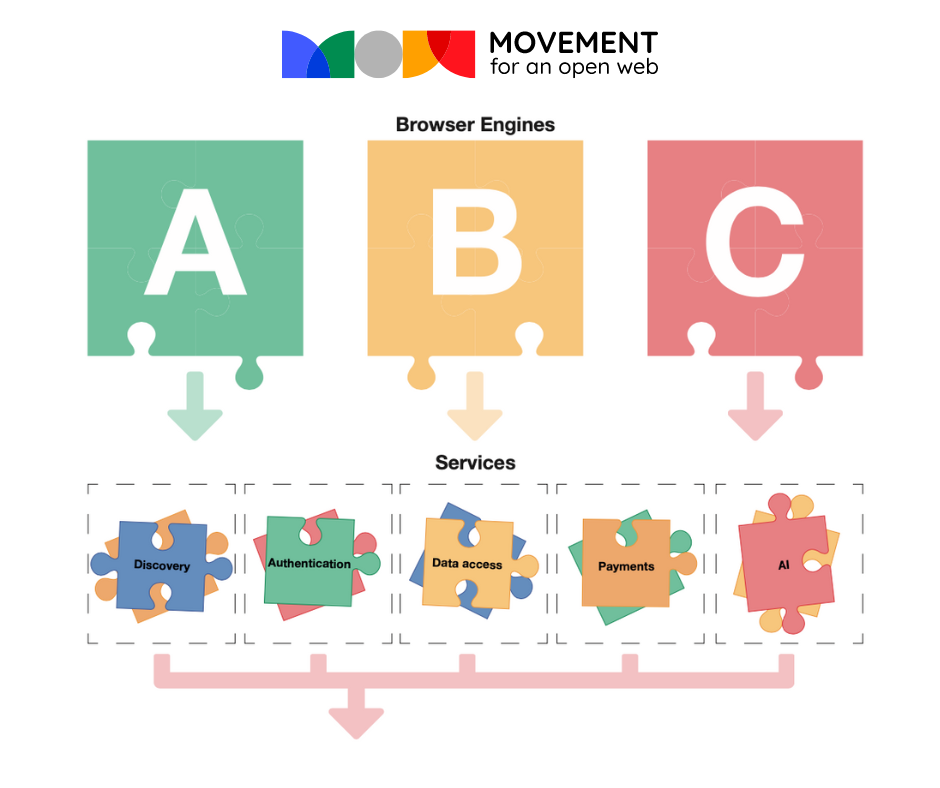
Break up the Browsers. A Proposal to Save the Open Web. - Movement For An Open Web
The Open Web is one of the world’s modern wonders. Based on core, universally recognised technical standards and owned and controlled by no one body, it is a unique structureRead More
My journey to the heart of the forgotten internet
Slowly but surely, huge swaths of the internet are vanishing. But the artefacts of the early web are still out there, and they have lessons for the future.

UI redesigns are mostly a waste of time
To preface the article, I primarily work on, and prefer, back-end code. I've been involved in both web and software development for over 4 y...
Introducing Ringspace: A Proposal for the Human Web
For months, I've been working on a project to demonstrate how we can preserve humanity on the web. It's finally ready for testing.

Information Architecture. Basics for Designers.
The World Wide Web contains a tremendous amount of information which is hard to imagine unstructured because a human brain wouldn’t be able…

‘Building a better web is much more universal. Empowering people to own their identity, publish more freely, form many kinds of communities, and leave without losing everything.’ manton.org/2026/07/18/social-web-disconn…
Social web disconnect
www.manton.org