

I have often found myself confounded by the behaviour of some people who seem impervious to reality — like the people still on X today. Here, I try to understand what grounds their epistemology and its consequences, and what that means for the rest of us. Being committed to a better future is where genuine seriousness is, and that seriousness can only be approached in a spirit of embodied, determined, relentless hope.
the collapse of online political education is upon us
the greatest minds of our generation are wasting time making video essays about sydney sweeneys jeans, liberal influencers are taking dark money, Philosophy YouTube is crumbling & im really stressed
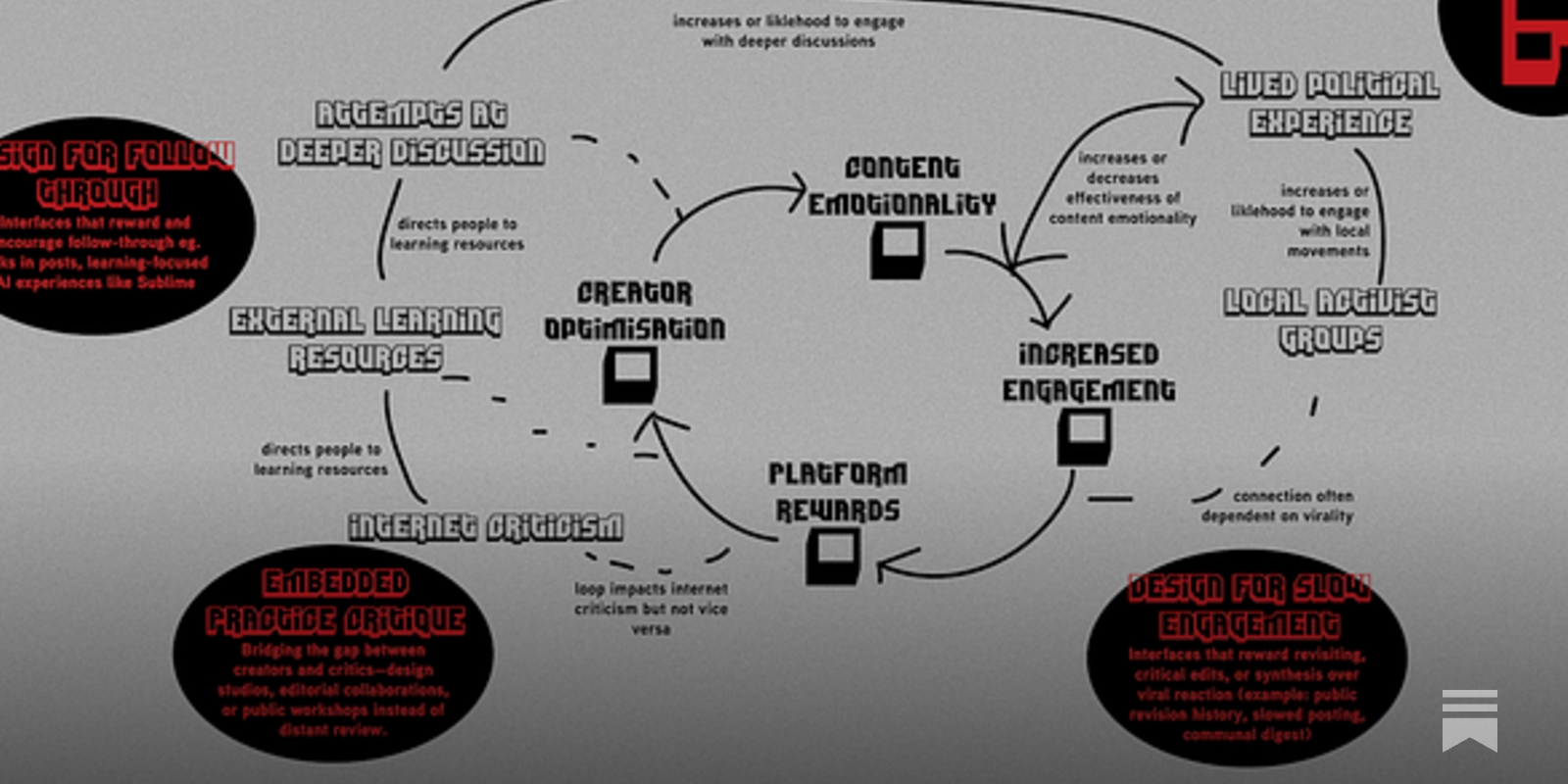
the chronically online will become a new underclass
The Malaise Of Peak Wokeism Within Online Culture
How have certain forms of education and new technology formed the template to woke culture today? This piece examines the link between social media and new technology to the outwoking of the wokest through a veritable closing of the mind.

Positech@CSCW2026
People care about climate change, injustice, and humanitarian crises. The challenge is not apathy but capacity: sustained engagement with large-scale problems is psychologically costly, and social media architecture often amplifies awareness while providing few pathways to meaningful action.
Why major life decisions should be approached with ‘epistemic humility’ | Psyche Videos
At a crossroads in life? No matter how much you deliberate, one unknowable remains: the person you will be on the other side

Ali Alkhatib: On techno-optimism
I’ve got a longer draft in the works, but I don’t think that’s going to become a blog post, so I figure it might be useful to publish something here and solicit feedback, or just plant a flag in the ground that this was a thing I did. Last week Several weeks ago I gave a talk at Wayne State University titled “the uncanny pessimism of techno-optimism”. In this post I’m going to breeze through some of the stuff I talked about and give a sense of what’ll be coming. Eventually.
Introducing a network for thoughtful conversations
The quality of conversations on the Internet is terrible. Most platforms like Twitter, Facebook, Instagram, Reddit, etc. optimize for engagement as their key metric. This spawns and rewards behavior that leads to bragging of gameable metrics such as likes and followers, self-feeding thought bubbles, knee-jerk reactions, “if you’re not on our side, you’re on their side” mentality, and thought policing even by people who think they’re fighting for a good cause. Today’s Internet doesn’t incentiviz
The Nightmare of Eternal Spring: Why Social Media Can't Survive on "Niceness" Alone - Nightflight
Alasdair MacIntyre’s Philosophy in Practice
It is a curious thing when an artist, thinker, or writer gains influence outside the audience he intends or is comfortable with. When a thinker associated with the right becomes popular on the left, or a novelist associated with the progressive left becomes popular among conservative readers, there can be a sort of strain felt between the audience in fact and the “true” audience, or between those who feel themselves to be the authentic recipients of a work’s message and meaning and those who, to the true believers, come across as opportunistic in their enjoyment of works in tension with their own views. The same is true when a writer working within an academic discipline gets picked up by those outside it: Those working within that discipline may find the co-opting of these thinkers misplaced at best or malicious at worst.
On technological optimism and technological pragmatism
"There are no guarantees that things are going to turn out very well for anyone.”

Izabella Kaminska on Twitter / X
The problem of our time is not merely information overload. It is that the time required to construct a coherent understanding of reality is becoming longer than the time during which that understanding remains valid.— Izabella Kaminska (@izakaminska) October 16, 2026
philosophy for life on Twitter / X
“Any fool can know. The point is to understand.”- Albert Einstein— philosophy for life (@philosophy_life) October 11, 2026
The Internet's Meaning Crisis
Parasocial media is a response to excessive irrelevance
will depue on Twitter / X
i don't think nearly anyone, myself included, has truly internalized there'll soon be a machine better than us in every single intellectual & physical capacitydeep down we all share a feeling that our 'entrepreneurship' or 'taste' or... is special & safe. it isn't. it's over— will depue (@willdepue) September 23, 2026
Twitter died a long time ago and X isn't worth it. Before I made the jump, my ego was holding me back. I was too concerned with vanity metrics. I finally realized if you're posting stuff people want to follow, then they'll follow you, even when you leave. siliconrepublic.com/enterprise/kelsey-hightower-b…

Open-source champion Kelsey Hightower on the promise of Bluesky
www.siliconrepublic.comI do think this is a kind of novel problem with our current media environment - Serious people aren't good at making content, they have other things to do, but content is what drives attention. Tastemakers used to highlight the serious people but they're gone, replaced by content creators.

