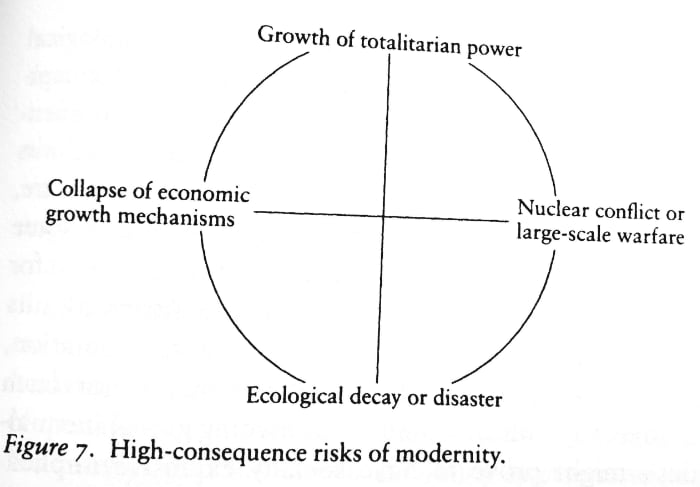
Working behind the scenes in the news media sector, it has become increasingly clear to me that tech and the internet as they operate today are causing structural damage to our collective institutions that runs deeper than seems to be understood. But these changes can be hard to characterise. If you take advertising revenue from high-quality contexts and use it to subsidise conspiracy theories, it's pretty obvious that nothing good will happen — but we barely have an understanding of the data economy sufficient to put a critique of this transfer on solid footing. If you move editorial decisions about what information people get to see first from tens of thousands of career editors working with methods that are highly diversified in biases, culture, skill, or politics the world around to a tiny number of algorithms that are everywhere uniform, what effect can you expect? Reputational and market-driven accountability will be removed, which is evidently bad, but the massive simplification of this ecosystem seems very likely to have deep-running consequences of its own — but how do you begin proving that? A new paper in PNAS leads the way forward.
Overview and key findings of the 2025 Digital News Report
This year’s report comes at a time of deep political and economic uncertainty, changing geo-political alliances, not to mention climate breakdown and continuing destructive conflicts around the world. Against that background, evidence-based and analytical journalism should be thriving, with newspapers flying off shelves, broadcast media and web traffic booming. But as our report shows the reality is very different. In most countries we find traditional news media struggling to connect with much of the public, with declining engagement, low trust, and stagnating digital subscriptions.

MediaJustice is Shifting the Terrain
The Case for Digital Public Infrastructure
The introduction of new media technologies invariably brings about potent social and economic shifts. We are well into one of those shifts as the advent of the consumer internet has destabilized existing models of news production and distribution and enabled new hegemons to establish massive and powerful businesses. Two decades into this shift, societies are asking difficult questions about whether internet technologies and the business models that accompany them are dangerous for our citizens and our democracies.
Fed up with big legacy news? Here are 13 independent, worker-owned outlets to support.
It’s been a weird time for the papers of record. The New York Times, The Los Angeles Times, and The Washington Post have all made compromising to catastrophic judgment errors. Most recently, …

Internet for the People: The Fight for Our Digital Future
"For all the informational convenience the internet offers, it is deeply flawed. How can it be improved? Writer Ben Tarnoff proposes one possibility in this intriguing book, which urges the development of 'a public lane on the information superhighway.' It's worth checking out for yourself." – Seth MacFarlane Why is the internet so broken, and what could ever possibly fix it? In Internet for the People, leading tech writer Ben Tarnoff offers an answer. The internet is broken, he argues, because it is owned by private firms and run for profit. Google annihilates your privacy and Facebook amplifies right-wing propaganda because it is profitable to do so. But the internet wasn't always like this—it had to be remade for the purposes of profit maximization, through a years-long process of privatization that turned a small research network into a powerhouse of global capitalism. Tarnoff tells the story of the privatization that made the modern internet, and which set in motion the crises that consume it today. The solution to those crises is straightforward: deprivatize the internet. Deprivatization aims at creating an internet where people, and not profit, rule. It calls for shrinking the space of the market and diminishing the power of the profit motive. It calls for abolishing the walled gardens of Google, Facebook, and the other giants that dominate our digital lives and developing publicly and cooperatively owned alternatives that encode real democratic control. To build a better internet, we need to change how it is owned and organized. Not with an eye towards making markets work better, but towards making them less dominant. Not in order to create a more competitive or more rule-bound version of privatization, but to overturn it. Otherwise, a small number of executives and investors will continue to make choices on everyone’s behalf, and these choices will remain tightly bound by the demands of the market. It's time to demand an internet by, and for, the people now.
When people trust humans more than brands: the incubator newsroom
How we might rebuild journalism from the ground up by rethinking what a newsroom is.

Artificial Intelligence in the News: How AI Retools, Rationalizes, and Reshapes Journalism and the Public Arena
<p>Download the pdf here. Executive Summary Despite growing interest, the effects of AI on the news industry and our information environment — the public arena — remain poorly understood. Insufficient attention has also been paid to the implications of the news industry’s dependence on technology companies for AI. Drawing on 134 interviews with news workers […]</p>

Let the community work it out: A throwback to early internet days could fix social media’s crisis of legitimacy
"We believe it is time to consider not just how online spaces can be governed efficiently and in service to corporate bottom lines, but how they can be governed fairly and legitimately."

Another Media System is Possible: Ripping Open the Overton Window, from Platforms to Public Broadcasting
Despite their absence within dominant policy discourses, radical ideas for structurally reforming information and communication systems are proliferating. This article begins to explore and synthes...

The Left’s Nonprofit Journalism Empire: The Nonprofit News Sector
In 2019 and 2021, Capital Research Center surveyed the changing media landscape, taking note of the increasing role of nonprofit and benefactor-driven “for-loss” media investments that are beginning to replace the 20th century’s commercial press empires. Since our last analysis, Fox News has held its national prominence among national-level right-leaning broadcast media even as it paid dearly for its post-2020 election content, liberal foundations have vowed a half-billion-dollar initiative to “revitalize” liberal-leaning local outlets, and Elon Musk, the world’s richest and perhaps most controversial man, upended the social media landscape.

The Substackerati
Did a newsletter company create a more equitable media system—or replicate the flaws of the old one?
interfluidity » Consensus not censorship
We’ve become obsessed over the past few years with the problem of misinformation. And for good reason. “Flood the zone with shit” is now standard operating procedure for a variety of interests and factions. Groups who pretend to be above that kind of thing let confirmation bias do the same work, elevating conjectures they find convenient to believe far beyond the evidentiary basis for believing them, and transmuting concurrence among prestigious groups whose biases are aligned into “authority” to which they demand deferrence. Casual information consumers become divided into two camps, the “do your own research” types who imagine, mistakenly, that they are capable of seeing through all this (and so succumb to their own confirmation bias), and those who more accurately understand that they cannot reliably distinguish truth from bullshit (and so opt out of democratic deliberation with a shrug, other than perhaps to vote for the candidates whose political party they distrust less).
I’m Building an Algorithm That Doesn’t Rot Your Brain
What is this? The case for continually questioning our online experience - [ Perspectiva ]
What options do we have, amidst the algorithms and incentives underpinning our media ecosystem, for getting a more expansive view of what’s really going on?

Show your work: The new terms for trust in journalism - PressThink
The transparency movement has finally come of age. Power has shifted to the users. Their trust has to be earned in different ways now.