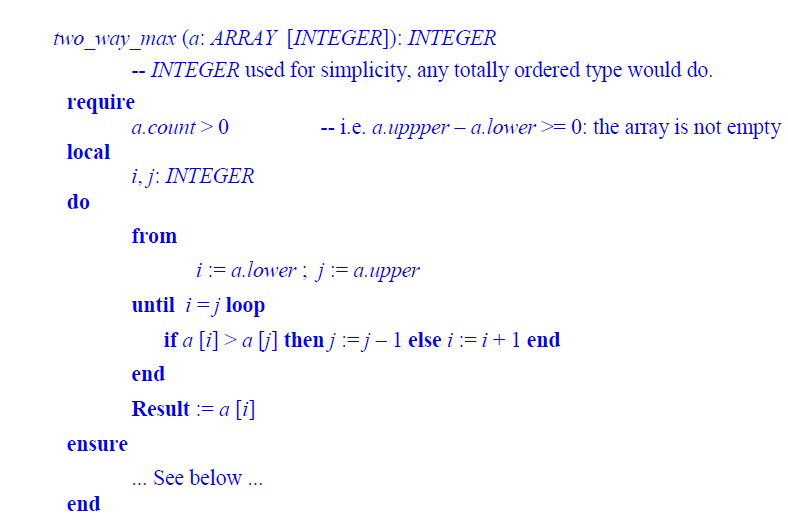
Program verification is making considerable progress but is hampered by a lack of abstraction in specifications. A crucial step is, almost always, absent from the process; this omission is the principal obstacle to making verification a standard component of everyday software development. 1. Steps in software verification In the first few minutes of any ... Read more
LLMs are making formal software verification feasible at a much larger scale
Claude formally proved security properties in the compiled code of 123 open-source libraries. Along the way, it found bugs that had eluded detection for years.

The Case Against Formal Verification, 50 Years Later - Ivan Gavran
Writings on software correctness, AI, formal verification, and other technical topics.

What Functional Programmers Get Wrong About Systems - Ian Duncan
Type systems verify properties of programs. Production correctness is a property of systems. The gap between these is where the interesting failures live.
Prediction: AI will make formal verification go mainstream — Martin Kleppmann’s blog
Much has been said about the effects that AI will have on software development, but there is an angle I haven’t seen talked about: I believe that AI will bring formal verification, which for decades has been a bit of a fringe pursuit, into the software engineering mainstream.
Code Worth Writing - Ray Myers | SSW 2026
When Does a Specification Become a Program? · The Phoenix Architecture
A spec can contain prose, tests, schemas, formal models, even executable code. The useful boundary is not the syntax but, rather, what survives: if you throw the implementation away, what has to remain so you can build the next one?
When Does a Specification Become a Program? - The Phoenix Architecture
A spec can contain prose, tests, schemas, formal models, even executable code. The useful boundary is not the syntax but, rather, what survives: if you throw the implementation away, what has to remain so you can build the next one?
When Does a Specification Become a Program? - The Phoenix Architecture
A spec can contain prose, tests, schemas, formal models, even executable code. The useful boundary is not the syntax but, rather, what survives: if you throw the implementation away, what has to remain so you can build the next one?
Anatomy of a Lean Proof for Software Engineers
Intro I recently worked through a problem from a theory of computation textbook that asked me to prove a property of a language using finite automata. The informal proof is a simple constructive proof where you build an automaton and show that it recognizes the language. This is kind of similar to program verification, so I thought it’d be interesting to see what it takes to formalize the proof. Lean is a good choice for this, because its Mathlib has all the theorems for the problem.
Foundations of Algebraic Specification and Formal Software Development
This book provides foundations for software specification and formal software development from the perspective of work on algebraic specification, concentrating on developing basic concepts and studying their fundamental properties. These foundations are built on a solid mathematical basis, using elements of universal algebra, category theory and logic, and this mathematical toolbox provides a convenient language for precisely formulating the concepts involved in software specification and development. Once formally defined, these notions become subject to mathematical investigation, and this interplay between mathematics and software engineering yields results that are mathematically interesting, conceptually revealing, and practically useful. The theory presented by the authors has its origins in work on algebraic specifications that started in the early 1970s, and their treatment is comprehensive. This book contains five kinds of material: the requisite mathematicalfoundations; traditional algebraic specifications; elements of the theory of institutions; formal specification and development; and proof methods. While the book is self-contained, mathematical maturity and familiarity with the problems of software engineering is required; and in the examples that directly relate to programming, the authors assume acquaintance with the concepts of functional programming. The book will be of value to researchers and advanced graduate students in the areas of programming and theoretical computer science.
Konrad Hinsen's blog
How can we document software and computational analyses in such a way that others can convince themselves of their validity, and build on them for their own work? The question has been around for many years, and a number of attempts have been made to provide partial answers. This post provides a brief review and describes my own tentative answer, inviting you to play with it.
Palomar – a registry of Lean verified mathematics
In recent months there has been a proliferation of AI-generated proofs of various old and new results, some of which have been formalized in the proof assistant language Lean. However, checking tha…


Live Coding with Quint
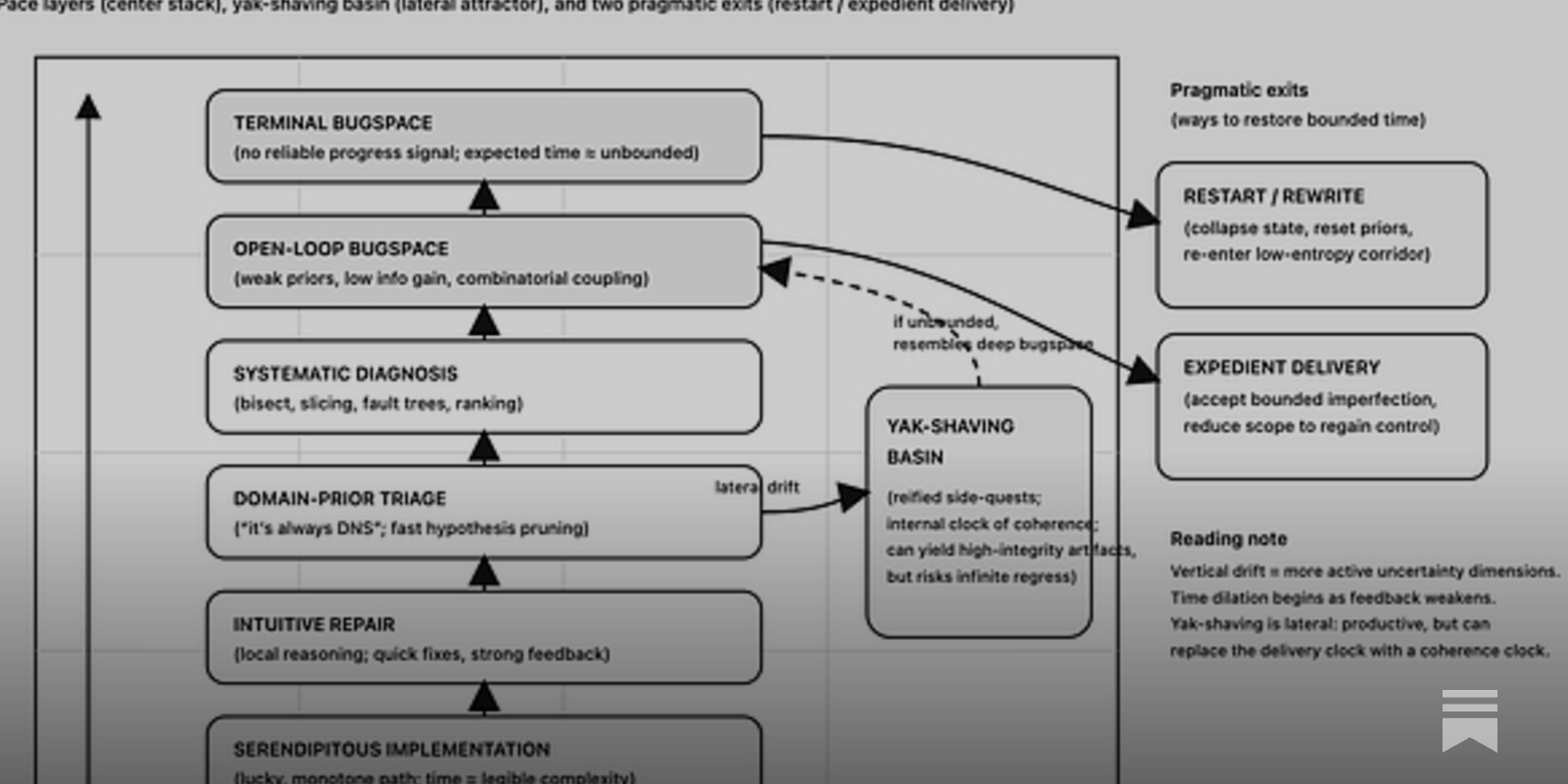
Lost in Bugspace
The temporality of implementation uncertainty in software